


ENVIRONMENTAL PRODUCT DECLARATION
HAGER COMPANIES
DOOR CLOSERS – 5100 SERIES

At Hager® we are concerned about how our company and products affect the environment. As a result, we've taken steps to minimize our footprint throughout the production process and product lifecycle.
These steps include reducing transportation through consolidation manufacturing and distribution, implementing scrap metal and corrugated product recycling efforts, emphasizing recycled content and working together with local communities to provide a clean environment.
Furthermore, Life Cycle Assessment (LCA) disclosure through Environmental Product Declarations (EPD) is a key element of our environmental impact reduction strategy.
LCA allows us to better understand the true burden of our products and EPDs allow us to share our results with our customers. As such, we are dedicated to completing LCAs and EPDs for all 13 of our product lines.
This document is a result of that dedication.

Hager Companies – Door Closers – 5100 Series According to ISO 14025, ISO 21930:2007 & EN 15804 to ISO 14025
This declaration is an environmental product declaration (EPD) in accordance with ISO 14025. EPDs rely on Life Cycle Assessment (LCA) to provide information on a number of environmental impacts of products over their life cycle. Exclusions: EPDs do not indicate that any environmental or social performance benchmarks are met, and there may be impacts that they do not encompass. LCAs do

not typically address the site-specific environmental impacts of raw material extraction, nor are they meant to assess human health toxicity. EPDs can complement but cannot replace tools and certifications that are designed to address these impacts and/or set performance thresholds – e.g. Type 1 certifications, health assessments and declarations, environmental impact assessments, etc. Accuracy of Results: EPDs regularly rely on estimations of impacts, and the level of accuracy in estimation of effect differs for any particular product line and reported impact. Comparability: EPDs are not comparative assertions and are either not comparable or have limited comparability when they cover different life cycle stages, are based on different product category rules or are missing relevant environmental impacts. EPDs from different programs may not be comparable.
| PROGRAM OPERATOR | UL Environment | ||||
|---|---|---|---|---|---|
| DECLARATION HOLDER | Hager Companies | ||||
| DECLARATION NUMBER | 4788757275.104.1 | ||||
| DECLARED PRODUCT | |||||
| REFERENCE PCR | PCR for Product Group, Builders Hardware UL9004. Version: April 23rd, 2014 | ||||
| REFERENCE PCR STANDARD |
☐
EN 15804 (2012) |
||||
|
☐
ISO 21930 (2007) |
|||||
|
☐
ISO 21930 (2017) |
|||||
| DATE OF ISSUE | January 1, 2019 | ||||
| PERIOD OF VALIDITY | 5 Years | ||||
| Product definition and information about building physics | |||||
| Information about basic material and the material's origin | |||||
| Description of the product's manufacture | |||||
| CONTENTS OF THE DECLARATION | Indication of product processing | ||||
| Information about the in-use conditions | |||||
| Life cycle assessment results | |||||
| Testing results and verifications | |||||
| The PCR review was conducted by: | PCR Peer Review Panel | ||||
| Chair: Dr. Lindita Bushi | |||||
| epd@ulenvironment.com | |||||
| This declaration was independently verified in accordance with ISO | |||||
| 14025 by Underwriters Laboratories |
☒
EXTERNAL |
||||
|
☐
INTERNAL |
Grant R. Martin, UL Environment | ||||
|
This life cycle assessment was independently verified in accordance
with ISO 14044 and the reference PCR by: |
|||||
| Thomas Gloria, Industrial Ecology Consultants | |||||

Product Description
Company
Founded in 1849, St. Louis-based Hager Companies offers more than 6,000 full-line quality door hardware products under one brand name. With 13 product lines including, commercial hinges, residential hinges, Roton® continuous geared hinges, stainless steel continuous hinges, exit devices, locks, door controls, auxiliary and trim, threshold and weather stripping, sliding door hardware, access control products, electrified solutions and Euroline, our European hardware line. Hager focuses on architectural hardware that exceeds today's building standards that are built to last. For additional information, visit www.hagerco.com.
Product
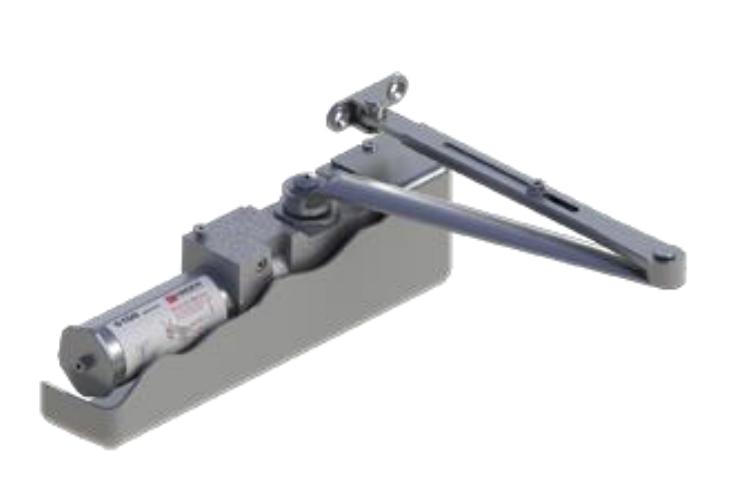
At Hager Companies, we know all about the importance of adding the finishing touches to your building projects. 5100 Series Closers are heavy duty door closers constructed of cast iron to be installed on exterior and interior doors that are subject to high use and potential abuse. They are designed and engineered for reliability and superior performance.
5100 Series Closers have a full rack and pinion operation, with a heat treated steel piston and triple heat treated steel spindle. The closers are non-handed to permit installation on doors of either hand. The sizing is adjustable from size 1 through size 6. These design features make this closer the ideal choice for doors with a maximum weight of 330 lbs.
Product Characterization
This product can be ordered from the manufacturer via phone, fax, email or online ordering. Product is shipped directly to customers or jobsites in packaging material that includes cardboard box, shipping labels and plastic materials. The amount of packaging materials is dependent on the size of the customer's order. No ancillary materials are necessary for installation or use.
Technical Information
Declared unit : One door closer per standard 3'0" x 7'0" door.
Application
The commercial applications ideal for these door closers include schools, medical facilities, institutions and hospitals as well as office buildings and any entrance door with high foot traffic.
Delivery Status
For shipping, all door closers are packaged individually in polyethylene film. In general, packaging for door closers includes cardboard box, paper labels and fasteners. Box and paper labels are recyclable in most municipal recycling systems. Large orders may be bulk packaged prior to shipping.


Base Materials
Base materials include:
| Material |
5100 Series (% of
Final Product) |
|---|---|
| Steel | 44.79% |
| Cast Iron | 44.39% |
| Brass | 0.12% |
| Nitrile rubber | 0.03% |
| ABS | 3.41% |
| Hydraulic Fluid | 7.26% |
| Total | 100% |
Manufacture
Hager's door closers are manufactured in China. Hager's suppliers receives extruded metal and plastic parts from their suppliers. Subsequently, the extruded metal is cut and hole punched at the facility. These processes are automated within the plant. After this, the product undergoes deburring and edging manually. It is then packaged with fasteners, in this case, galvanized steel screws to be shipped to the US for transport to customer. The packaging includes a corrugated cardboard box and two labels. Any waste in the cutting process is captured and sold to recycler. Electricity, natural gas and some water is used in the process.
Environment and Health During Manufacturing
Hager meets all federal and state standards related to the Environment and Health during manufacturing. Additionally, Hager has taken further steps to reduce the environmental and health impacts of our manufacturing process. These steps include:
- Consolidated manufacturing and distribution efforts to reduce transportation (consuming less fuel and producing less emissions) and reducing inventory space (reducing our physical footprint).
- Implementing recycling efforts for scrap metals and corrugated products.
- Implemented a corporate headquarters recycling program that single streams the recycling of paper, plastic, glass, metal, and other materials (diverting such waste from thelandfill)
- Further information is available here: https://www.hagerco.com/leed-green/initiative.
Packaging
For shipping, all door closers are packaged individually in polyethylene film. In general, packaging for door closers includes cardboard box, paper labels and fasteners. Box and paper labels are recyclable in most municipal recycling systems. Large orders may be bulk packaged prior to shipping.
Product Installation
Detailed installation instructions can be found online. While installation equipment is required to install the door closer product, it is not included in the study as these are multi-use tools and the impacts per declared unit is considered negligible. All waste generated during installation, including packaging waste, is disposed of according to the tables found in Section 2.8.5 of Part A: Life Cycle Assessment Calculation Rules and Report Requirements from UL Environment.
Environment and Health During Use
There are no environmental or health considerations during the use of the product.
Re-use Stage
Hager products may be recycled or reused at the end of life. The LCA that this EPD is created from takes the conservative approach by assuming that all products are disposed of within the system boundary. However, potential recycling is calculated in Module D – Benefits Beyond System Boundary .


Disposal
Disposal pathways in the EPD are modeled in accordance with disposal routes and waste classification referenced in Sections 2.8.5 and 2.8.6 of Part A: Life Cycle Assessment Calculation Rules and Report Requirements from UL Environment. This indicates an end-of-life split amongst landfill, recycling, and incineration pathways.
Further Information
At Hager, we are concerned about how our company and products affect the environment. As a result, we've taken steps to minimize our footprint throughout the production process and product lifecycle.
Hager's green initiatives include:
- Consolidated manufacturing and distribution efforts to reduce transportation (consuming less fuel and producing less emissions) and reducing inventory space (reducing our physicalfootprint)
- Implementing recycling efforts for scrap metals and corrugated products
- Using materials in the production of our products that are made of both pre- and post-consumer materials, enabling our customers to qualify for LEED® credits
- Work together with the communities in which it operates to provide a clean environment and support and provide positive contributions to the people and community
- Implemented a corporate headquarters recycling program that single streams the recycling of paper, plastic, glass, metal, and other materials (diverting such waste from thelandfill)
We will continue to pursue and adopt procedures and processes to protect the health of our employees, customers/end users and the environment.
Life Cycle Assessment
Declared Unit
All values shown in the table below are for a standard North American 3'x7' door.
| Name | 5100 Series | Unit |
|---|---|---|
| Door Closer | 1 | piece |
|
Weight per Declared
Unit, excluding fasteners |
5.313 | kg |
| Fasteners | 0.136 | kg |
| Declared Unit | 5.449 | kg |


System Boundary
An LCA for products in which a functional life is not declared can be one of three options. These options include a Cradle to Shipping Gate LCA, a Cradle to Building LCA or a Cradle to Building-with EOL Stage LCA.
This particular LCA is a Cradle to Building with EOL stage LCA.
A summary of the life cycle stages included in this LCA is presented in the following table.
|
Module
Name |
Description | Summary of Included Elements |
|---|---|---|
| A1 | Product Stage: Raw Material Supply |
Raw Material sourcing and processing as defined by
secondary data. |
| A2 | Product Stage: Transport |
Shipping from supplier to manufacturing site. Fuel use
requirements estimated based on product weights and mapped distance. |
| A3 | Product Stage: Manufacturing |
Energy, water and material inputs required for
manufacturing from raw materials. Packaging Materials included as well. |
| A4 | Construction Process Stage: Transport |
Shipping from manufacturing site to project site. Fuel use
requirements estimated based on product weights and mapped distance. |
| A5 | Construction Process Stage: Installation | Installation and packaging material waste. |
| B1 | Use Stage: Use | Use stage impacts are not assessed in this study. |
| B2 | Use Stage: Maintenance | Use stage impacts are not assessed in this study. |
| B3 | Use Stage: Repair | Use stage impacts are not assessed in this study. |
| B4 | Use Stage: Replacement | Use stage impacts are not assessed in this study. |
| B5 | Use Stage: Refurbishment | Use stage impacts are not assessed in this study. |
| B6 | Use Stage: Operational Energy Use | Use stage impacts are not assessed in this study. |
| B7 | Use Stage: Operational Water Use | Use stage impacts are not assessed in this study. |
| C1 | EOL: Deconstruction | No inputs required for deconstruction. |
| C2 | EOL: Transport |
Shipping from project site to landfill. Fuel use
requirements estimated based on product weight and estimated distance. |
| C3 | EOL: Waste Processing |
Waste processing not required. All waste can be
processed as is. |
| C4 | EOL: Disposal |
Assumes all products are sent to landfill. Landfill impacts
modeled based on secondary data. |
| D | Benefits beyond system |
Accounts for the avoided burden beyond the system
boundary associated with sourcing raw steel and aluminum. Subtracted from these benefits are the impacts outside the system boundary associated with processing the recycled content prior to use. |


Estimates and Assumptions
All estimates and assumptions are within the requirements of ISO 14040/44. The majority of the estimations are within the primary data. The primary data was collected as annual totals including all utility usage and production information. For the LCA, the usage information was divided by the production to create an energy and water use per unit of product. As there are different products produced at this facility, it is assumed all products are using the same amount of energy. Another assumption is that the installation tools are used enough times that the per declared unit impacts are negligible.
Recycled content – Hager products may contain recycled content, most notably recycled steel and aluminum, which are two of the most recycled materials throughout the globe. The specific amount of recycled content may vary based on the availability of materials to suppliers at the time of sourcing. Data sets sourced from GaBi include assumptions based on typical aluminum and steel recycled content and have been calculated based on expert evaluation and critical review. It was determined appropriate and a conservative approach to use default recycled content values in the GaBi aluminum and steel datasets.
Cut-off Criteria
All inputs in which data was available were included. Material inputs greater than 1% (based on total mass of the final product) were included within the scope of analysis. Material inputs less than 1% were included if sufficient data was available to warrant inclusion and/or the material input was thought to have significant environmental impact. Cumulative excluded material inputs and environmental impacts are less than 5% based on total weight of the declared unit. The excluded materials include:
• Any optional topical finish on the product was excluded from the study
Background Data
Primary data were collected by facility personnel and from utility bills and was used for all manufacturing processes. Whenever available, supplier data was used for raw materials used in the production process. When primary data did not exist, secondary data for raw material production was utilized from GaBi Database Version 8.7, Service Pack 36.
Data Quality
The geographical scope of the manufacturing portion of the life cycle is China. All primary data were collected from the manufacturer. The geographic coverage of primary data is considered excellent. The primary data provided by the manufacturer represent all information for calendar year 2017. Using this data meets the PCR requirements. Time coverage of this data is considered very good. Primary data provided by the manufacturer is specific to the technology that Hager uses in manufacturing their product. It is sitespecific and considered of good quality. It is worth noting that the energy and water used in manufacturing the product includes overhead energy such as lighting, heating and sanitary use of water. Sub-metering would improve the technological coverage of data quality. Data necessary to model cradle-to-gate unit processes was sourced from GaBi LCI datasets. Improved life cycle data from suppliers would improve technological coverage.
Allocation Procedures
General principles of allocation were based on ISO 14040/44. Where possible, allocation was avoided. When allocation was necessary it was done on a physical mass basis. Allocation was most prevalent in the secondary GaBi datasets used to represent upstream processes. As a default, GaBi datasets use a physical mass basis for allocation.

LCA Results
The following tables disclose the life cycle results for door closers. Impact categories were determined through reference to the BHMA Product Category Rules for Builders Hardware (UL9004).
Description of the System Boundary (X=included in LCA; MND=module not declared)
| Product Stage |
Construction
Process Stage |
Use Stage | End of Life Stage |
Benefits and
Loads Beyond the System Boundaries |
||||||||||||
|---|---|---|---|---|---|---|---|---|---|---|---|---|---|---|---|---|
|
Raw material
supply |
Transport | Manufacturing |
Transport from the
gate to the site |
Assembly | Use | Maintenance | Repair | Replacement | Refurbishment |
Operational
energy use |
Operational Water
use |
De-construction
demolition |
Transport | Waste processing | Disposal |
Recovery-
Recycling- potential Reuse- |
| A1 | A2 | A3 | A4 | A5 | B1 | B2 | B3 | B4 | B5 | B6 | B7 | C1 | C2 | C3 | C4 | D |
| X | X | X | MND | MND | MND | MND | MND | MND | MND | X | X | X | X | X | ||
TRACI 2.1
Table 1: North American Impact Assessment Results for Door Closers – 5100 Series
| Results of the LCA - Environmental Impact, TRACI 2.1 | ||||||||||||
|---|---|---|---|---|---|---|---|---|---|---|---|---|
| Parameter | Unit | A1-A3 | A4 | A5 | C1 | C2 | C3 | C4 | D | |||
|
Global Warming Air,
incl. biogenic carbon |
[kg CO2-Equiv.] | 1.28E+01 | 1.47E+00 | 7.99E-01 | 0.00E+00 | 3.36E-02 | 0.00E+00 | 2.28E-01 | 0.00E+00 | |||
| Ozone Depletion Air |
[kg CFC 11-
Equiv.] |
9.59E-09 | 4.62E-14 | 2.63E-13 | 0.00E+00 | 2.38E-16 | 0.00E+00 | 4.19E-14 | 0.00E+00 | |||
| Acidification | [kg SO2-Equiv.] | 2.77E-02 | 2.04E-02 | 3.35E-03 | 0.00E+00 | 6.46E-05 | 0.00E+00 | 1.28E-03 | 0.00E+00 | |||
| Eutrophication | [kg N-Equiv.] | -7.42E-03 | 8.66E-04 | 2.95E-04 | 0.00E+00 | 3.40E-06 | 0.00E+00 | 1.42E-04 | 0.00E+00 | |||
| Smog Air | [kg O3-Equiv.] | 6.08E-01 | 4.28E-01 | 2.64E-02 | 0.00E+00 | 1.25E-03 | 0.00E+00 | 2.09E-02 | 0.00E+00 | |||
|
Abiotic Depletion for
fossil resources |
[MJ surplus
energy] |
7.45E+00 | 2.66E+00 | 3.89E-01 | 0.00E+00 | 6.46E-02 | 0.00E+00 | 4.56E-01 | 0.00E+00 | |||
Table 2: Rest of World Results for Door Closers - 5100 Series
| Results of the LCA - Environmental Impact, CML 2001 - Jan 2016 | ||||||||||||
|---|---|---|---|---|---|---|---|---|---|---|---|---|
| Parameter | Unit | A1-A3 | A4 | A5 | C1 | C2 | C3 | C4 | D | |||
|
Global Warming
Potential |
[kg CO2-Equiv.] | 1.29E+01 | 1.47E+00 | 8.18E-01 | 0.00E+00 | 3.37E-02 | 0.00E+00 | 2.29E-01 | 0.00E+00 | |||
|
Ozone Layer Depletion
Potential |
[kg R11-Equiv.] | 7.63E-09 | 4.62E-14 | 2.63E-13 | 0.00E+00 | 2.38E-16 | 0.00E+00 | 4.19E-14 | 0.00E+00 | |||
| Acidification Potential | [kg SO2-Equiv.] | 5.43E-02 | 1.86E-02 | 3.19E-03 | 0.00E+00 | 5.37E-05 | 0.00E+00 | 9.78E-04 | 0.00E+00 | |||
|
Eutrophication
Potential |
[kg Phosphate
Equiv.] |
1.25E-03 | 2.40E-03 | 4.02E-04 | 0.00E+00 | 9.78E-06 | 0.00E+00 | 2.20E-04 | 0.00E+00 | |||
|
Photochem. Ozone
Creation Potential |
[kg Ethene
Equiv.] |
6.65E-03 | 1.14E-03 | 2.94E-04 | 0.00E+00 | -1.05E-05 | 0.00E+00 | 8.61E-05 | 0.00E+00 | |||
| Abiotic Depletion | [kg Sb-Equiv.] | 5.59E-06 | 2.51E-07 | 2.66E-05 | 0.00E+00 | 1.20E-09 | 0.00E+00 | 9.87E-08 | 0.00E+00 | |||
|
Abiotic Depletion for
fossil resources |
[MJ surplus
energy] |
1.03E+02 | 1.98E+01 | 4.89E+00 | 0.00E+00 | 4.55E-01 | 0.00E+00 | 3.55E+00 | 0.00E+00 | |||

CML 2001 - Jan 2016
Table 3: EU Impact Assessment Results for Door Closers - 5100 Series
| Results of the LCA - Environmental Impact, CML 2001 - Jan 2016 | ||||||||||||
|---|---|---|---|---|---|---|---|---|---|---|---|---|
| Parameter | Unit | A1-A3 | A4 | A5 | C1 | C2 | C3 | C4 | D | |||
|
Global Warming
Potential |
[kg CO2-Equiv.] | 1.29E+01 | 1.47E+00 | 8.18E-01 | 0.00E+00 | 3.37E-02 | 0.00E+00 | 2.29E-01 | 0.00E+00 | |||
|
Ozone Layer Depletion
Potential |
[kg R11-Equiv.] | 7.63E-09 | 4.62E-14 | 2.63E-13 | 0.00E+00 | 2.38E-16 | 0.00E+00 | 4.19E-14 | 0.00E+00 | |||
| Acidification Potential | [kg SO2-Equiv.] | 5.43E-02 | 1.86E-02 | 3.19E-03 | 0.00E+00 | 5.37E-05 | 0.00E+00 | 9.78E-04 | 0.00E+00 | |||
|
Eutrophication
Potential |
[kg Phosphate
Equiv.] |
1.25E-03 | 2.40E-03 | 4.02E-04 | 0.00E+00 | 9.78E-06 | 0.00E+00 | 2.20E-04 | 0.00E+00 | |||
|
Photochem. Ozone
Creation Potential |
[kg Ethene
Equiv.] |
6.65E-03 | 1.14E-03 | 2.94E-04 | 0.00E+00 | -1.05E-05 | 0.00E+00 | 8.61E-05 | 0.00E+00 | |||
| Abiotic Depletion | [kg Sb-Equiv.] | 5.59E-06 | 2.51E-07 | 2.66E-05 | 0.00E+00 | 1.20E-09 | 0.00E+00 | 9.87E-08 | 0.00E+00 | |||
|
Abiotic Depletion for
fossil resources |
[MJ surplus
energy] |
1.03E+02 | 1.98E+01 | 4.89E+00 | 0.00E+00 | 4.55E-01 | 0.00E+00 | 3.55E+00 | 0.00E+00 | |||
Resource Use
Table 4: Resource Use for EU Impact Assessment Results for Door Closers - 5100 Series
| Results of the LCA - Resource Use | |||||||||
|---|---|---|---|---|---|---|---|---|---|
| Parameter | Unit | A1-A3 | A4 | A5 | C1 | C2 | C3 | C4 | D |
| PERE | MJ, net calorific value | 1.19E+01 | 3.52E-01 | 9.85E-01 | 0.00E+00 | 2.51E-03 | 0.00E+00 | 2.57E-01 | 0.00E+00 |
| PERM | MJ, net calorific value | 0.00E+00 | 0.00E+00 | 0.00E+00 | 0.00E+00 | 0.00E+00 | 0.00E+00 | 0.00E+00 | 0.00E+00 |
| PERT | MJ, net calorific value | 1.19E+01 | 3.52E-01 | 9.85E-01 | 0.00E+00 | 2.51E-03 | 0.00E+00 | 2.57E-01 | 0.00E+00 |
| PENRE | MJ, net calorific value | 1.77E+02 | 1.99E+01 | 5.43E+00 | 0.00E+00 | 4.56E-01 | 0.00E+00 | 3.65E+00 | 0.00E+00 |
| PENRM | MJ, net calorific value | 0.00E+00 | 0.00E+00 | 0.00E+00 | 0.00E+00 | 0.00E+00 | 0.00E+00 | 0.00E+00 | 0.00E+00 |
| PENRT | MJ, net calorific value | 1.77E+02 | 1.99E+01 | 5.43E+00 | 0.00E+00 | 4.56E-01 | 0.00E+00 | 3.65E+00 | 0.00E+00 |
| SM | kg | 0.00E+00 | 0.00E+00 | 0.00E+00 | 0.00E+00 | 0.00E+00 | 0.00E+00 | 0.00E+00 | 0.00E+00 |
| RSF | MJ, net calorific value | 0.00E+00 | 0.00E+00 | 0.00E+00 | 0.00E+00 | 0.00E+00 | 0.00E+00 | 0.00E+00 | 0.00E+00 |
| NRSF | MJ, net calorific value | 0.00E+00 | 0.00E+00 | 0.00E+00 | 0.00E+00 | 0.00E+00 | 0.00E+00 | 0.00E+00 | 0.00E+00 |
| FW | m3 | 2.83E-02 | 1.69E-03 | 2.99E-03 | 0.00E+00 | 8.79E-06 | 0.00E+00 | 4.41E-04 | 0.00E+00 |
| Key | |||
|---|---|---|---|
| PERE |
Use of renewable primary energy excluding renewable
primary energy resources used as raw materials |
PENRT |
Total use of non-renewable primary energy resources
(primary energy and primary energy resources used as raw materials) |
| PERM |
Use of renewable primary energy resources used
as raw materials |
SM | Use of secondary materials |
| PERT |
Total use of renewable primary energy resources
(primary energy and primary energy resources used as raw materials) |
RSF | Use of renewable secondary fuels |
| PENRE |
Use of non-renewable primary energy excluding non
renewable primary energy resources used as raw materials |
NRSF | Use of non-renewable secondary fuels |
| PENRM |
Use of non-renewable primary energy
resources used as raw materials |
FW | Net use of fresh water |
Outputs and Waste
Table 5: Waste and Output Flow for Door Closers - 5100 Series
| Results of the LCA - Waste and Output Flows | |||||||||||||
|---|---|---|---|---|---|---|---|---|---|---|---|---|---|
| Parameter | Unit | A1-A3 | A4 | A5 | C1 | C2 | C3 | C4 | D | ||||
| HWD | Kg | 4.04E-06 | 1.03E-07 | 2.05E-08 | 0.00E+00 | 6.37E-11 | 0.00E+00 | 1.26E-08 | 0.00E+00 | ||||
| NHWD | Kg | 2.42E-01 | 5.90E-04 | 5.53E-01 | 0.00E+00 | 4.08E-06 | 0.00E+00 | 5.19E+00 | 0.00E+00 | ||||
| RWD | Kg | 9.79E-04 | 4.21E-05 | 2.12E-04 | 0.00E+00 | 1.41E-07 | 0.00E+00 | 3.74E-05 | 0.00E+00 | ||||
| CRU | Kg | 0.00E+00 | 0.00E+00 | 0.00E+00 | 0.00E+00 | 0.00E+00 | 0.00E+00 | 0.00E+00 | 0.00E+00 | ||||
| MFR | Kg | 0.00E+00 | 0.00E+00 | 0.00E+00 | 0.00E+00 | 0.00E+00 | 0.00E+00 | 0.00E+00 | 0.00E+00 | ||||
| MET | Kg | 0.00E+00 | 0.00E+00 | 8.77E-02 | 0.00E+00 | 0.00E+00 | 0.00E+00 | 0.00E+00 | 0.00E+00 | ||||
| EEE | MJ, net calorific value | 0.00E+00 | 0.00E+00 | 1.39E-01 | 0.00E+00 | 0.00E+00 | 0.00E+00 | 0.00E+00 | 0.00E+00 | ||||
| EET | MJ, net calorific value | 0.00E+00 | 0.00E+00 | 1.39E-01 | 0.00E+00 | 0.00E+00 | 0.00E+00 | 0.00E+00 | 0.00E+00 | ||||
| Key | |||||||||
|---|---|---|---|---|---|---|---|---|---|
| HWD | Disposed-of-hazardous waste | MFR | Materials for recycling | ||||||
| NHWD | Disposed-of non-hazardous waste | MET | Materials for energy recovery | ||||||
| RWD | Disposed-of Radioactive waste | EEE | Exported electrical energy | ||||||
| CRU | Components for reuse | EET | Exported thermal energy | ||||||
Comparability of EPDs
The comparison of the environmental performance of Builder's Hardware using the EPD information shall be based on the product's use in and it's impacts on or within the building, and shall consider the complete life cycle with all information modules.
Results presented in this EPD are relative expressions and do not predict impacts on category endpoints, the exceeding of thresholds, safety margins, or risks. Results are not intended to be used to determine superiority of one product over another. Environmental declarations from different programs may not be comparable.


Life Cycle Assessment Interpretation
A Dominance Analysis evaluates each life cycle stage and compares the impacts from that stage to the sum of the impacts calculated for all declared modules. A Dominance Analysis was completed for the CML results. Module D was excluded from the Dominance Analysis.
Table 6: Dominance Analysis – Door Closers – 5100 Series
| Dominance Analysis - Environmental Impact, CML 2001 - Jan 2016 | ||||||||||||
|---|---|---|---|---|---|---|---|---|---|---|---|---|
| Parameter | Unit | A1-A3 | A4 | A5 | B1-B7 | C1 | C2 | C3 | C4 | |||
| Global Warming Potential | [kg CO2-Equiv.] | 89% | 8% | 3% | MND | 0% | 0% | 0% | 0% | |||
| Ozone Layer Depletion Potential | [kg R11-Equiv.] | 100% | 0% | 0% | MND | 0% | 0% | 0% | 0% | |||
| Acidification Potential | [kg SO2-Equiv.] | 82% | 16% | 2% | MND | 0% | 0% | 0% | 0% | |||
| Eutrophication Potential | [kg Phosphate-Equiv.] | 71% | 26% | 3% | MND | 0% | 0% | 0% | 0% | |||
| Photochemical Ozone Creation Potential | [kg Ethene-Equiv.] | 85% | 12% | 2% | MND | 0% | 0% | 0% | 0% | |||
| Abiotic Depletion | [kg Sb-Equiv.] | 99% | 0% | 1% | MND | 0% | 0% | 0% | 0% | |||
| Abiotic Depletion for fossil resources | [MJ surplus energy] | 89% | 9% | 2% | MND | 0% | 0% | 0% | 0% | |||
The dominance analysis shows that the manufacturing stage (A1-A3) of the life cycle is responsible for the majority of impacts (87%, on average) across all impact categories. A1-A3 includes the extraction, processing and sourcing of all materials. The second most impactful stage is transportation to customer (A4). This is mainly due to the manufacturing being done overseas in China and then being transported to customers in the US. In the sourcing, extraction and manufacturing stage, steel and cast iron contributes to around 33.7% and 31.9% of the overall GWP impacts respectively. Hydraulic fluid contributes to around 3.5% of total GWP impacts. Electricity for manufacturing contributes to 7.7% of overall impacts. Apart from manufacturing inputs, shipping to customer and fasteners at installation contribute 9.3% and 3.1% respectively of total impacts.
References
- 1. Life Cycle Assessment, Hager, LCA Report for Hager Door Closers. WAP Sustainability Consulting. December 2018.
- 2. Product Category Rule (PCR) for preparing an Environmental Product Declaration (EPD) for Product Group, Builders Hardware UL9004. Version: April 3rd, 2014.
- 3. ISO 14044: 2006 Environmental Management Life cycle assessment Requirements and Guidelines.
- 4. ISO 14025:2006 Environmental labels and declarations Type III environmental declarations Principles and Procedures.
- 5. ISO 21930:2007 Sustainability in building construction -- Environmental declaration of building products.
- 6. Hager's Green Initiatives. (2018, July 24). Retrieved from https://www.hagerco.com/leed-green/initiatives
- 7. European Standard DIN EN 15804: 2012.04+A1 2013. Sustainability of construction works Environmental product declarations – Core rules for the product category of construction products (includes Amendment A1:2013)