Trine EN430 & EN435 Electric Strike Installation Instructions
Open the original PDF document
View PDF| Possible Trouble | Probable Cause | Suggested Remedy |
|---|---|---|
|
Door lockset is not
secured by Electric Strike |
1) Centerline of lockset is not
properly aligned to the centerline of the electric strike. |
Check for proper cutout installation of Electric Strike by
referring to template and door frame and lockset position. |
|
2) Latch does not project
properly into the cavity of the electric strike |
Check for excessive gap between door and jamb. | |
|
Check that lockset is compatible with EN series cavity and requirements. If necessary, use other type of lockset
or Electric Strike (refer to Trine Catalog for more information). |
||
|
3) Latch Spring broken
or missing |
Hold Electric Strike so that wiring faces down and apply pressure to Latch. Verify that Latch releases and that
there is sufficient Spring tension to push it to closed positionwhen released. If Latch does not have Spring tension, disassemble Electric Strike and inspect for improperly installed or broken Spring. |
|
|
Electric Strike
does no energize |
1) Wiring to electric strike is
Check that electrical connections are secure and that no fraying has occurred during installation. Use voltmeter open or shorted. to verify that Electric Strike is receiving energizing voltage and that wiring is not shorted. |
|
| (activate) |
2) Insufficient voltage to
electric strike. |
Verify that voltage rating on Electric Strike label is compatiblewith voltage from secondary transformer
(12V or 24V). If voltages do not match, either replace transformer or change Electric Strike or Coil Assembly. |
| Use voltmeter to verify that Electric Strike is receiving proper voltage and that wiring is not shorted. | ||
|
If voltage is too low because wire size is too small for length or wiring to Electric Strike (see
wiring-length data on previous page), either replace wiring or use transformer with higher VA rating. |
||
|
3) Slider does not move when
coil receives proper voltage |
Using an OHM meter, verify that resistance of the Coils matches the chart on page 3. If Coil is open (burned out),
verify that transformer for Electric Strike has correct voltage current AC/DC and is wired correctly. AC Coils do not operate at continuous duty, or on DC voltage. |
|
| Check that Slider (2) floats freely, as follows: | ||
|
Remove Electric Strike from jamb and hold with wires facing up. Test that Strike is locked by applying pressure
to Latch. Then turn Strike upside down with wires facing down and verify that Latch opens freely by applying pressure. The locking Slider (#2) must float freely for unit to operate properly. |
||
|
Electric Strike energizes
but does not disengage the lockset |
1) Lockset is applying pressure
to electric strike, preventing latch from releasing. |
Check for proper cutout installation of Electric Strike. Latch requires proper clearance to open correctly and
provide path for Lockset Latch to engage Strike. |
| Check that Lockset Latch is not binding to bottom of Strike cavity due to door sag. | ||
|
Check if foam insulation or the materials around door jamb are preventing door from closing flush, causing
door to put pressure on Latch. |
||
FOR ADDITIONAL INFORMATION, HELP, ACCESS TO SPECS ON A OUR FULL LINE OF PRODUCTS, OR ADDITIONAL CONTACT OPTIONS PLEASE VISIT OUR WEBSITE
www.trineonline.com
V. 18.0105
TRINE ACCESS TECHNOLOGY
PHONE: (203) 730-1756 FAX: (203) 730-1781 2 PARKLAWN DRIVE, BETHEL, CT 06801 email: customerservice@trineonline.com website: www.trineonline.com
EN430 & EN435 ELECTRIC STRIKE

INSTALLATION INSTRUCTIONS
Congratulations on the purchase of this quality TRINE security product. This product has been designed to install easily, perform reliably, and provide years of trouble free security.
BEFORE proceeding with your installation, please review the following list of features. If you have any questions after reading this document please call TRINE's TECHNICAL SUPPORT (203) 730-1756 EXT. 447, or visit the TRINE web site at www.trineonline.com
PARTS LIST
| Index No. Name Part | Number | |
|---|---|---|
| 1 | EN400 Latch | EN-430/435-LCH |
| 2 | Slider | EN-430/435-SLR |
| 3 | Coil Assembly (12V) | EN-CA-12DC or EN-CA-12AC |
| Coil Assembly (24V) | EN-CA-24DC or EN-CA-24AC | |
| 4 | Screws (2) #4-40 x 1/8" (Cover) EN-SCR 1/8 | |
| 5 | Frame Cover | EN-FR.C |
| 6 | Screws #4-40 x 1/4" (Coil) | EN-SCR 1/4 |
| 7 | Frame ** | EN-FR400 |
| 8 | Assembly Pin* | EN-ASS.PN |
| 9 | Spring | EN-SPR |
| 10 | Latch Pivot Pin | EN-LCH-PV-ST |
| 11 | Slider Guard | EN-GRD |
| 12 | Face Plate | EN-430FACE, EN435FACE |
| 13 | Mounting Screws (2) #12-24 x 1/2" EN-MTS | |
| 14 | Shim Kit (3) 1/16" Shim | EN-UNV-SHIM |
| 15 | Shim Screws (2) #6-32 x 1/4" | EN-SHIM-SCR-S |
| 16 | Shim Screws (2) #6-32 x 3/8" | EN-SHIM-SCR-L |
Swing Doors)
UL LISTED - 10B fire rated (class A, 3-hour, Single
UL LISTED - 294 Access Control System Units
UL LISTED - 1034 Burglary Resistant Locking Mechanism for Indoor or Outdoor Use
ANSI/BHMA - A156.5 - 1992 - 4-7/8" x 1-1/4" Fits Cutout Specification A115.1 (with Slight Jamb Modification)
BHMA - Grade 1
NYC MEA - 79-01-E
All models have bene evaluated for the following performance levels per UL 294 6th edition:
|
Destructive
Attack |
Access Control
Line Security |
Endurance Standby Power | |
|---|---|---|---|
| I | I | IV | I |
Listed Class 2 Power-limited burglary power supply
OPERATING TEMP RANGE: -20°C TO +40°C
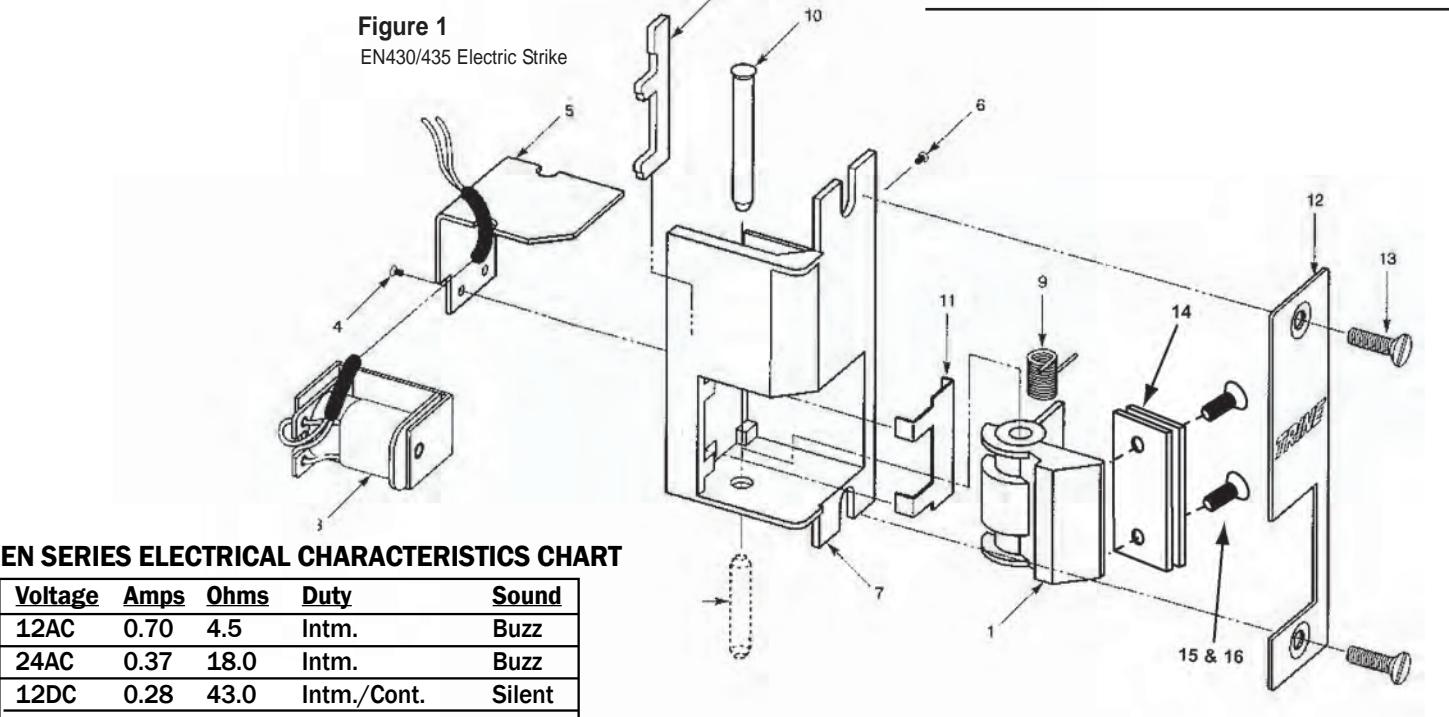
NOTE: Numbers in parenthesis ( ) indicates part in Parts List.
| Voltage Amps Ohms | Duty | Sound | |
|---|---|---|---|
| 12AC | 0.70 4.5 | Intm. | Buzz |
| 24AC | 0.37 18.0 | Intm. | Buzz |
| 12DC | 0.28 43.0 | Intm./Cont. | Silent |
| 24DC | 0.15 164.0 Intm./Cont. | Silent |
.4
HANDING DETERMINATION
Door handing is determined by theposition of the hinges, as viewed from the outside of the room or building. If the door hinges are on the left, the door is termed left handed; if the door hinges are on the right, the door is termed right handed. Also a door is either inswinging (opens into the room), or outswinging (opens to the outside of the room).
DOOR HANDING GUIDE
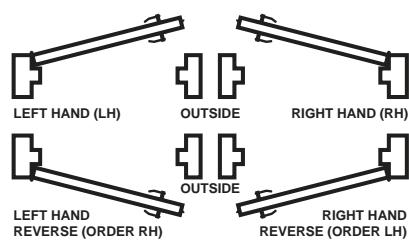
HANDING OF DOOR IS ALWAYS DETERMINED FROM THE OUTSIDE
NOTE
The EN430 and 435 are available in either LH (Left-handed) or RH (Right-handed). This needs to be specified when ordering.
The position of the Electric Strike within the door jamb will be the same for a right-handed inswinging door and a left-handed outswinging door. For these installations, the Electric Strike position within the door jamb will be as viewed in Figure 3.
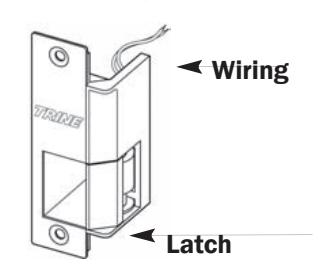
Figure 3. Position of Electric Strike for Right Handed Door.
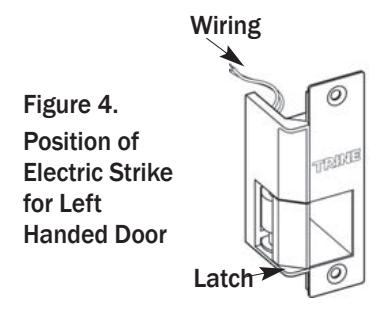
In a similar manner, the position of the Electric Strike within the door jamb will be the same for a left-handed inswinging door and a right-handed outswinging door. For these installations, the Electric Strike position within the door jamb will be as viewed in Figure 4.
ACTION (F AIL SECURE OR F AIL SAFE)
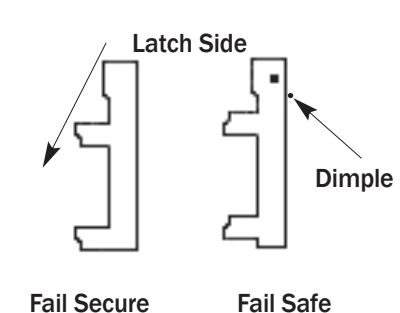
The standard action is fail secure and is field changeable to fail safe when replaced with special order part EN-SLR-RS. When using the fail safe Slider, a DC Coil must be used.
The fail safe Slider is identified by the small dimple below the welded tip.
CHANGING THE ACTION
- 1. Place Electric Strike face down and, from back of assembly, remove Screw (4) from Frame Cover (5). Remove Frame Cover from Electric Strike.
- 2. On side of Electric Strike, remove Screw (6), which holds Coil Assembly (3) to Frame (7).
- 3. Remove Coil Assembly from Electric Strike.
NOTE
The Latch (1) is removed in the following step. Assembly Pin (8) is pushed through Latch to keep Spring (9) in place. If Assembly Pin is not available, use care when removing Latch Pivot Shaft (10) to keep Spring within Latch. If Spring comes out of Latch, reinstall Spring as shown in Figure 5.
The three EN latch shims provide cavity width adjustment in 1/16" incr e men ts.
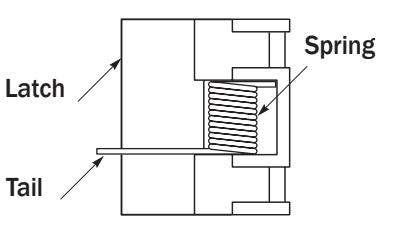
Figure 5.
Correct orientation of Latch Spring
Place Electric Strike on a flat surface with front of frame (7) facing up and insert Assembly Pin (8) into Latch to push out Latch Pivot Shaft (10). Remove Latch (1) containing Assembly Pin.
From top of frame remove Slider (2) from beneath Guard (11). Figure 6A. Take replacement fail safe Slider and insert through top opening with welded tip in upright position. Make sure the Slider rests on the bottom of the cavity. Figure 6B.
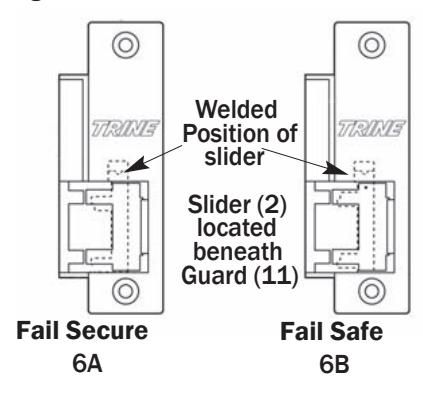
Figure 6.
Slider and Guard Positions
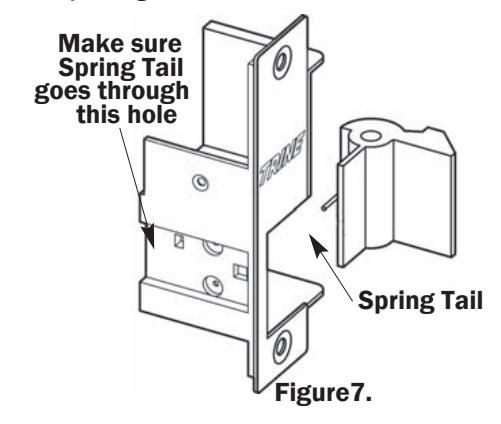
Hold Latch by satin side and roll into frame cavity with back end and exposed tip of Spring at the bottom of the cavity. Insert tail end of Spring into hole on the side of frame while replacing latch.
Cont... Page 2 Door Handing Determination INSTALLATION PROCEDURE:
Figure 8. Take Latch Pivot Shaft with crown end in upright position and insert through shaft hole at the top of the frame. This will push the Assembly Pin out through bottom hole
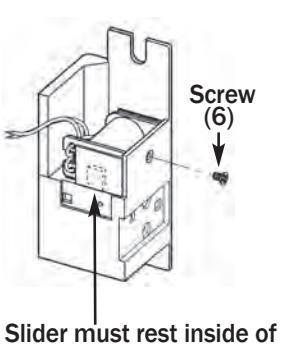
Coil Assembly Bracket
Check Slider action. Make sure Slider is free to move up and down with no resistance.
Before replacing cover, make sure the unit operates properly by testing with appropriate voltage. NOTE: Do not attempt to lubricate Electric Strike!!!
Place Strike face down and attach the cover over the Coil with wire leads seated through the notched hole.
negative side wire terminal to the negative side of the
circuit.
.3
- For new or replacement installation in wood
Verify that voltage rating of Electric Strike is compatible with supply voltages of installtion. Coil voltages are color coded.
| CODE/STRIPE |
|---|
| Blue/Orange Stripe |
| 2 Orange Stripe |
| Blue/Black Stripe |
| 2 Black Stripe |
2. Using template supplied with Electric Strike, mark door jamb for cutout and screw holes.
NOTE
or metal jambs.
For proper installation, center line of latches must be aligned with center line of Electric Strike.
- 3. Prepare door frame (cut out jamb if required) for Electric Strike. Leave sufficient space for splicing between power supply wiring and Electric Strike wiring.
- 4. If required, run new wiring to door frame mounting hole. See figure 10 for typical wiring installations. Refer to wiring chart below for correct wire size. (Total wiring length includes routing to door-release push button).
Total Wiring Length
| To Transformer | 12V | 24V |
|---|---|---|
| Up to 50 Ft | 18AWG | 20AWG |
| • | ||
| 50 to 150 ft | 16AWG | 18AWG |
| 150 to 300 ft | 14AWG | 16AWG |
| 300 to 600 ft | 12AWG | 14AWG |
NOTI
For DC operation, to obtain an audible signal when Electric Strike is energized, install buzzer type BZ-12 for 12VDC operation, or BZ-24 for 24VDC operation (purchased seperately), as illustrated in figure 10. 5. Hold Electric Strike upright (wiring toward top) and determine if handing is required. If so, perform handing procedure.
- 6. Splice Electric Strike wiring to supply wiring. Secure with wire nuts (supplied).
- 7. For wood and aluminum door jambs, drill pilot holes for securing Electric Strike to door jamb. For steel and aluminum door jambs, secure Electric Stike to existing mounting tabs.
- 8. Install Electric Strike into door jamb and secure with flat head mounting screws (supplied).
- 9. Verify that door operates correctly when Electric Strike is energized and not energized.
NOTE
- 1. Rectifier can be located either between transformer and push button, or between push button and electric strike.
- 2. Use either a silicon rectifier or a current regulating rectifier for converting the AC voltage at the transformer secondary to the DC for operating the electric strike.
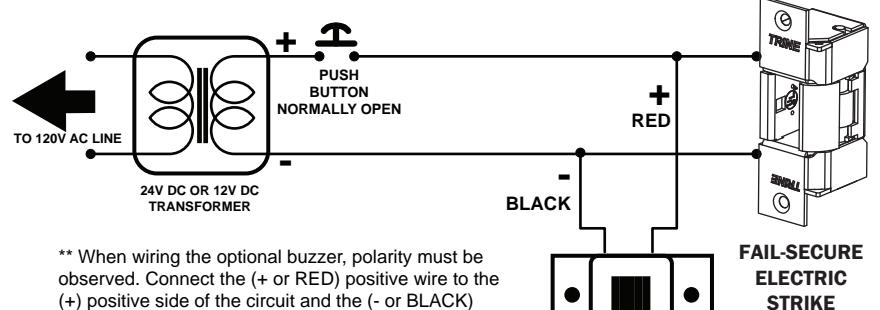
Figure 9.
SAMPLE WIRING DIAGRAMS FOR THE EN SERIES
Figure 10a. USING DC TRANSFORMER
Figure 10a. USING DC TRANSFORMER
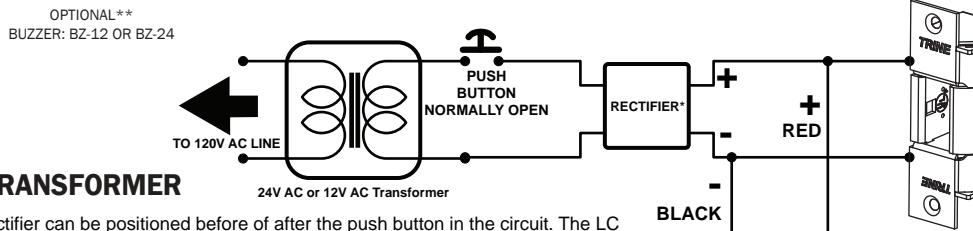
* The rectifier can be positioned before of after the push button in the circuit. The LC module can ONLY be positioned after the push button as shown above.
*** When wiring the optional buzzer, polarity must be observed . Connect the (+ or RED) positive wire to the (+) positive side of the circuit and the (- or BLACK) negative side wire terminal to the negative side of the circuit.
NAL** BUZZER: BZ-12 OR BZ-24 BZ-6 FOR LC VERSION
FAIL-SAFE ELECTRIC
STRIKE