Trine 4100 Electric Strike Installation Instructions
Open the original PDF document
View PDFUSING THE LATCH SPACER SHIMS
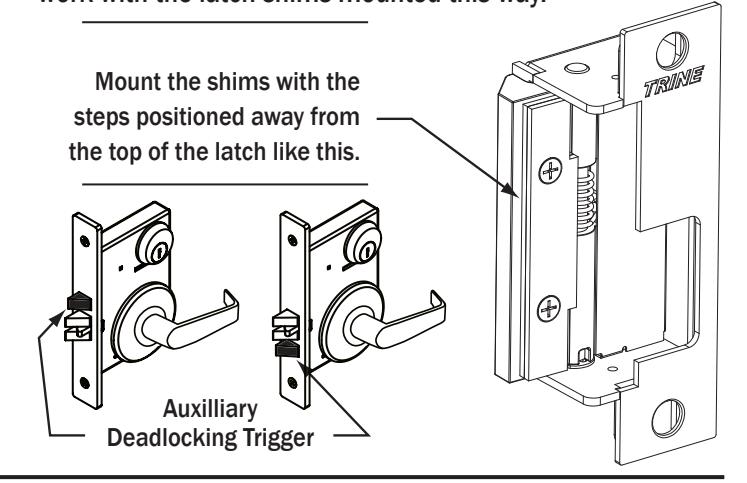
The latch spacer shims are used to make adjustments to minimize the space between the door's inside face and the door stop or reduce door play. For cylindrical locks aligning to the vertical center of the strike mount the shims as shown below. Mount the shims with the steps positioned aligned with the top of the latch like this. This position will ensure that the cylindrical lock's auxilliary trigger will function properly.
USING THE LATCH SPACER SHIMS (CONTINUED...)
For locks not aligning to the vertical center of the strike, mount the shims as shown below. Most if not all mortise locks will work with the latch shims mounted this way.
TROUBLESHOOTING THE COMPLETED INSTALLATION:
DO NOT APPLY AN OVER VOLTAGE OF MORE THAN 10% OVER THE RATED OPERATING VOLTAGE OF THE STRIKE OR THE SOLENOID WILL BE DAMAGED
Auxilliary Trigger
SYMPTOM : Electric release is not actuating:
- Verify proper voltage is present AT THE STRIKE. If voltage is present, the strike may have been affected during the installation, or dirt or debris may be preventing proper operation. Ensure that all moving parts are clean. DO NOT LUBRICATE THE SOLENOID.
- 2. If voltage IS NOT present:
- Verify Circuit breaker is on
- · Verify voltage at the transformer/power supply output.
- Verify that there are no additional, external switches or devices which may be interrupting your circuit.
- · Check for damaged wiring or bad wire splices.
SYMPTOM: Door will not open but strike is working
- · First, check to see if the electric strike works properly while the door is open.
- · Check for proper lock-latch engagement
- Check for pressure from the door on the electric strike by following these steps:
Push the door from the outside, try and relieve the bolt to latch pressure and actuate the 4100. While the 4100 is unlatched swing the door open. If the door opens, then the bolt maybe applying pressure to the latch. Adjust the position of the 4100 to relieve the pressure.
Possible remedies include:
- 1. Re-adjust door closer.
- 2. Remove door silencers.
- 3. Remove, or trim, weather stripping around the door.
- 4. Adjust electric strike position if possible.
- 5. Correct excessive warping of door.
WIRING DIAGRAMS USE THE PROPER CONNECTOR 12VDC OR 24VDC PUSH BUTTON 24V DC OR 12V DC TRANSFORMER For AC use the 12 VDC connectors FAIL-SECURE ELECTRIC STRIKE For 12 - 24 VAC use 50-60 Hz USE THE PROPER NECTOR 12VDC OR 24VDC ASSEMBLY FOR PUSH BUTTON NORMALLY CLOSED TO 120V AC LINI 24V DC OR 12V DC Cannot use AC in Fail Safe Configuration FAIL-SAFE ELECTRIC STRIKE
4100 OPTIONS:
4100RS - FAIL SAFE CONFIGURATION 4100LB - LATCH BOLT MONITORING
4100RSLB - FAIL SAFE/LATCH BOLT MONITORING
BZ-12 - 12VDC Piezo Buzzer
BZ-24 - 24VDC Piezo Buzzer

PHONE: (203) 730-1756 FAX: (203) 730-1781 2 PARKLAWN DRIVE BETHEL, CT 06801\nemail: customerservice@trineonline.com website: www.trineonline.com
V. 17.1128
4
4100 ELECTRIC STRIKE INSTALLATION INSTRUCTIONS
FACEPLATE AND OFFSET DIMENSIONS:

TRINE 4100 THE ONE BOX SOLUTION FOR CYLINDRICAL AND MORTISE LOCKS
Congratulations on the purchase of this quality TRINE security product. This product has been designed to install easily, perform reliably, and provide years of trouble free security.
BEFORE PROCEEDING with your installation, please review the following list of features. If you have any questions after reading this document please call TRINE's TECHNICAL SUPPORT (203) 730-1756 EXT. 447, or visit the TRINE Web site at www.trineonline.com
The 4100 is WH recognized for:

- UBC 7-2, Uniform building Code
- CAN4 S104, Standard Method for Fire Tests of Door Assemblies NFPA 252 -
Issue: 1999/01/01 Standard Methods of Fire Tests of Door Assemblies
NOTE: WH fire listing is void when using fail safe action.
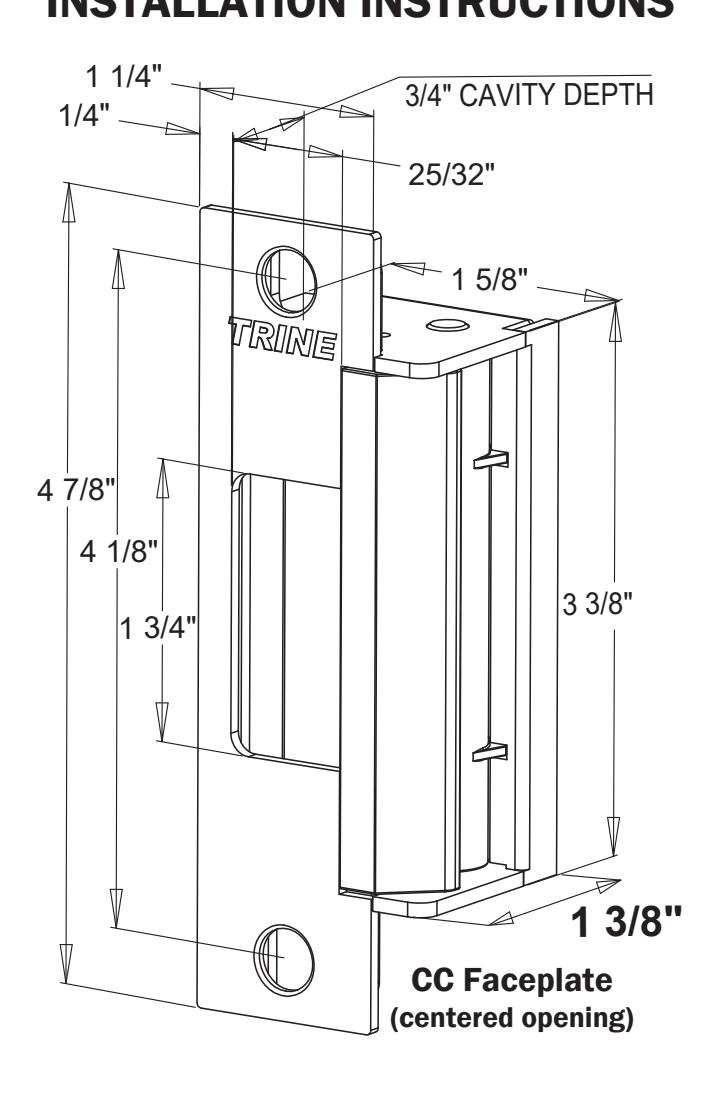
ANSI/BHMA A156.5 - 1992 - 4-7/8" x 1-1/4" Fits Cutout Specification A115.1 (with Slight Jamb Modification) BHMA - Grade 1
The 4100 is ETL recognized for: UL1034 Burglary Listed

The 4100 is WH recognized for UL294
| Feature | Level |
|---|---|
| Destructive Attack | II |
| Line Security | Ī |
| Endurance | IV |
| Standby Power | L |
4100 ELECTRICAL CHARACTERISTICS
| Current | Power | ||
|---|---|---|---|
| Voltage | Draw | Consumption | Resistance |
| 12DC | .240 A | 2.90 W | 50 Ω |
| 24DC | .114 A | 2.74 W | 210 Ω |
| 12AC @ 50-60Hz | .210 A | 2.50 W | 50 Ω |
| 16AC @ 50-60Hz | .281 A | 4.48 W | 50 Ω |
| 24AC @ 50-60Hz | .420 A | 10.08 W | 50 Ω |
When removing the connector and using the wires direct; Red & Blue Wire accepts 12DC & 12-16 AC, Brown & Blue Wire accepts 24DC.
OPERATING TEMP RANGE: -20 °C TO +40 °C DO NOT APPLY AN OVER VOLTAGE OF MORE THAN 10% OVER THE RATED OPERATING VOLTAGE OF THE STRIKE OR THE SOLENOID WILL BE DAMAGED.
1 - (1) 4100 Electric Strike Mechanism 2 - (4) Faceplates with Openings (CC, MHO, MMO, MLO) 3 - (2) #12-40 x 1 inch Philips Mounting Screws 4 - (2) #12-40 x 1 inch Torx® Security Mounting Screws 5 - (2) Quick Connect Socket & Wire Assembly 12VDC & 24VDC Version 6 - (2) Sealed Crimp Connectors 7 - (2) Latch Spacer WHAT'S IN THE BOX:
COMPATIBLE LOCKSETS
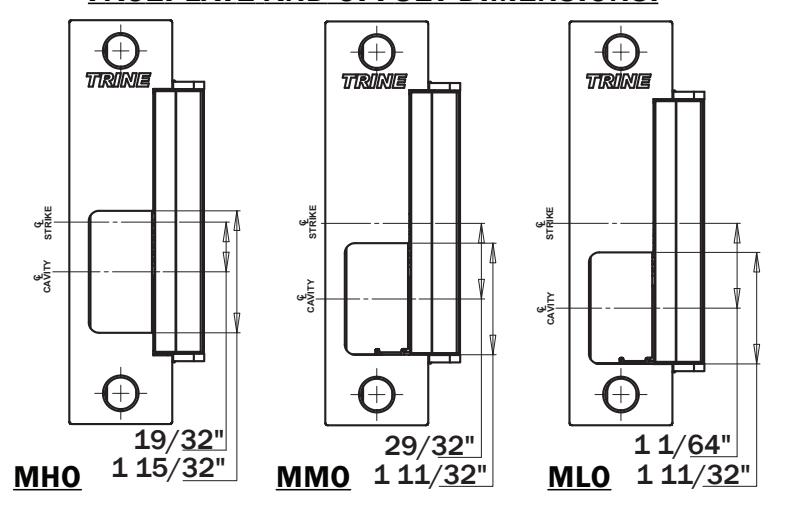
CC: Centered Cylindrical (Reference HES® J faceplate) - Cylindrical Locksets up to 3/4" throw and all locksets center lined bolts: Corbin Russwin® Security Bolt, Weiserbolt®.
MHO: Mortise High Offset (Reference HES® KM faceplate) - Accurate®, Arrow®, Best®, Corbin Russwin®, Falcon® (1992M Series), Sargent® (7800, 8200, & 9200 Series), Yale® (8800)
MMO: Mortise Medium Offset (Reference HES® K faceplate) - Baldwin®, Marks®, PDQ®.
MLO: Mortise Low Offset (Reference HES® KD faceplate) - Jackson®, Sargent® (7700 & 8100), Schlage® (L Series), Yale® (8700), Dorma M9080®
PREMIUM TRIM SKIRT FOR THE 4100
USING THE TRIM SKIRT
Shims & (2) Mounting Screws 8 - (1) Frame Trim Skirt & (2) Screws
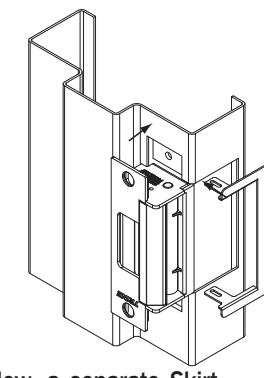
The skirt can be used to clean up the cut line of the frame face during installation. The Trim Skirt comes with 2 screws for fastening to the top and bottom of the 4100.
Available in 6 architectual finishes: US32D, US32, US3, US4, US10, US10B to match the finish of the electric strike and faceplates.
CCTS
If retrofitting for the electric strikes listed below, a separate Skirt may be used to cover the gap left in the frame. Note: Specify the finish of the CCTS so it matches the 4100 you have.
H.E.S.® 1006, Folger Adams® 712/732, Von Duprin® 6200 Series, or Trine EN Series Strikes
RECOMMENDED PRE-INSTALLATION CHECK:
- 1. Determine that the door swings without interfering with jamb or sill; the door must operate properly for the system to provide best results.
- 2. The door must be equipped with a door closer and the door closer "latch mode" must hold door in a completely closed position in order to avoid the lock latch from applying pressure against the releasing latch portion of the electric strike.
- 3. Electrical wire connections must be completed and ready to be terminated inside the frame.
- 4. Confirm that the power line in the frame is the correct voltage and that the switch works properly.
- 5. Confirm proper clearance exists between the end of the lock latch and jamb.
- 6. The faceplate opening used on the electric door strike must be centered with lock latch centerline when it is installed on the doorjamb.
- 7. For best installation results, the door frame must be reasonably flat and straight.
3 3/8" 1 3/8" 4 7/8" 1 17/64" 3 11/16" 4 1/8" FRAME PREPARATION CC, MHO, MMO ON HOLLOW METAL FRAME Use the Premium Trim Skirt to clean up your cut line (see pg 4) Use the Premium Trim Skirt to clean up your cut line (see pg 4) ON WOOD FRAME 1 3/8" 3 3/8" 4 7/8" 1 17/64" 4 1/8" MLO ON HOLLOW METAL FRAME (note 7/8" top dimension) 3 3/8" 4 7/8" 4 1/8" 1 17/64" 1 3/8" 7/8"
INSTALLING THE 4100 STRIKE:
NOTE: The 4100 electric strike has two terminal wires to supply power to two separate solenoids.
USE THE BOTTOM WIRE LEADS ONLY.
- 1. Prepare door frame as shown on page 2 (based on frame type).
- 2. Pull the switched power wires to the door frame. (Caution: Connect the power ONLY as the last step.)
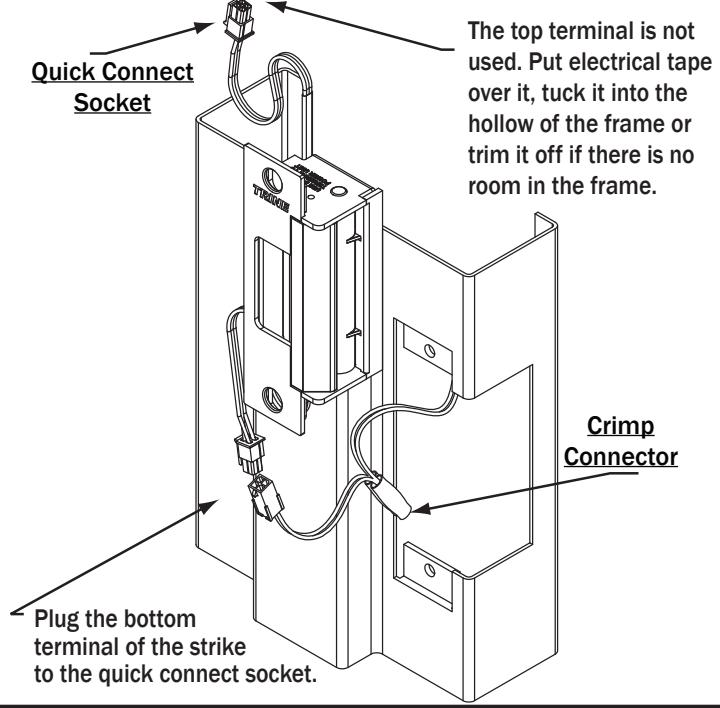
- 3. Carefully choose the quick connect socket to match the required voltage. The quick connect sockets are labeled 12VDC (Blue Wire) or 24VDC (White Wire).
- 4. Use the crimp connectors to terminate the ends of the quick connect socket to the power wires coming out of the frame.
- 5. Connect the strikes bottom terminal to the quick connect socket.
- 6. Tuck the wires inside the door frame.
- 7. Install the electric strike into the door frame
- 8. Connect the power supply and turn power on.
- 9. Test your system.
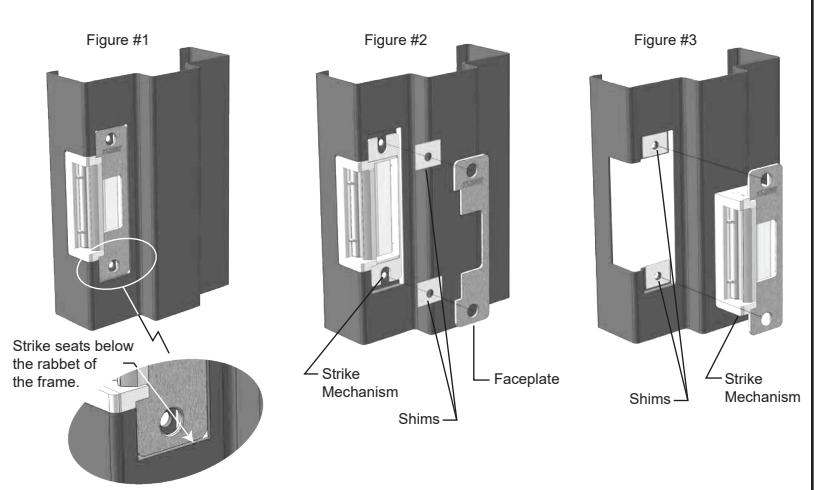
FLUSH TO FRAME
If the 4100 electric strike does not mount flush to the rabbet of the frame, use the enclosed shims to correct this condition. There are two ways of mounting the shim; 1) between the strike mechanism and the faceplate as shown in figure #2 or 2) between the frame mounting tab and the strike mechanism as shown on figure #3.
WITH SOME LOCKING MECHANISMS Figure #1
Sharp Edges
2
3/16"
We have included different kinds of shims and trims to help fix problems that are encountered in the field while installing the 4100.
Here for example is a mortise lock with an anti-friction bolt and dead locking trigger with sharp edges see Figure #1. Depending on the mounting relationship of the strike and the lock, the dead locking trigger can wedge between the faceplate and the latch keeper as shown on Figure #2a & 2b. This can create a pre-load condition on the latch keeper which will prevent the strike from unlocking.
Use the latch shim as shown on Figure #3a & 3b to prevent the dead locking trigger from getting trapped between the latch keeper and the strike faceplate. The faceplate must be notched to clear the latch shim (see Figure #3a).
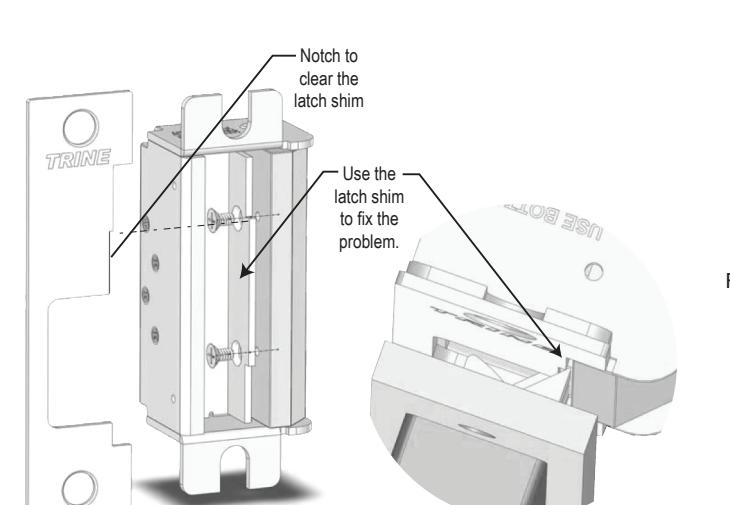
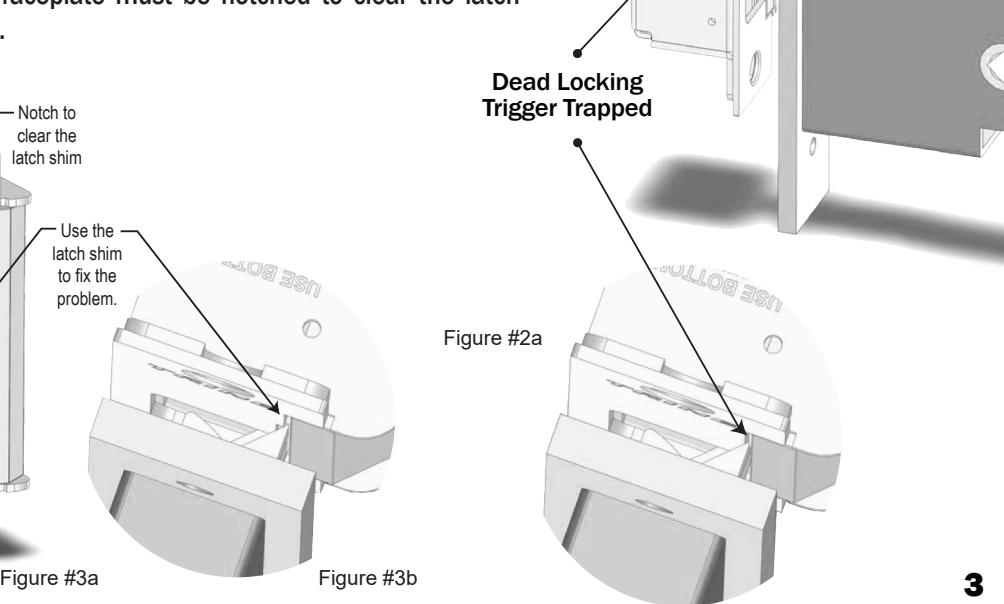
Figure #2b