Surewave CM-336 Manual
Open the original PDF document
View PDF

Door Activation Devices
CM-336
Battery Operated Active Infra-Red "Hands-Free" Switches
INSTALLATION INSTRUCTIONS
1. GENERAL DESCRIPTION
Sure-Wave™ Hands-Free switches are active infra-red devices utilizing micro burst sensor technology, designed for use in ADA compliant automatic door control applications. These switches eliminate the spread of germs by avoiding physical contact and offer building occupants greater convenience when moving through the premises. Sure-Wave™ switches are available with either stainless steel or impact resistant polycarbonate faceplates, in narrow (jamb), single gang or double gang configurations. All models are ROHS compliant with lead-free construction.

Sure-Wave™ battery powered hands-free switches are American Disability Act (ADA) compliant, and provide barrier free access and egress to buildings and washroom facilities. Their rugged construction makes them ideal for use on low-energy automatic doors, drive-up windows, and interior and exterior doors in virtually any commercial (office, retail), institutional (school, hospital or clinic), or industrial (manufacturing) facility.
Three standard face plate widths are available:
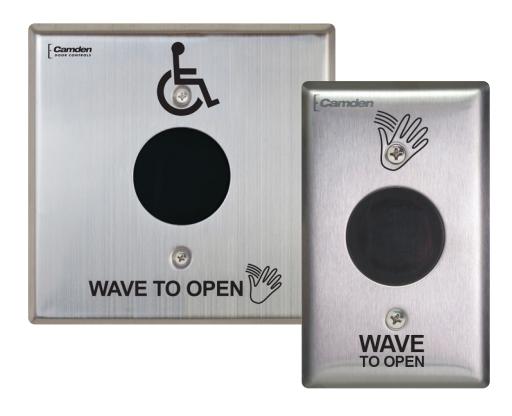
CM-336: 2 ¾" x 4 ½" polycarbonate or stainless steel, fits on single gang electrical boxes.
CM-336/N: 1 ¾" x 4 ½" polycarbonate or stainless steel.
CM-336/W: 4 ½" x 4 ½" polycarbonate or stainless steel, fits on single gang, double gang or 4 x 4 electrical boxes.
All faceplates may be ordered up with a plain face, with the waving hand symbol (/40), with the waving hand symbol and words: WAVE TO OPEN (/41) or with the waving hand, and wheelchair icons plus words: WAVE TO OPEN (/42).
3. INSTALLATION
Mounting
Sure-Wave™ may be mounted in door jambs, single or double gang electrical boxes, and 4 x 4 boxes.
NOTE: The sealing gasket (included) is recommended for outdoor or wet locations. If using with Automatic doors install in accordance with ANSI A156.10 / A156.19. Select from one of the following three mounting subsections:
SINGLE GANG ELECTRICAL BOX: CM-336
- 1a If using an in-wall box ensure the box is plumb and square, and flush with the wall surface. (See Diagram 1)
- 1b If using a surface box, ensure it is secure & plumb.
- 2 Using the dip switch located on the end of the unit, set the operating mode. (See Section 4)
- 3 Attach the unit to the enclosure using the two #6-32 screws provided.
- 4 Attach the faceplate to the unit using the two black #6-32 x 3/8 machine screws or tamperproof screws.
Do not overtighten!!
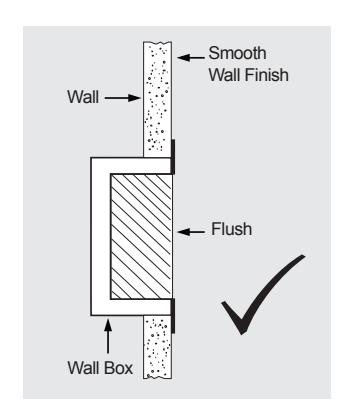
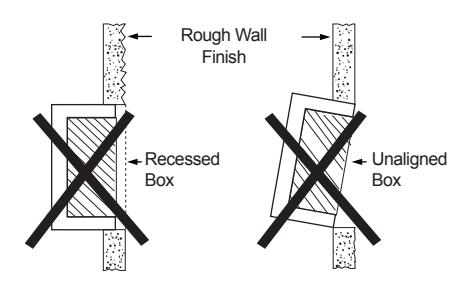
Diagram 1 - Proper Box Installation
2- GANG (or 4x4) ELECTRICAL BOX: CM-336W
- 1a If using an in-wall box ensure the box is plumb and square, and flush with the wall surface. (See Diagram 1)
- 1b If using a surface box, ensure it is secure & plumb.
- 1c If using a 4 x 4 box, ensure the box is plumb and square, and flush with the wall surface, then attach the metal adaptor plate (included in the CM-336W package) to the box using appropriate fasteners.
- 2 Attach the unit to the enclosure using the two #6-32 screws provided.
- 3 Attach the faceplate to the unit using the two black #6-32 x 3/8 machine screws or tamperproof screws.
Do not overtighten!!
Pairing the CM-336
The CM-336 battery operated wireless SureWave™ switch utilizes our Lazerpoint RF technology and is for use with Camden CM-RX90 V2, CM-RX91 or CM-RX92 Lazerpoint receivers.
To pair the CM-336 transmitter to a receiver, press the PB1 (or PB2 on the CM-RX92) button on the receiver using a small blunt object such as a small blade screwdriver or similar. Within 10 seconds, wave your hand in front of the CM-336 to activate it. The Green LED Array on the receiver will flash once to confirm enrollment. Repeat with any additional CM-336 wireless Surewave™ switches. Activating the paired CM-336 again will signal the receiver that you are finished programming and LED's 1 & 2 will flash, in an alternating sequence. Activating the CM-336 a third time will activate the receiver's relay and corresponding LED, and also the device connected to the relay contacts.
If you wait longer than the 10 second period, the receiver will time out of Pairing Mode and revert back to standby. The LED will then flash to indicate the number of transmitters learned into the receiver.
Wiring
CAUTION: Do not apply power to the unit until all wiring is complete, and dip-switches have been set.
The CM-336 is powered from 2 AA batteries (supplied). The battery holder has been pre-installed. Insert the batteries into the battery holder. Please be careful that the polarity of the batteries is correct.
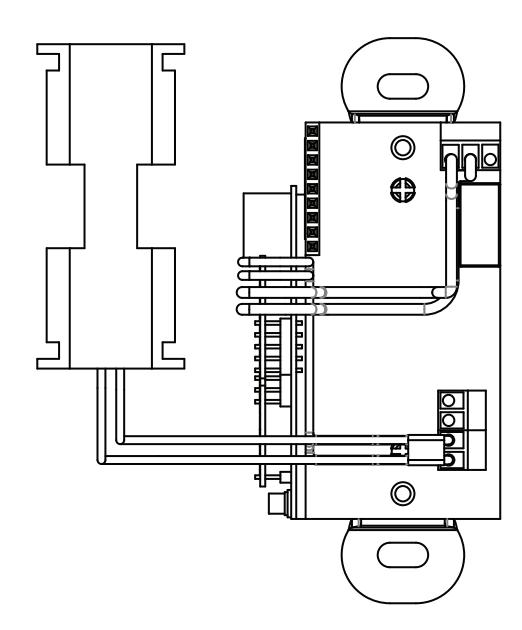
Diagram 2
4. APPLICATIONS & SET-UP APPLICATIONS
See Diagram 3 for the location of the Dip switches.
DIP Switch Settings DIP Switch 1
| CM-336 | Description | |
|---|---|---|
| 1 | LED Enable | Green LED flashes while the output is activated |
| 2 | Audio Enable | Piezo buzzer sounds when the output is activated |
| 3 | Not Used | |
| 4 | Not Used | |
Switch 1 – LED On/LED Off
This switch disables the LED, should this feature be desired. Factory setting is OFF. This feature will decrease the battery life if set to ON.
Switch 2 – Audio Enable
Set this switch ON to enable an audible beep every time the switch is activated. Factory default is OFF. Enabling this feature will use additional power and decrease the life of the battery.
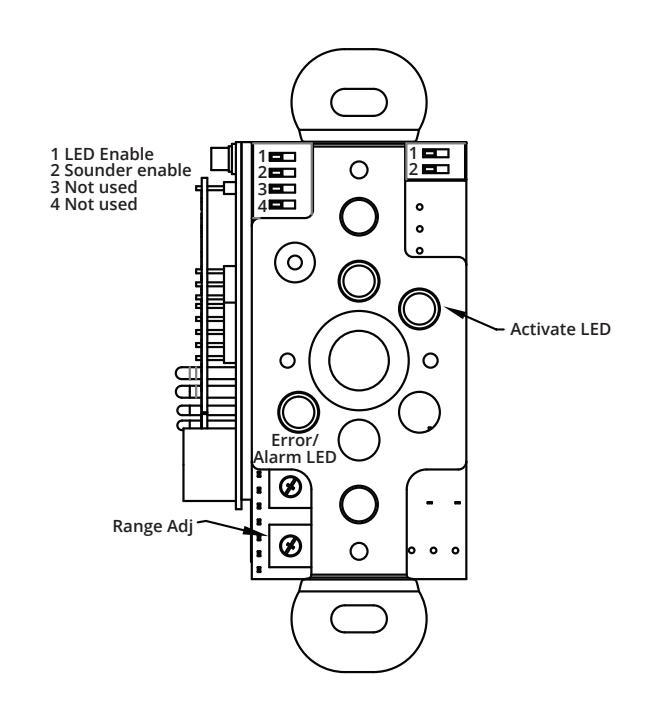
Diagram 3
Battery Strength Meter
To check the battery strength, place an object in front of the Surewave™ switch for approximately 5 seconds. The Surewave™ switch will beep up to 5 times indicating the battery charge level. 5 beeps being fully charged. 1-3 beeps indicates you should change the batteries.
Adjustments
Once the Dip switches have been set, and the unit is installed in the frame or enclosure, apply power to the unit and observe operation.
Set both potentiometers to minimum setting initially (fully counter-clockwise).
Adjust the range potentiometer by turning the pot in a clockwise manner, and passing your hand in front of the unit. Rotate the pot until the desired range is obtained.
See Diagram 3 for locations.
5. SYSTEM INSPECTION INSTRUCTIONS
After the Installation and operational check of the system:
- 1. Place warning label on the door (as per ANSI A156.10 or A156.19 guidelines). This will advise the person entering the swing side zone that the door will move.
- 2. Instruct the owner on door system operation and how to test it. This should be checked on a daily basis.
- 3. Instruct the owner on what to do if the door or any of its components become damaged.
- 4. Strongly recommend to the owner that the complete entry be inspected twice a year as part of the service agreement.
6. TECHNICAL DATA
| No. of IR Sensors | (1) |
|---|---|
|
Batteries
(Supplied) |
(2) 'AA' Alkaline (Supplied) |
|
Estimated Battery
Life |
2 Years (Based on 100 Operations/Day) |
|
Standard
Operating Range |
1"- 12" (25.4mm - 304mm)
Factory Set to 6" (152mm) |
| Operating Mode | Momentary |
| Inputs |
Request to Exit (to trigger the relay remotely or
from the other side of the door) |
| Wireless Output |
Built-in 915Mhz. Spread Spectrum
Wireless Transmitter |
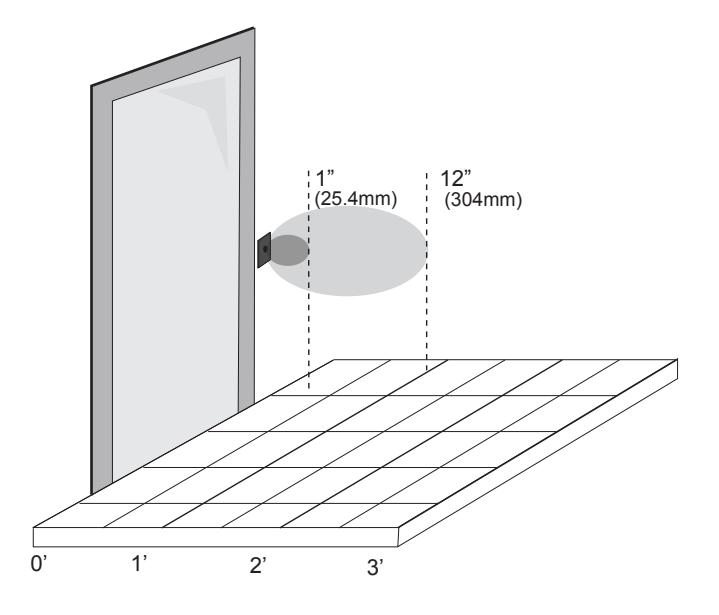
Diagram 4 Adjustable Range Settings