Securitron R100 Aperio Wireless Card Reader Installation and Operating Instructions
Open the original PDF document
View PDFSecuritron® R100 Aperio® Wireless Card Reader
Installation & Operating Instructions
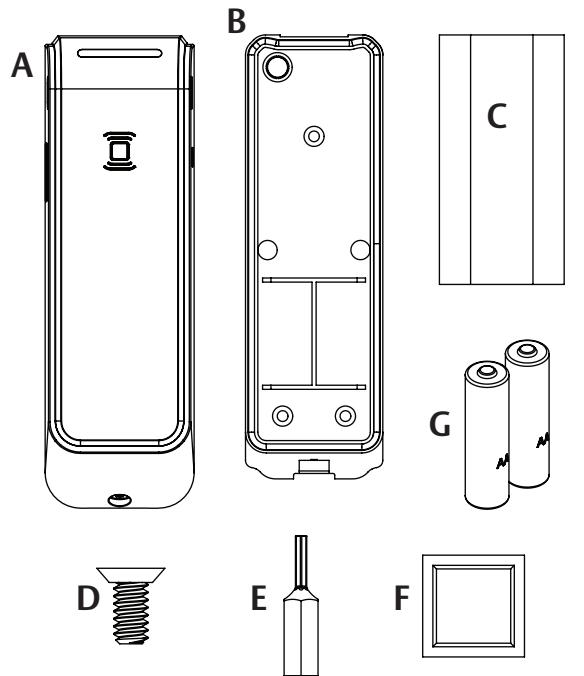
Product Contents
A Reader
B Backplate
C VHB Tape
D Torx T8 4-40 x 1/4" Security Screw
E Torx T8 Driver Security Bit
F Alcohol Swab
G 2X AA Lithium Batteries*
*AA Lithium Batteries required. Use of other types of batteries, such as Alkaline, will significantly decrease battery life.
Recommended Tools
- Level
- Pencil, Wax Pencil
- Clamp
Diagram 1: Product Components
Product Specifications
- • Wireless Frequency 2.4GHz, IEEE 802.15.4, using AES 128-bit encryption
- • Lock Battery Type AA Lithium, 1.5 Volts (V)
- • Battery Life 50,000 cycles*
*All battery life claims are approximate and based on a set configuration profile. Battery performance is based on pre-defined system settings such as battery chemistry and battery model used, credential presentation settings (LED/buzzer), UHF polling period, UHF status intervals, and operations per day. Actual battery performance will vary and depends on the factors above.
• Operating Temperature 32° to 122° F (0° to 50° C)
-
• HID® multiCLASS SE® technology Credentials Supported:
-
• High Frequency (13.56 MHz):
- » HID iCLASS®
- » HID iCLASS SE® (SIO-enabled)
- » HID iCLASS® Seos™
- » HID MIFARE® SE
- » HID DESfire® EV1 SE
- » MIFARE CLASSIC
- » DESfire® EV1
-
• Low Frequency (125 kHz):
- » HID Prox®, AWID, EM4102, ioProx
-
• NFC/BLE*
-
» Mobile enabled credentials
- * Supported on BLE-enabled models
-
» Mobile enabled credentials
-
• High Frequency (13.56 MHz):
Mounting the Back Plate
- 1. Level and mark the desired placement. Clean the mounting surface with provided alcohol swab. Remove reader from backplate.
- 2. Cut the VHB tape into two pieces and apply tape as shown in Diagram 3. Mount backplate to marked location and apply pressure to activate tape adhesive.
NOTE: VHB tape is intended to be used on glass and non-porous metal surfaces. For all other surfaces, use an appropriate adhesive and follow the manufacturer's instructions.
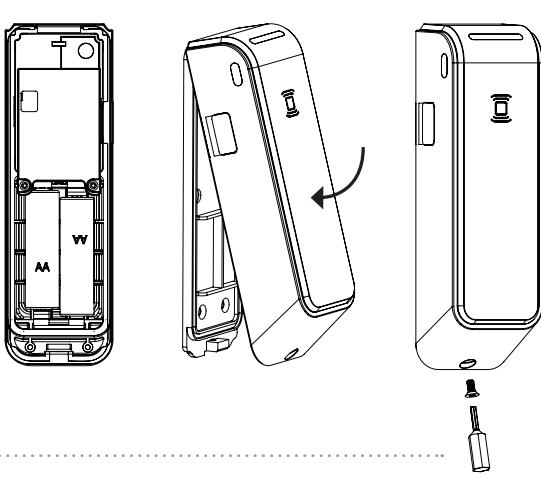
- 3. Install batteries (Diagram 4) .
- 4. Secure reader to backplate.
NOTE: Ensure reader is fully seated against the backplate and the screw hole is properly aligned before securing.
Diagram 2: Mark Placement & Remove Back Cover
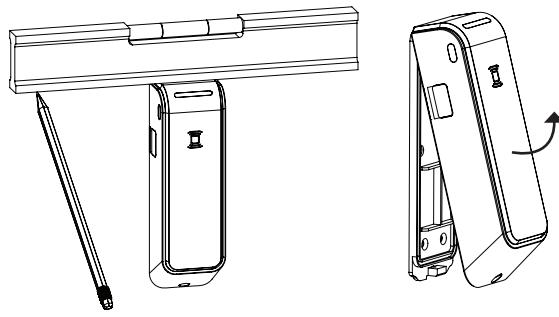
Diagram 3: VHB Placement & Mounting
Diagram 4: Install Batteries & Secure Reader
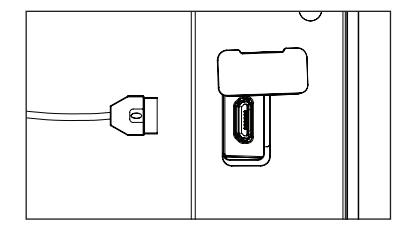
Micro USB Port
For emergency power & local (hard wired) firmware updates, use micro USB port located on the side of the R100 reader.
Diagram 5: Micro USB
Aperio Hub Specifications
- Approvals CE, ETL, FCC, IC, C-Tick
- Safety & Emissions FCC 47CFR Part 15 subpart B and subpart C; IC RSS-210 EN ETSI 301 489-17 v2.1.1; ENETSI 300 328 v1.7.1; EN 60950-1 ed.2 2007
- Dimensions 82mm x 82mm x 37mm
- Power Supply 8-24 VDC
- Current 250 mA minimum
- Internal Antenna 2 cross polarized dipoles
- External Antenna (Part No. EXT-10-ANT) One reverse polarity SMA external antenna connector. Optional antenna type dipole with max antenna gain of 3.9dBi
- Radio Standard IEEE 802.15.4(2.4GHz) 15 channels (11-25)
- Encryption (RadioCommunications) AFS 128 bits
- Wireless Operating Range Up to 50 ft
- Receiver Sensitivity 100dBm 20% PER
- Wireless Transmit Power 10 d Bm/MHz
- Class of Protection IP 20
- Operating temperature 41°F to 95°F [5°C to 35°C]
- Humidity < 95% non-condensing
- Status LED (red/green/yellow)
LED Codes
| Aperio LED LOCK Codes | ||
|---|---|---|
| (1) ONE Yellow Flash | Card read | |
| (1) ONE Green Flash | Access Granted | |
| (5) FIVE Yellow (1) ONE Red | 111111 | Force Closed (in open mode) |
| Continuous Yellow Flashes (.25 sec every second) | 1 1 1 1 | Comhub busy |
| (1) ONE Red Flash | ı |
Access Denied
(AC Online) |
| (3) THREE Red Flash | Ш |
Access Denied
(AC Offline) |
| Continuous Red Flashes (.125 sec every second) | 1111 | Lock is Blocked (when closing) |
| (10) TEN Red Flashes | Error in Lock | |
| Continuous Yellow Flashes (.25 sec every 5 seconds) | Low Battery | |
| Continuous Red Flashes (.25 sec every 5 seconds) | Dead Battery | |
| Aperio LED HUB Codes | ||
|---|---|---|
| Steady Green | Online | |
|
Steady Green
+ (1) ONE Red Flash |
Lock Offline | |
|
Steady Green
+(2) TWO Red Flashes |
- |
Access Control
Offline |
|
Steady Green
+(3) Three Red Flashes |
Access Control
& Lock Offline |
|
|
Flashing
Yellow |
UHF
Communication |
|
Connecting the Hub
The following applies only to Aperio factory paired kits with AH20 Hubs.
1. Connect the Wiegand D1, D0, red, and green LED signals.
NOTE: The Green LED input is used to grant access to the cabinet lock. If the Green LED signal is not available to indicate approved access, the approval input can be activated by a relay with "NO" attached to Green LED and "C" to GND. The Red LED input is used to indicate access denied. If the RED LED signal is not connected, the lock will flash RED three times when a non-approved card is presented indicating loss of connection to the hub rather than access denied. Any other codes may be reference on the LED reference card.
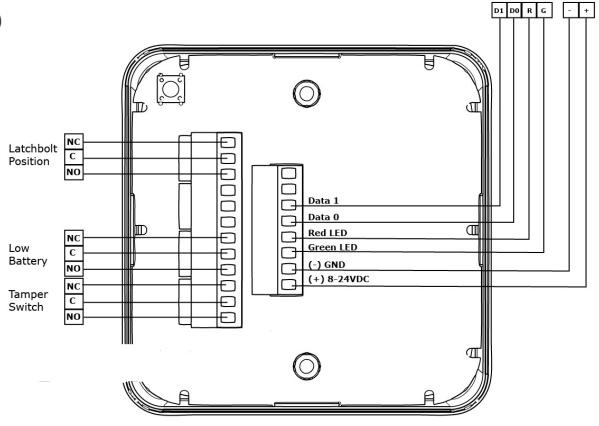
For placement of hub, see AH20/AH30 Installation Instructions
WARNING
FCC Statement
This equipment has been tested and found to comply with the limits for a class B digital device, pursuant to part 15 of the FCC Rules. These limits are designed to provide reasonable protection against harmful interference in a residential installation. This equipment generates, uses, and can radiate radio frequency energy and if not installed and used in accordance with the instructions, may cause harmful interference to radio communications. However, there is no guarantee that interference will not occur in a particular installation. If this equipment does cause harmful interference to radio or television reception, which can be determined by turning the equipment off and on, the user is encouraged to try to correct the interference by one or more of the following measures:
- 1. Reorient or relocate the receiving antenna.
- 2. Increase the separation between the equipment and receiver.
- 3. Connect the equipment into an outlet on a circuit different from that to which the receiver is connected.
- 4. Consult the dealer or an experienced radio/TV technician for help.
Operation with non-approved equipment is likely to result in interference to radio and TV reception. The user is cautioned that changes and modifications made to the equipment without the approval of manufacturer could void the user's authority to operate this equipment. To comply with FCC and Industry Canada RF radiation exposure limits for general population, the module must be installed to provide a separation distance of at least 20cm from all persons and must not be colocated or operating in conjunction with any other antenna or transmitter.
This module is labeled with its own FCC ID and IC Certification Number. If the FCC ID and IC Certification Number are not visible when the module is installed inside another device, then the outside of the device into which the module is installed must also display a label referring to the enclosed module. In that case, the final end product must be labeled in a visible area with the following:
Contains FCC ID: VC3-R100V3 Contains IC: 7160A-R100V3
IC Statement
This device complies with Industry Canada license-exempt RSS standards(s). Operation is subject to the following two conditions:
- (1) this device may not cause interference, and
- (2) this device must accept any interference, including interference that may cause undesired operation.
Conformité aux normes FCC
Cet équipement a été testé et trouvé conforme aux limites pour un dispositif numérique de classe B, conformément à la Partie 15 des règlements de la FCC. Ces limites sont conçues pour fournir une protection raisonnable contre les interférences nuisibles dans une installation résidentielle. Cet équipement génère, utilise et peut émettre des fréquences radio et, s'il n'est pas installé et utilisé conformément ment aux instructions du fabricant, peut causer des interferences nuisibles aux communications radio. Rien ne garantit cependant que l'interférence ne se produira pas dans une installation particulière. Si cet équipement provoque des interférences nuisibles à la réception radio ou de télévision, qui peut être déterminé en comparant et en l'éteignant, l'utilisateur est encouragé à essayer de corriger les interférence par une ou plusieurs des mesures suivantes:
- 1. Réorienter ou déplacer l'antenne de réception.
- 2. Augmenter la distance entre l'équipement et le récepteur.
- 3. Branchez l'appareil dans une prise sur un circuit différent de celui auquel le récepteur est connecté.
- 4. Consultez votre revendeur ou un technicien radio / TV pour assistance.Avertissement
Les changements ou modififications à cet appareil sans expressément approuvée par la partie responsable de conformité pourraient annuler l'autorité de l'utilisateur de faire fonctionner cet équipement. L'opération est soumise aux deux conditions suivantes:
- (1) Cet appareil ne doit pas causer d'interférences nuisibles, et
- (2) Cet appareil doit accepter toute interférence reçue, y compris les interférences susceptibles de provoquer un fonctionnement indésirable.
Pour se conformer aux limites d'exposition aux rayonnements RF de la FCC et d'Industrie Canada pour la population en général, le module doit être installé pour fournir une distance de séparation d'au moins 20 cm de toutes les personnes et ne doit pas être localisé ou en combinaison avec une autre antenne ou émetteur.
Ce module est étiqueté avec son ID FCC et son numéro de certification IC. Si l'identifiant FCC et le numéro de certification IC ne sont pas visibles lorsque le module est installé à l'intérieur d'un autre appareil, l'extérieur de l'appareil dans lequel le module est installé doit également afficher une étiquette faisant référence au module ci-joint. Dans ce cas, le produit final final doit être étiqueté dans une zone visible avec ce qui suit:
Contient FCC ID: VC3-R100V3 Contient IC ID:7160A-R100V3
Conformité aux normes IC
Cet appareil est confrome avec Industrie Canada exempt de license RSS standard(s). Son fonctionnement est souimes aux deux conditions suivantes:
- (1) cet appareil ne peut causer d'interférences, et
- (2) cet appareil doit accepter toute interference, y compris des interférences qui peuvent provoquer un fonctionnement indésirable du périphérique.
4 of 4
techsupport.esh@assaabloy.com | 800 626 7590 assaabloyesh.com
4 of 4 10027 S. 51st Street, Ste. 102 Phoenix, AZ 85044 USA
Patent pending and/or patent www.assaabloydss.com/patents
Copyright © 2020, Hanchett Entry Systems, Inc., an ASSA ABLOY Group company. All rights reserved. Reproduction in whole or in part without the express written permission of Hanchett Entry Systems, Inc. is prohibited. 3080006.015_4