Securitron EPT, EPTL Power Transfer Installation Instructions
Open the original PDF document
View PDFSecuritron® EPT-EPTL
Electrical Power Transfer Includes: EL-EPT/EL-EPTL – ElectroLynx® Version
Installation Instructions
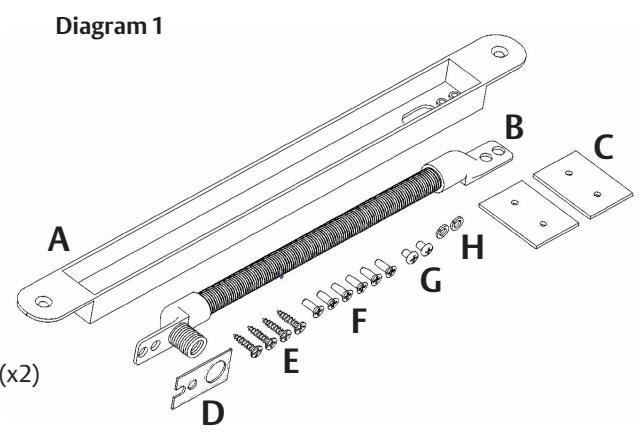
Product Contents
- A Lead Cover
- B Flexible Shield
- C Flush Tab Bracket (x2)
- D Bezel Plate
- E #6 X 5/8" SMS Screw (x4)
- F 6-32 3/8" Type "F" Self Tapping Screw (x6)
- G Phillips Pan Head 8-32 X 3/16" (x2)
- H Split Helical Washer for #8 Screw (x2)
Upon unpacking this product, an inventory should be made to ensure that all of the required components have been included. With these instructions and the installation template.
Recommended Tools
- Router or Saber Saw
- Measuring Instrument (Ruler/Tape Measure)
- Hammer
- Masking Tape
- Chisel
- Fish Tape or Lead Wire
- Center Punch
- Wire Strippers/Cutter
- Power Drill
- Crimp Wire Connectors
- 1/8", 5/32" and 3/4" Drill Bits
- Crimp Tool
- 3/8" Diameter X 82° Countersink Bit
- Multimeter
- Phillips and Standard Screwdrivers
Description
The EPT/EPTL allows an electric lock or exit device, such as a Securitron Touch Sense Bar or Touch Sense Handle, to be installed while concealing and protecting the cabling between the hinged edge of a door and its doorframe. The EPT/EPTL provides a flexible steel shield conduit, which is approximately 5/16" [7.9mm] I.D. (inside diameter).
The EPT/EPTL power transfer devices can be installed onto doors with Full Mortise Butt Hinges, Continuous Butt
Hinges or Offset Pivot Type Hinges. The Pivot Type Hinge styles may have up to a 3/4" [19.0mm] offset maximum.
NOTE: The EPT/EPTL models are not compatible with doors containing swing clear type hinges or countertype doors.
Installation
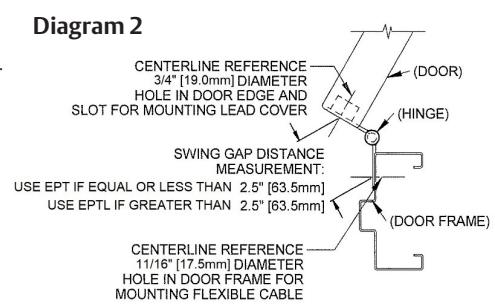
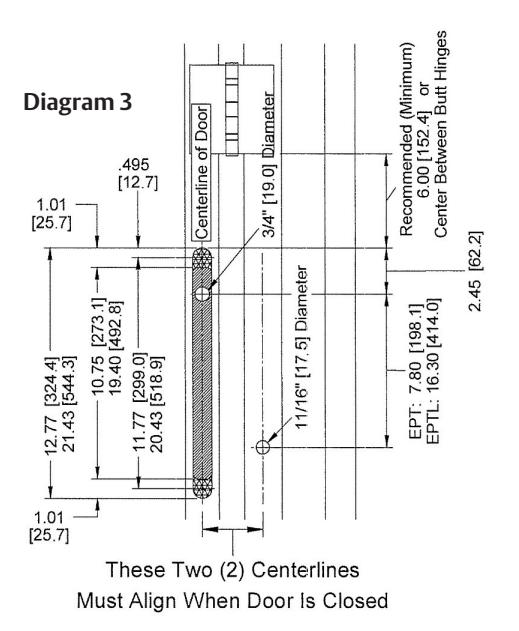
It is recommended to edge mount the EPT/EPTL in the upper half of a steel door and the lower half of a wood door. The EPT/EPTL Lead Cover should be a minimum of 6" [152.4mm] from the middle butt hinge cutout or centered between the butt hinges. Prior to installation, ensure that you have the correct version of the EPT/EPTL by fully opening the door to its full travel distance, and measuring the "swing gap distance" as shown in Diagram 2 .
Given the movement of the electrical power transfer during door movement, it is required that certain steps are taken to prevent wire breakage of 'installer provided' cabling.
- 1. Use only highly flexible cable with a robust flexible jacket. Flexible cabling is characterized by a high copper strand count (we recommend at least 19 strands) while a robust flexible jacket is at least 1/32" thick (with a maximum jacket OD of 0.275") made of PVC, PTFE, polyolefin or similar jacket material.
- 2. Provide for some wire slack for the wire entering and exiting the EPT. The wire bundle must be free to move (approximately 1") within the EPT during normal door movement to prevent wire breakage.
As such, any splices or connectors should be at least 2" away from the exit of the power transfer device to ensure the wire is not restricted from moving within the EPT during normal door movement.
Although using the above recommendations reduces the risk of wire breakage, ASSA ABLOY cannot be held responsible for wire failure in power transfer devices in which ASSA ABLOY did not provide the wiring.
If the swing gap distance is 2.5" [63.5mm] or less an EPT may be used. If the distance is greater than 2.5" [63.5mm] an EPTL must be used. Once the correct unit is determined, use the following step-by-step procedure to install the EPT/EPTL correctly.
NOTE: The door stile, number of hinges and distance between hinges may vary depending upon the door manufacturers. Consult the specific door manufacturer to help decide if the EPT/EPTL will fit the application.
Wood Doors & Frames
- 1. Using a router, cut the main recess slot into the edge of the door .700" [17.8mm] deep as explained in Diagram 2 and Diagram 3 . Reset the router depth to .075" [1.9mm] and cut the two (2) recessed flange areas for the flush mount tabs.
- 2. Place the lead cover into position and mark the location of the cable exit oblong hole and the mounting hole. Remove the Lead Cover and drill the (2) two holes using a 1/8" [3.2mm] diameter drill approximately 1/2" [12.7mm] deep.
- 3. Drill the 3/4" [19.0mm] diameter hole into the door edge. Pass cable from the exit device through the hole in the door edge. Pass the cable through the oblong hole in the Lead Cover.
- 4. Properly make wiring connection at the door location. Mount the Lead Cover into place using the two (2) #6 x 5/8" Flathead Type-A Screws provided.
- 5. Locate and mark the mounting holes for the Flexible Shield onto the doorframe.
- 6. Drill the 11/16" [17.5mm] diameter hole into the doorframe.
- 7. Drill (2) two holes using a 1/8" [3.2mm] diameter drill approximately 1/2" [12.7mm] deep for mounting of the Flexible Shield.
- 8. Pass the cable through the Flexible Shield and apply Bezel Plate if not preassembled. Properly make wiring connection at the frame location and pass into the hole of the door frame.
- 9. Mount the Flexible Shield onto the Lead Cover using the two (2) 8-32 x 3/16" Screws and #8 Split Helical Washers provided.
- 10. Align the cable and the other end of the Flexible Shield onto the door frame and secure using the two (2) remaining #6 x 5/8" Flathead Type-A screws provided as shown in Diagram 5 .
NOTE: Use the Bezel Plate to conceal the hole in the frame.
Metal Doors & Frames
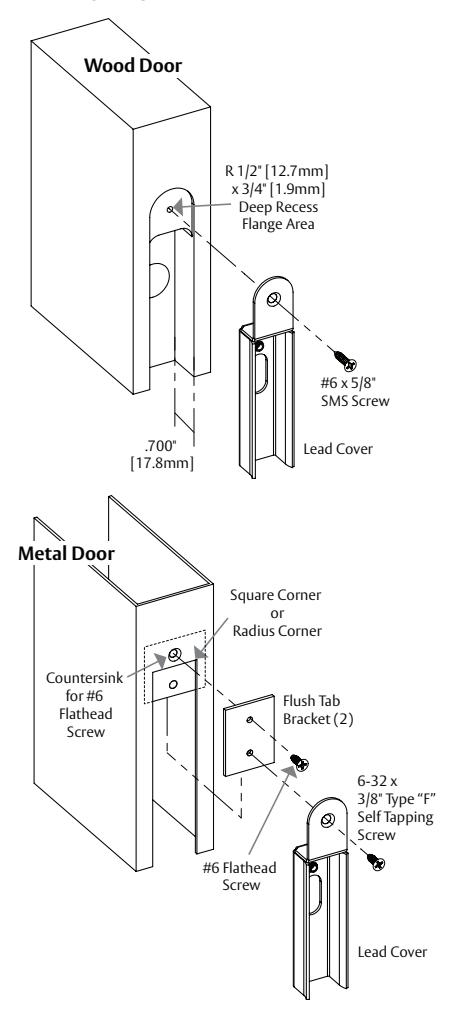
- 1. Metal doors must also have a flush surface mount installation. The door/frame manufacturer may prepare a pre-fabricated tab for internal mounting capabilities or use the Flush Tab Brackets provided. The cut out for the Lead Cover may be cut with a radius or square cornered as noted in Diagram 4 and on the Template provided.
- 2. If field retrofit installation is being performed, cut the complete perimeter for the lead cover and install the Flush Tab Brackets provided, see Diagram 4 .
- 3. When mounting the Lead Cover, drill the mounting holes 1/8" [3.2mm] and use the 6-32 x 3/8" Type "F" Self Tapping Screws provided.
- 4. Follow the Template provided for placement of the screw holes for the Flush Tab Brackets. Also when mounting the Flexible Shield to the metal door frame, drill the same holes at 1/8" [3.2mm] and use the two (2) remaining 6-32 x 3/8" Type "F" Self Tapping Screws.
NOTE: Applications containing combinations of doors or frames made of wood or metal; follow the proper procedures related to the device as necessary.
Diagram 4
Illustration shows exploded views of configurations for both the solid core wood door and hollow metal door installations. This Diagram illustrates the correct process for flush mounting the EPT/ EPTL according to the door application required.
NOTE: Routing is generally performed into the edge of the door (as shown) but this can be reversed with the routing being done into the frame.
EL-EPT / EL-EPTL ElectroLynx Version
Description
ElectroLynx is a standardized plug-in connection system, which allows for the easy installation of door-mounted hardware. Door mounted locking hardware, doors, hinges or power transfer devices and frames are available prewired from ASSA ABLOY companies with universal plug-in connectors for a simplified, time saving field installation.
Overview
The structural design of the ElectroLynx version is the same as the EPT/EPTL unit. It includes an additional 12-conductor cable placed in the Flexible Coil with 2 connectors applied on each end containing an 8-pin and a 4-pin connector pre-wired pin-to-pin.
Installation
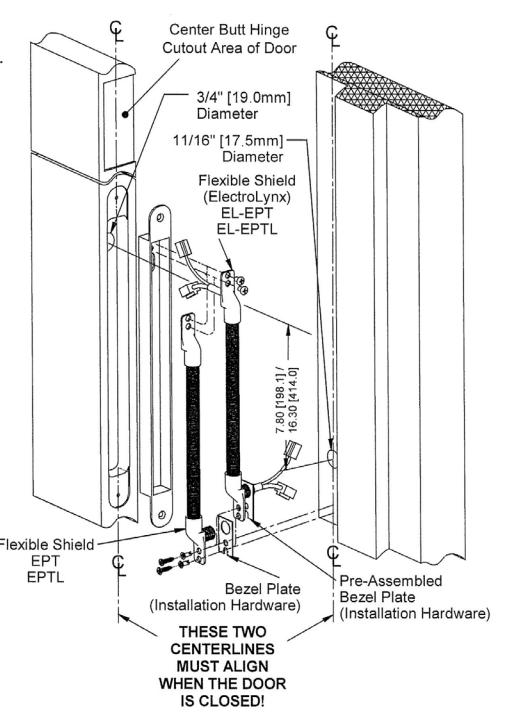
The installation of the ElectroLynx version (EL) is similar to the standard EPT/EPTL. The ElectroLynx version comes pre-harnessed on both ends with dual harness plug adapters for system accessories as illustrated in Diagram 5 .
The dual harness connectors provided come out of the backside of the Lead Cover for connection to the door edge accessory devices.
The opposite end also contains dual harness plug adapters to connect into device signal lines through the doorframe accessory devices.
- 1. Attach all proper connections of the harness at the door location.
- 2. Push the cable and connectors back into the hole of the door.
- 3. Mount the Flexible Shield to the Lead Cover as shown in Diagram 5 .
- 4. Mount the Lead Cover as described in Diagram 4.
- 5. Attach the proper connections at the frame location.
- 6. Push the cable and connectors back into the frame.
- 7. Mount the Flexible Shield to the frame as shown in Diagram 5 .
NOTE: Use the attached Bezel Plate to conceal the hole in the frame.
EL-EPT/EL-EPTL ElectroLynx Electrical NOTE: Electrical Rating: EL-EPT and EL-EPTL is 1 Amp @ 12V or 24V – AC or DC
Diagram 5
EPT & EPTL Special UL/Electrical Notes
To maintain compliance with UL listings (UL 10C and UBC 7-2-1997), the maximum number of electrical conductors to be used is twelve (12) — using No. 20-22 AWG size wire.
Electrical rating for the EPT-SC and the EL-EPT-SC is 1Amp at 12V or 24V – AC or DC.
4 of 4
techsupport.esh@assaabloy.com | 800 626 7590 assaabloyesh.com
10027 S. 51st Street, Ste. 102 Phoenix, AZ 85044 USA 1 of 12
Patent pending and/or patent www.assaabloydss.com/patents
Copyright © 2019, Hanchett Entry Systems, Inc., an ASSA ABLOY Group company. All rights reserved. Reproduction in whole or in part without the express written permission of Hanchett Entry Systems, Inc. is prohibited. 500-14250_8