Securitron BPS Power Supplies Installation Instructions
Open the original PDF document
View PDFSecuritron® BPS-12-3, 4.5, 6, 9, 15 and BPS-24-2, 3, 4, 6, 10 Power Supplies
Installation & Operating Instructions
Description
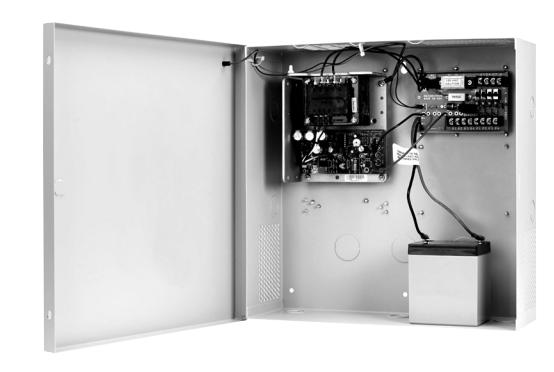
These instructions cover 10 different models as shown above which are designed to be installed in an indoor dry environment. The part number expresses first the output voltage (12 or 24) and second the maximum output current capacity. For example, Securitron BPS-24-6 can supply up to 6 amps at 24 volts. Securitron large power supplies consist of a power module and CCS control board to which all installer connections are made.
The board accomplishes several functions. It provides terminals for line voltage input and DC outputs on separate circuits, so that a number of devices can be powered. Securitron BPS-12-3, BPS-12-4.5, BPS-24-2 and BPS-24-3 are furnished with the CCS-4 control board with four separate output circuits.
The other larger units in the range are furnished with the CCS-8 control board with eight separate output circuits. Each control circuit has an individual slide switch to turn it on and off and an LED to annunciate its status. The CCS control board also provides LED indication showing that the power supply is on, emergency release terminals, line voltage and DC fuses and sealed lead acid - gel cell battery charging capability. All power supplies in the Securitron BPS series are Class 2 rated when installed following these instructions.
Performance levels per UL 294 6e are as follows:
- Attack I Line
- Security I
- Endurance IV
- Standby Power I (CH units); II (non-CH units)
The models which incorporate the suffix "H" in the part number have not been evaluated by UL. These power supplies have only been evaluated by UL for use in the EXD-1 and EXD-1F FWAX systems.
Safety
Two hazards are present in the Securitron BPS series power supplies:
- Line voltage input presents a high voltage shock hazard and the DC/battery output, represent a high energy (current) hazard.
- A shorted battery can swiftly supply levels of current sufficient to melt wiring insulation and cause a fire.
To ensure safety , note first that the cover LED is on at any time that the supply is dangerous, which is either if it is receiving line voltage or if batteries are operating. The supply enclosure must only be opened by trained service personnel when the cover LED is on.
Other safety features include line voltage and DC fuses and the fact that the line voltage input terminals are under a warning guard plate.
Line Voltage Input
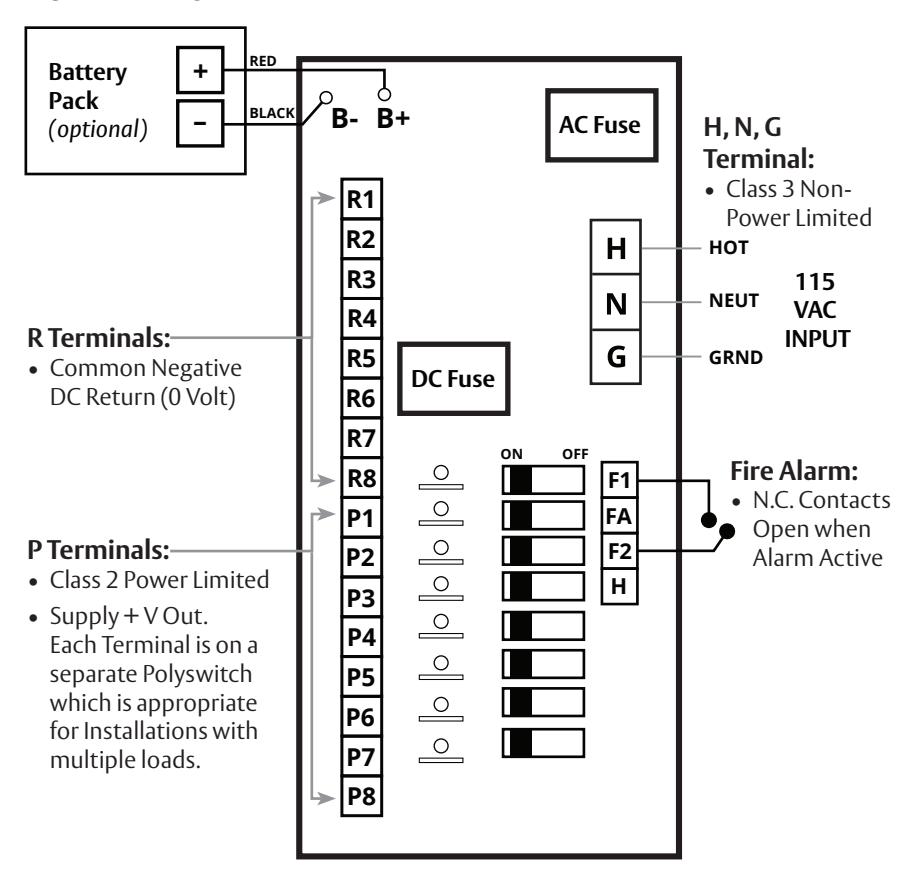
110-120 VAC should be input to terminals "H", "N", "G", as shown in the Diagram 1 . This is fed to the input of the power module through factory made connections.
The line voltage current drawn by the power supply module will be approximately half the DC output.
FOR EXAMPLE, for a 4 amp power supply, the line voltage service should be able to supply at least 2 amps.
NOTE : if the suffix "H" appears in the part number (i.e. Securitron BPSH-24-4), the unit requires 220 VAC input. Apart from this change, all other characteristics are the same.
F1 FA F2 H HOT NEUT GRND ON RED BLACK OFF 115 VAC INPUT AC Fuse DC Fuse Battery Pack (optional) R1 B- B+ R2 R3 R4 + – P1 P2 P3 P4 Diagram 1: Wiring with CCS-4 Board P Terminals: • Class 2 Power Limited • Supply + V Out. Each Terminal is on a separate Polyswitch which is appropriate for Installations with H Terminal: • Single High-Current Output (upstream of Polyswitches) Fire Alarm: • N.C. Contacts Open when Alarm Active H, N, G Terminal: • Class 3 Non-Power Limited • Operation of AC and DC fuses is described in Fusing and Circuit Polyswitches R Terminals: • Common Negative DC Return (0 Volt) • Slide switches power and de-power each "P" output.
LED's show output status
multiple loads.
DC Output
The maximum DC output of the power supply is expressed by the final figure in the part number. The Securitron BPS-24-3 can supply up to 3 amps; the Securitron BPS-12-6, up to 6 amps etc. However, these power supplies are adjustable and the voltage level set affects the current output capacity. When used with batteries, the power supplies must be set at 10% over voltage (13.2 V for 12 volt supplies and 26.4 V for 24 volt supplies) . This is the factory setting and if the voltage is to be changed, use the potentiometer marked "V Adj" on the power supply module.
The current rating takes into account the possibility of the supplies operating at 10% over voltage. Therefore any supply which is operated at its nominal voltage (12 or 24 V) can supply about 20% more than its rated current. Despite this, we strongly recommend that supplies be operated substantially below their maximum output capability. Operating power supplies at their maximum greatly increases the possibility of heat induced failure. "Margin for error" is lost and this is inappropriate for a security system. Power supplies should be run at no more than two thirds of their maximum capacity for optimum reliability.
Emergency Release Terminals
If the power module is operating or if batteries are operating, the LED will illuminate. +V (12 or 24VDC depending on the model power supply) will then be on terminal F1. Connection must then be made between terminals F1 and F2 before +V is routed to the "P" terminals.
• Terminals F1 and F2 therefore constitute an emergency release point. If desired, for instance, NC contacts controlled by the user's fire alarm system can be connected across terminals F1 and F2 such that the connection between these terminals will be broken in the event of a fire. UL listed auxiliary latching normally closed contacts from the fire alarm system should be used. "Trouble" contacts must not be used. This will automatically release all the devices being driven
by the unit. If the emergency release terminals are not to be used in this way, a jumper should be placed between them so that the board's output terminals will function. Make sure that the switching capability of any switch or relay contacts placed across F1 and F2 can handle the full output load of the power supply.
• Terminal FA is a free parking terminal used only with Securitron's Power Supply Monitor. The PSM interconnects with the power supply and monitors the continued correct behavior of the supply including voltage level and whether the batteries are functioning. The PSM signals any problem including whenever the battery pack takes over the load. If you are using the PSM, wiring with the FA terminal is shown in the manual.
Output Terminals
- The CCS board has three types of output terminals. "P" terminals are on individual circuit breakers and carry +12 or +24 volts on them (when the emergency release terminals are closed) .
- The "H" terminal carries the full +V output of the supply on a single terminal (when F1 and F2 are closed). Use the "H" terminal for applications where the device being powered requires more than 2 Amps of current.
- The Polyswitch circuit breakers cannot reliably supply more than 2 Amps of current without tripping and you should never wire multiple "P" terminals in parallel to supply increased current.
This bypasses the safety role of the Polyswitch breakers and also does not work very well.
- When two "P" terminals are wired in parallel , current carrying capacity is not doubled. The current conducted through the two terminals will not be identical so one switch will break first and then the second will immediately trip. When "P" terminals are correctly used as isolated outputs, each is inherently current limited to Class 2 standards. Always use the "H" terminal for applications requiring high current.
- Finally, the "R" terminals are all for 0 volt DC negative return and are in common.
Fusing and Circuit Polyswitches
An AC fuse, DC fuse and four or eight Polyswitches are present on the board.
- The AC fuse is on the hot 120 VAC input and protects against an internal short in the power supply transformer. A short in the DC load will not blow the AC fuse.
- The DC fuse protects the full DC output of the supply prior to it being divided through the Polyswitches to the individual "P" outputs. The Polyswitch is a special type of automatic circuit breaker.
• The Polyswitches are rated at 2.5 A which means that each "P" terminal must be less than 2.5 A. If one of the Polyswitches receives an overload, it will rapidly cut the current down to a small leakage current (about 100mA) which will allow the rest of the installation to continue to operate.
NOTE that each "P" output includes a slide switch and LED. The slide switch can cut DC power to its respective output and the LED monitors when the output is powered. In the event of one of the Polyswitches tripping, the associated LED will go out. If all the LED's go out, one of the fuses has tripped or the power supply has gone into automatic shut.
The DC fuse should only trip if there is a short circuit in the supply itself (downstream short circuits or overloads will trip individual Polyswitches). This could occur if the F1-H terminal block somehow contacts DC negative. Alternately, if you are not using the "P" terminals for downstream wiring but are using the "H" terminal to operate an individual, high current, downstream load, a short circuit or overload could trip the DC fuse.
Securitron's power supply family contains an additional safety feature which is automatic shut off in the event of a DC short circuit or overload. This is often called a "crowbar" circuit. When you are using the power supply without batteries, a DC short circuit will usually cause the power
supply to shut itself off rather than tripping any fuse or Polyswitch. If batteries are implemented, however, they will attempt to drive into the load as soon as the short circuit or overload occurs and the fuses and/or Polyswitches will trip to maintain safety. If this happens there is a release procedure.
- 1. CORRECT the overload condition.
- 2. REMOVE ALL CURRENT from the Polyswitch for a period of 10 seconds. You do this by moving the associated slide switch to the "off" position.
- 3. WAIT 10 SECONDS, return the slide switch to "on" and operation will return to normal. If you haven't corrected the overload, naturally the Polyswitch will trip again but you must always depower and re-power the Polyswitch to reset it.
The multiple safety features of these power supplies can be confusing so the following chart provides summary information on operation of the safety features when the power supply is used with and without batteries.
| AC Fuse | DC Fuse | Polyswitch | Auto Shutoff | |
|---|---|---|---|---|
| Without Batteries | Will trip only if internal transformer shorts (all LED's will be out) | Generally will not trip. Supply will go into auto shut-off in case of overload (all LED's will be out) | Generally will not trip. Supply will go into auto shutoff in case of overload* (all LED's will be out). | Will generally occur in the case of any short or overload (all LED's will be out) |
| With Batteries | Will trip only if internal transformer shorts (all LED's will be out) |
Will trip if terminal F1, F2
or H shorts to negative or in case of overload when terminal H is used as single output (all LED's will be out) |
Will trip in the event of individual zone short or overload (individual zone LED will be out) | Batteries drive into short or overload which trips another safety feature unless overload current is less than fuse or Polyswitch rating. |
* A Polyswitch can individually trip in an overload condition without batteries in the special case where the overload current is greater than the Polyswitch trip current (2.5 Amps) but less than the power supply output capacity. This is unusual. A pure short circuit is more common and this will put the supply into Auto shut-off.
Battery Charging Capability
A resistor and diode are present on the CCS board which, together with the power supply, constitute a battery charging circuit appropriate for standby rated sealed lead acid or gel cell batteries.
Dry cell or NICAD batteries must not be used.
Batteries are an option. The power supply can be used with or without them. The battery pack of the appropriate voltage is connected to the red and black flying leads following the correct polarity. In the event of a line voltage power failure, the batteries will automatically drive the load at the same DC voltage. If the emergency release terminals are opened, battery power will, however, be blocked just as normal power from the power supply would be.
The components utilized on the CCS board for battery charging function for battery packs up to 20 amp hours in capacity whether 12 or 24 volts. Larger battery packs can be handled but Securitron must be informed so that the board may be modified. Consult the following table to calculate the correct battery pack based on desired backup time and the current drawn by the load. For proper battery charging, the power supply must be set at 26.4 volts for a 24 volt system,
and 13.2 volts for a 12 volt system. Securitron power supplies are factory set to this level and if it is not maintained, the batteries will not hold their full capacity, and may even be damaged.
Battery charging capability has not been evaluated or investigated by UL.
|
Securitron
Power Supply |
Battery Pack |
Securitron
Power Supply |
Battery Pack |
|---|---|---|---|
| BPS 12-3 | 12 AH | BPS 24-2 | 8 AH |
| BPS 12-4.5 | 16 AH | BPS 24-3 | 12 AH |
| BPS 12-6 | 18 AH | BPS 24-4 | 16 AH |
| BPS 12-9 | 28 AH | BPS 24-6 | 18 AH |
| BPS 12-15 | 36 AH | BPS 24-10 | 28 AH |
- Units have been evaluated for 30 minutes and battery sizes are listed in the chart above. If external batteries are required that do not fit within the enclosure the enclosure must be UL listed.
- Batteries must be sealed lead acid or gel cell types. Dry cells will not recharge and will be damaged.
- This chart is only valid if batteries are operated at room temperature. In a cold environment, capacity is reduced. Batteries should be replaced after 5 years of use.
Code Approved Wiring Methods
Note that these units are Class 2 rated. This means that the individual DC outputs of the supplies (on "P" terminals) are current limited and can pose neither a high voltage nor high energy hazard outside of the enclosure. Electrical building codes in most jurisdictions permit Class 2 wiring to be done "in the open" rather than in conduit. To maintain the Class 2 ratings on the "P" terminal outputs, never connect them together to obtain higher capacity.
If you require higher capacity use the "H" terminal but the "H" terminal is high current (not Class 2) and generally must be in conduit. The line voltage wiring coming into the unit also must generally be in conduit as it poses a high voltage hazard. Be sure to check with your local building department to make sure you are complying with applicable wiring codes before installing these units. Wiring methods shall be in accordance with ANSI/NFPA 70 standards.
Secondary Board
Your power controller may include more than one CCS board. If so, the other boards will be "secondary" boards (part # CCB-8) whose only purpose is to provide eight additional "P", and "R" terminals. The boards will not be fully populated as the functions of AC input, battery charging, emergency release and DC and AC fusing are only needed on the "primary" board. The eight additional Class 2 "P" terminals naturally constitute individual outputs protected by Polyswitches and including zone LED's and slide switches.
Approvals
All Securitron power supplies are tested by various agencies. Consult the label inside the supply to be advised of current approval status.
Diagram 2: Wiring with CCS-8 Board
Warranty
For information on warranty coverage and replacement options, please visit assaabloyesh.com/warranty
techsupport.esh@assaabloy.com | assaabloyesh.com 800 626 7590 | 10027 S. 51st Street Phoenix, AZ 85044 USA