Schlage Utility Software SUS for Android Devices User Guide
Open the original PDF document
View PDF


Schlage Utility Software
For Android Devices, Ver. 1.0 User's Guide
Important Information
Customer Service
U.S.A.: 877-671-7011 us.allegion.com electronic_lock_techprodsupport@allegion.com
Copyright
©2021 Allegion
Revision
This document has been updated for Schlage Utility Software for Android (SUS-A) Rev 1.0. Got to www.schlage.com/support , search "AD firmware" or "CO firmware" for latest SUS-A versions.
Important Information Warranty
Warranty
SCHLAGE LIMITED PRODUCT WARRANTY
(COMMERCIAL APPLICATIONS ONLY)
Schlage Lock Company, LLC (the "Company") extends a warranty against defects in material and workmanship to the original user of the products manufactured by the Company (the "Products") beginning from the date of purchase by the original user. Certain Products contain restrictions to this limited warranty, additional warranties, or different warranty periods. Please see below for specific Product warranty periods and details.
| PRODUCT | WARRANTY PERIOD |
|---|---|
| 47282796 SUS-A KIT | 1 year |
What The Company Will do: Upon return of the defective Product to the Company or its authorized distributor for inspection, free and clear of all liens and encumbrances and accompanied by the statement of defects and proof of purchase, the company will, at its option, repair or replace the Product (with new or remanufactured product (as applicable), or refund the purchase price.
Original User: These warranties only apply to the original end user of the Products ("Original User"). These warranties are not transferable.
What is not Covered: The following costs, expense and damages are not covered by the provisions of these limited warranties: (i) back charges or labor costs including, but not limited to, such costs as the removal and reinstallation of the Product or for normal maintenance; (ii) shipping and freight expenses required to return the Product to Schlage; (iii) failures, defects, or damage (including, but not limited to, any security failure or loss of data) caused by any third party product, service, or system connected or used in conjunction with the Product; (iv) loss of use of control panel or video recorder; (v) any other incidental, consequential, indirect, special and/or punitive damages, whether based on contract, warranty, tort (including, but not limited to, strict liability or negligence), patent infringement, or otherwise, even if advised of the possibility of such damages; or (vi) normal wear and tear.
The provisions of these limited warranties do not apply to Products: (i) used for purposes for which they are not designed or intended by the Company; (ii) which have been subjected to alteration, misuse, abuse, negligence, or accident; (iii) which have been improperly stored, installed, maintained, repaired or operated; (iv) which are not the proper size for the application, have been used in violation of written instructions provided by the Company, or have been installed with improper or incorrect parts; (v) which have been subjected to improper temperature, humidity, or other environmental conditions (i.e., corrosion); or (vi) which, based on the Company's examination, do not disclose to the Company satisfactory non-conformance to these warranties. Company will not warrant ANSI A156.2 Grade 1 lever Product installed in educational facilities and student housing. Additionally, these warranties do not cover scratches, abrasions, or deterioration due to the use of paints, solvents, or other chemicals.
Additional Terms: The Company does not authorize any person to create for it any obligation or liability in connection with the Products. No other warranties, express or implied, are made to the Original User with respect to the Products including, but not limited to, any implied warranty of merchantability or fitness for a particular purpose. No agent, representative, dealer, or distributor of Company has the authority to increase or alter the obligations under this limited warranty. No action arising out of a claimed breach of this warranty by Company may be brought by the Original User more than one (1) year after the cause of action has arisen.
Claims Process: If you have a claim under this limited warranty, please contact Company's Customer Service for repair, replacement or refund of the original purchase price in exchange for the return of the Product to Company. Contact Company's Customer Service at 1-877-671-7011.
Contents
ii Important Information
- ii Customer Service
- ii Copyright
- ii Revision
- iii Warranty
Overview
Getting Started and Daily Operations
- System Components and Compatibility Requirements
- Install/Update Schlage Utility Software for Android
- Logging In
- Connecting the Mobile Device
- Transferring Door and Audit Files
- Updating Firmware
- Interface Reference
SUS-A Settings
- Connection Examples
- Audit Retrieval Mode
- SUS Password
- Coupling Password
- Language
- Import/Export Configuration Feature
- Diagnostic Data Log Feature
AD-Series Locks and Controllers
- Couple mobile device to Lock
- Couple mobile device to PIM400 or PIB300
- Couple mobile device to WRI400/CT5000
- Program a Lock or Controller
- Collect Audits and Update Lock
- Device Information
- Lock Configuration
- Reader Configuration
- Put PIM400 into Link Mode
- Put PIM400 into Demo/Diagnostic Mode
- Update Firmware
- Diagnostic Data Log Feature
- AD-Series Readers
- Lock Properties
- Controller Properties
CO-Series Locks
- Couple mobile device to Lock
- Program a Lock
- Collect Audits
- View Properties
- Edit Properties
- View Reader Properties
- Edit Reader Properties
- Update Firmware
- Lock Properties
Legacy Locks
- Program a Lock or Controller
- Supported Legacy Locks
- Collect Audits and Update a Lock
- View Properties
- Edit Properties
- Update Firmware
- Demo mode
Troubleshooting
Glossary
File Transfer Guide
Going from Pideon HHD to SUS-A Cable solution
Import/Export Configuration
- About Import/Export Configuration Feature
- Supported Locks and Accessories
- Prerequisites
- Create an Import/Export Configuration
- Copy a Saved Import/Export Configuration
Diagnostic Data Log
Index
Overview
The Schlage Utility Software for Android is an application that runs on the Android operating system. It is used to configure, edit and program all supported devices.
Supported Devices
Supported for version 1.0
| AD-Series Locks | Legacy Locks | AD-Series Accessories and |
|---|---|---|
| AD-200 | BE367 | Legacy Controllers |
| AD-300 | FE210 | PIM400 |
| AD-301 | WPR400 | |
| AD-302 | PIB300 | |
| AD-400 | AD-Series Readers | |
| AD-401 | ||
| AD-402 |
Support planned for future versions
| AD-Series Locks | Legacy Locks | AD-Series Accessories and |
|---|---|---|
| AD-201 | KC2-5100 | Legacy Controllers |
| AD-250 | KC2-5500 | CT5000 Controller |
| KC2-9000 | CT500 Controller | |
| CO-Series Locks | CT1000 Controller | |
| WRI400 | ||
| CO-250 | ||
| CM5700 | ||
| CM993 | ||
| CL5100 | ||
| CL5500 | ||
| CL5200 | ||
| CL5600 | ||
| CL993 | ||
|
CO-200
CO-220 |
CM5100
CM5500 CM5200 CM5600 |
SUS-A Functions by Device
| AD-Series Devices | AD-2002 | AD-250 | AD-3002 | AD-4001 2 | CT5000 | PIB300 |
M400
PI |
WPR4001 | WRI4001 |
|---|---|---|---|---|---|---|---|---|---|
| Collect Audits | • | • | • | ||||||
| Edit Lock Properties | • | • | • | • | • | • | • | ||
| Edit PIB300 properties | • | ||||||||
| Edit PIM400 properties | • | ||||||||
| Edit Door Properties | • | • | • | • | |||||
| Update Firmware | • | • | • | • | • | • | • | • | • |
| Couple mobile device to Device | • | • | • | • | • | • | • | • | • |
| Set Date/Time | • | • | • | • | • | • | |||
| Demo mode | • | ||||||||
| Change Lock Class | • | • | • | • |
1. AD-Series wireless device properties may also be viewed or edited through the PIM400.
2. These devices work with the FIPS201 standard. AD-200 will become AD-201, AD-300 will become AD-301, and AD-400 will become AD-401 when a FMK reader is attached. If the FMK reader is attached to the WPR400, it will become WPR401.
| CO-Series Devices | |||
|---|---|---|---|
| CO-200 | CO-220 | CO-250 | |
| Collect Audits | • | • | • |
| Edit Lock Properties | • | • | • |
| Update Firmware | • | • | • |
| Couple mobile device to Device | • | • | • |
| Set Date/Time | • | • | • |
| Legacy Devices | KC2 |
M
C |
CL | BE367 | FE210 | CT500/1000 | CL Controller |
M
Legacy PI |
WA1 | WPR21 |
M1
WS |
WRI1 |
|---|---|---|---|---|---|---|---|---|---|---|---|---|
| Collect Audits | • | • | • | • | • | • | • | |||||
| Edit Lock Properties | • | • | • | • | • | • | • | |||||
| Update Firmware Update | • | • | • | • | • | • | • | • | ||||
| Edit Legacy PIM properties | • | |||||||||||
| Edit WAPM Properties | • | • | • | • | • | |||||||
| Demo mode | • |
1. Legacy wireless access point devices cannot be configured directly. They are configured through the legacy PIM.
Getting Started and Daily Operations
System Components and Compatibility Requirements
The Schlage Utility Software for Android (SUS-A) is a software application that runs on Android OS, version 9 or higher, with a type C connection. It is used to transfer data files between the access control software and locks and controllers.
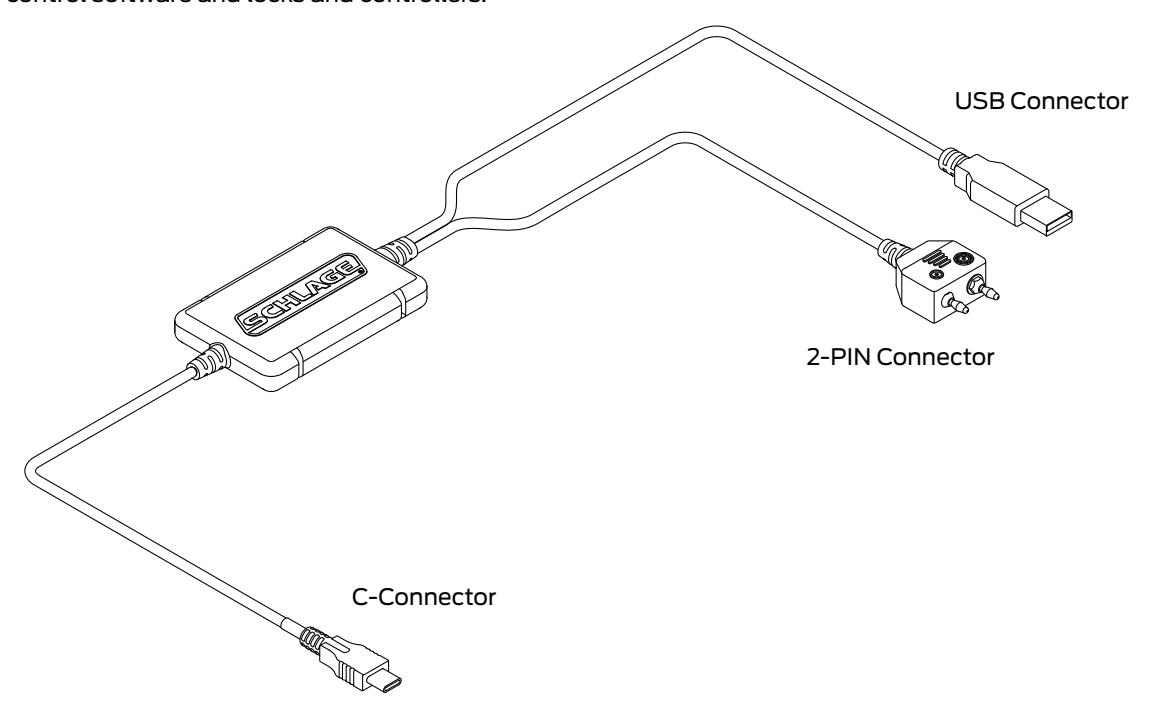
System Components
| ID | Description |
|---|---|
| SUS-A Cable |
Cable used to connect an Android device to AD- and CO-Series products. The legacy
products BE367 and FE210 are also supported. |
| Mobile Device |
The Android OS device, version 9 or higher with a type C connection, upon which the
SUS-A application has been installed. |
CAUTION
- Do not hang the mobile device or the lock from the cable connection.
- Carefully plug and unplug the mobile device and USB/2-PIN device connectors to prevent damage.
- Do not expose the cable to high heat (like the dash board of your work truck).
Install/Update Schlage Utility Software for Android

Download Schlage Utility Software for Android from the Google Play Store.
Logging In
Logging in for the first time
Once the application is downloaded, you must change default password.
- 1 Select User Type: Manager or Operator.
- 1 Enter Default Password: 123456
-
2
You will be prompted to enter a new password and confirm the new password.
- Î New password must not be a default password, subset or super set of default password.
- 3 You must log in again with User Type: Manager or Operator and new password.
Log in as a manager or operator
You can log in to the Schlage Utility Software for Android (SUS-A) as either a Manager or an Operator. The Manager role has access to all commands. The Operator role has access only to limited commands.
| Manager | Operator | |
|---|---|---|
| Lock Properties | • | • |
| Program Lock | • | • |
| Firmware Update | • | |
| Change Lock Class | • | |
| Couple mobile device to Device | • | |
| Set Date/Time | • | |
| Diagnostic Data Log | • | • |
| Door Properties | • | • |
| PIM properties | • | • |
| Demo Mode | • | |
| SUS Password | • | • |
| Coupling Password | • | |
| Language | • | • |
| Auto/Manual Update | • | • |
| List All/Pending Doors | • | • |
Connecting the Mobile Device
Î The mobile device must have file transfer via USB enabled to function properly. See Enable File Transfer on page 62 for more information.
The Schlage button will flash green while the lock is waiting to communicate with the mobile device. The Schlage button will begin to flash red when communication between the lock the mobile device is established.
When communication is established, the device name will be displayed on the SUS-A main screen.
AD-Series and CO-Series Locks
- 1 Start the Schlage Utility Software for Android (SUS-A).
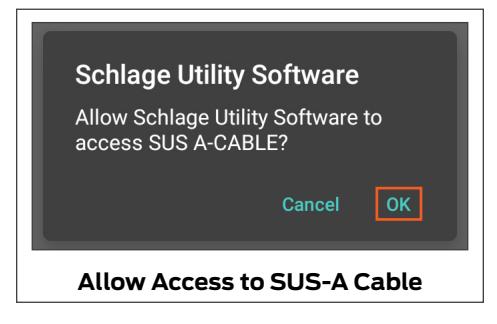
- 2 Connect the SUS-A Cable to the mobile device. A pop-up will appear, "Allow Schlage Utility Software to access SUS A-CABLE?" Click OK to continue.
- 3 Plug the SUS-A Cable into the lock's USB port located in the bottom of the exterior housing.
- 4 Press the Schlage button twice to begin communication.
AD-Series Controllers
- 1 Start the Schlage Utility Software for Android (SUS-A).
- 2 Connect the SUS-A Cable to the mobile device. A popup will appear, "Allow Schlage Utility Software to access SUS A-CABLE?" Click OK to continue.
- 3 Plug the SUS-A Cable into the controllers's USB port. Communication will begin automatically.
USB Connection
Legacy CM and CL Locks
- 1 Start the Schlage Utility Software for Android (SUS-A).
- 2 Connect the SUS-A Cable to the mobile device. A popup will appear, "Allow Schlage Utility Software to access SUS A-CABLE?" Click OK to continue.
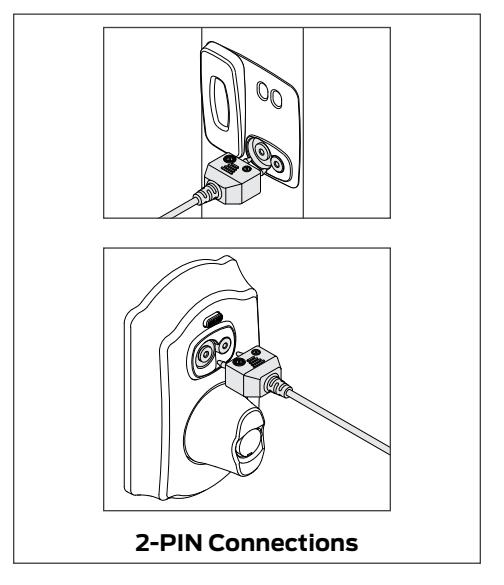
- 3 Plug the SUS-A Cable into the lock's 2-Pin connector.
- 4 Press the Schlage button twice to begin communication.
Legacy BE367 and FE210
- 1 Start the Schlage Utility Software for Android (SUS-A).
- 2 The deadbolt must be retracted if this is the first time programming the lock.
- 3 Connect the SUS-A Cable to the mobile device. A popup will appear, "Allow Schlage Utility Software to access SUS A-CABLE?" Click OK to continue.
- 4 Present the Red programming iButton to the lock.
-
5
Plug the SUS-A Cable into the lock's 2-Pin connector.
- Î If the lock does not connect and begin communication, the lock may have timed out. Present the red programming button again.
When you present the red programming fob, if the Schlage button lights red and then green one time, the cam is in the wrong position. See alle.co/BE367IS.
Before attempting to transfer files, Schlage Express must be set up and running on a PC.
The xx in the extension of a door file or audit file is the number of the door that represents the order in which the door was originally entered into Schlage Express.
Transferring Door and Audit Files
Schlage Express is used in conjunction with SUS-A. It is the application for PC that is used to set up users and access for a site, and then create door files for programming. Audit files are collected from the locks and devices using SUS-A or another legacy device, prior to SUS-A.
| Types of Files | ||
|---|---|---|
| File type | Extension | Purpose |
| Door files | .dxx |
Transfers user and access information from Schlage Express to a lock or
device via SUS-A. |
| capindex | .ndx |
Transfers the door names to the locks so they can be displayed for easy
reference during programming. |
| Audit files | .axx |
Transfers door audits to Schlage Express from a lock or device via
SUS-A. The numbers in the extension correspond to the door file with the same numbers. Only doors that were programmed will return an audit file. |
| uplink | .log | Tells Schlage Express which doors have been successfully updated. |
| Device Template | .dte |
Used to save device settings from one device and then copy them to
another device of the same type. Ensures each device has the same settings applied. |
| Device Data Log | .ddl |
AD-Series devices only: Captures the settings and status of the last 50
devices that the SUS has connected with. Used to check status and settings while offline and not connected with the device |
| n/a | .kxx |
These are system files that do not need to be transferred during
updates; they can be ignored. |
The mobile device must have file transfer via USB enabled to function properly. See Enable File Transfer on page 62 for more information.
* The SUS-A cable cannot be used to transfer files between the PC and the mobile device. A high-quality data transfer cable should be used.
To find the export folder on PC, go to Settings > Program Settings > Programming Tab. The option that is checked will show where the files generate.
Transfer Files from the PC to the Mobile Device for Programming
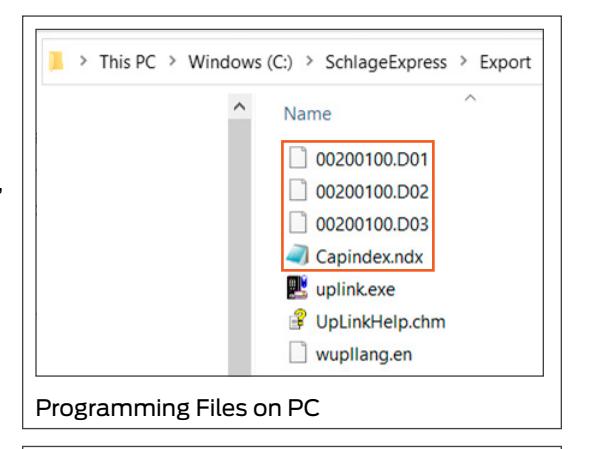
- 1 Navigate to the Export folder (usually C:\SchlageExpress\Export) on the PC. Copy the door files (*.dxx) and capindex.ndx file.
- 2 Connect the mobile device to the computer's USB port using a data transfer cable*.
- 3 Once the mobile device drive appears on the PC, locate the folder named Schlage Utility Software.
- 4 Paste the copied files to the folder on your mobile device.
Transfer Files from the Mobile Device to the PC after Programming
- 1 Connect the mobile device to the PC's USB port using a data transfer cable*.
- 2 Once the mobile device drive appears on the PC, navigate to the folder named Schlage Utility Software.
-
3
Copy the audit files (*.axx), uplink.log and capindex.ndx from Schlage Utility Software.
- Î There should be one audit file for each door that was programmed.
- 4 Navigate to the Export folder (usually C:\SchlageExpress\Export) on the PC. Paste the copied files into the folder.
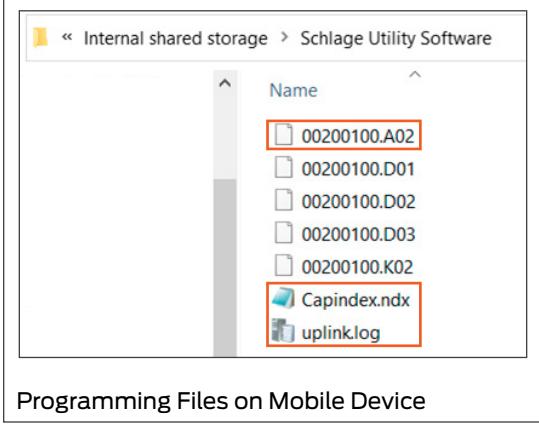
Transferring Device Template Export (.DTE) and Device Data log(.DDL) Files to PC
- 1 Connect the mobile device to computer's USB port using a data transfer cable*.
- 2 Once the mobile device drive appears on the PC, locate the folder named Schlage Utility Software.
- 3 Copy DTE/DDL files and paste it to a desired folder on the PC.
Updating Firmware
Firmware files can be downloaded and transferring to SUS-A using a PC, or by downloading them directly to the SUS-A
Download Firmware Files to SUS-A Using PC
- Î Choose this process or Download Firmware Files Directly to SUS-A . You do not need to do both.
- 1 Navigate to www.schlage.com/support .
- 2 Search for AD firmware.
- 3 Click on the latest firmware package in the list. The file will download to your PC. Note the location.
- 4 Extract the .zip file and note the location.
- 5 Connect the mobile device to computer's USB port using a data transfer cable*. Once the mobile device drive appears on PC, locate the folder named Schlage Utility Software.
- 6 Locate the extracted file (AD.A.xxx.ffp) and move it to the mobile device folder called Schlage Utility Software.
Download Firmware Files Directly to SUS-A
- Î Choose this process or Download Firmware Files to SUS-A Using PC . You do not need to do both.
- 1 Navigate to www.schlage.com/support .
- 2 Search for AD firmware.
- 3 Click on the latest firmware package in the list. The file will download to the mobile device.
- 4 Extract the .zip file and note the location.
- 5 Locate the extracted file (AD.A.xxx.ffp) and move it to the mobile device folder called Schlage Utility Software.
Interface Reference
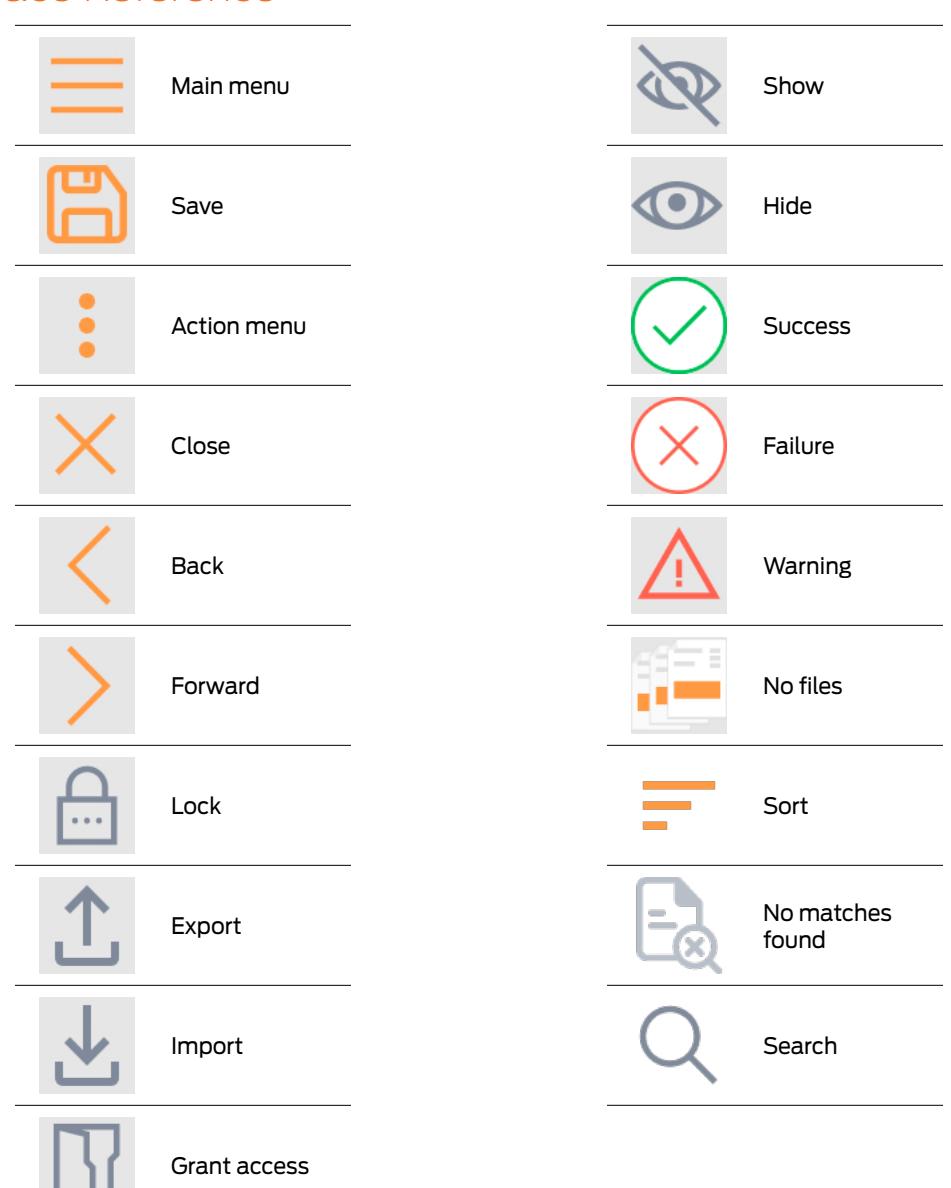
SUS-A Settings
Connection Examples
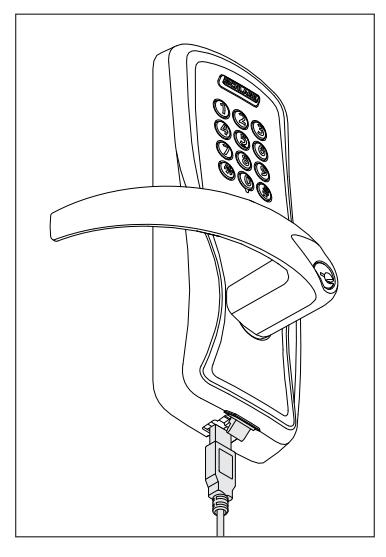
USB Connection
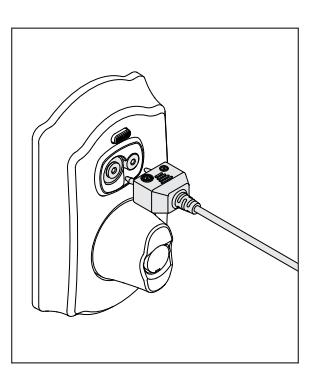
2-pin Connection
Audit Retrieval Mode
When Auto Update is selected, the SUS will automatically set the date and time in the lock to which it is connected, retrieve the audit and program the lock. When Manual Update is selected, the functions must be independently performed by the user.
- Î Manual Update is recommended when managing Legacy Locks.
- 1 Select .
- 2 Select Settings.
- 3 Use the toggle button next to Audit Retrieval Mode to choose Auto or Manual.
SUS Password
You must be logged in to a role to change the password for that role.
- 1 Select .
- 2 Select Settings.
- 3 Select SUS Password.
- 4 Enter the old password into the Old Password box.
-
5
Enter the new password into the New Password box.
- Î The new password must be between four (4) and eight (8) characters long and can include capital and lowercase characters, numbers, and symbols. It must not be a default password, subset or super set of default password at any point of time
- 6 Enter the new password again into the Confirm New Password box.
- 7 Select the Update button.
SUS-A Settings Coupling Password
This function is available only when logged into the mobile device as a manager.
The default Coupling Password is 123456.
Coupling Password

- 1 Select .
- 2 Select Settings.
- 3 Select Coupling Password.
- 4 Enter the old password into the Old Password box.
-
5
Enter the new password into the New Password box.
- Î The new password must be between four (4) and eight (8) characters long and can include capital and lowercase characters, numbers, and symbols. It must not be a default password, subset or super set of default password at any point of time
- 6 Enter the new password again into the Confirm New Password box.
- 7 Select Update.
Language
- 1 Select .
- 2 Select Language.
- 3 Select the desired language.
Import/Export Configuration Feature
The Import/Export Configuration feature facilitates creation, modification and duplication of Device Properties settings across multiple devices. In addition, the Import/Export Configuration will also report additional device status parameters for a complete summary of the device's health.
Locating the Import/Export Configuration Feature:
- 1 Select Device Options.
- 2 Select Lock Properties for the connected device.
- 3 Select the Edit or Reader tab
- 4 The Import/Export Configuration is at the bottom of the screen
- Î For details on the Import/Export Configuration feature, see Import/Export Configuration on page 68 .
Diagnostic Data Log Feature
This new feature provides a simple method for AD-Series customers to quickly gather and save important lock-status information in a file.
Î For details see Diagnostic Data Log on page 70 .
AD-Series Locks and Controllers
Supported Locks
All chassis for the following models are supported.
AD-Series Offline
AD-200
AD-Series Networked
AD-300 AD-301 AD-302 AD-400 AD-401 AD-402
Supported Controllers
PIM400 (Panel Interface Module) WRI400 (Wireless Reader Interface) WPR400 (Wireless Portable Reader) PIB300 (Panel Interface Board) CT5000 Controller
This function works with AD-Series devices only.
Couple mobile device to Lock
AD-Series locks can be coupled, or authenticated, with the mobile device. This provides enhanced security by ensuring that the lock will only communicate with mobile device(s) to which it has been coupled. Once the lock has been coupled, the Coupling Password is passed to the device from the mobile device during programming.
- Î mobile devices with the same coupling password can program the same devices. Once the mobile device and lock are coupled, the coupling password is disabled in the lock and any mobile device with the correct coupling password will automatically couple with the lock.
- 1 Connect the mobile device to the lock using the SUS-A cable.
- 2 Press the Schlage button twice. The lock will be displayed on the screen.
- 3 On the mobile device, select Device Options.
- 4 Remove the top inside lock cover.
- 5 Press and hold the Inside Push button. Then press and release the tamper switch three times.
- 6 Release the Inside Push button. On the lock, the Inside Push button LED will illuminate.
- 7 On the mobile device, select Couple mobile device to Device.
- 8 When Coupling is successful, a message will be displayed on the screen.
The mobile device will use a default Coupling Password (123456) when coupling with a device. The Coupling Password should be changed to provide increased security for your locks. See Coupling Password on page 14 for more information.
If a device is not in Coupling mode, SUS-A will display a device specific message with instructions for placing the device into Coupling mode.
This function works with AD-Series devices only.
The mobile device will use a default Coupling Password (123456) when coupling with a device. The Coupling Password should be changed to provide increased security for your locks. See Coupling Password on page 14 for more information.
If a device is not in Coupling mode, SUS-A will display a device specific message with instructions for placing the device into Coupling mode.
This function works with AD-Series devices only.
The mobile device will use a default Coupling Password (123456) when coupling with a device. The Coupling Password should be changed to provide increased security for your locks. See Coupling Password on page 14 for more information.
If a device is not in Coupling mode, SUS-A will display a device specific message with instructions for placing the device into Coupling mode.
Couple mobile device to PIM400 or PIB300
AD-Series devices can be coupled, or authenticated, with the mobile device. This provides enhanced security by ensuring that the device will only communicate with mobile device(s) to which it has been coupled. Once the device has been coupled, the coupling password is passed to the device from the mobile device during programming.
- Î mobile devices with the same coupling password can program the same devices. Once the mobile device and the device are coupled, the coupling password is disabled in the PIM400 or PIB300 and any mobile device with the correct coupling password will automatically couple with the PIM400 (or PIB300).
- 1 Remove the PIM400 or PIB300 cover.
- 2 Connect the mobile device to the PIM400 or PIB300 using the SUS-A cable. The PIM400 or PIB300 will be displayed on the mobile device screen.
- 3 On the mobile device, select Device Options.
- 4 On the PIM400 or PIB300, press and hold the LINK 1 button. Then press the LINK 2 button three times.
- 5 On the mobile device, select Couple mobile device to Device.
- 6 When Coupling is successful, a message will be displayed on the mobile device screen.
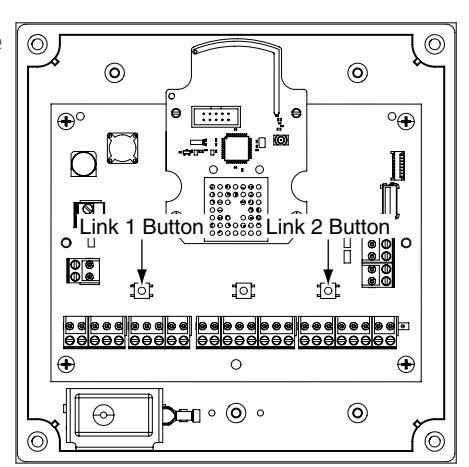
Couple mobile device to WRI400/CT5000
The WRI400/CT5000 can be coupled, or authenticated, with the mobile device. This provides enhanced security by ensuring that the device will only communicate with mobile device(s) to which it has been coupled. Once the device has been coupled, the programming password is passed to the device from the mobile device during programming.
- Î mobile devices with the same programming password can program the same devices. Once the mobile device and the device are coupled, the coupling password is disabled in the WRI400/ CT5000 and any mobile device with the correct coupling password will automatically couple with the WRI400/CT5000.
- 1 Remove the device cover.
- 2 Connect the mobile device to the device using the SUS-A cable. The name of the device will be displayed on the mobile device screen.
- 3 On the mobile device, select Device Options.
- 4 On the WRI400/CT5000, press and hold the Schlage button. Then press the LINK button three times within five (5) seconds. Then release both buttons.
- 5 On the mobile device, select Couple mobile device to Device.
- 6 When Coupling is successful, a message will be displayed on the mobile device screen.
Program a Lock or Controller
Offline Locks
- 1 Connect the mobile device to the lock or controller and establish communication between the mobile device and the device.
- 2 Select Device Options.
- 3 Select Program Lock.
-
4
Select the door file that should be associated with the lock or controller.
- Î Door files are downloaded to the mobile device when synchronized with the access control software.
- 5 Select OK.
Online Locks
Î NOTE: This function is not applicable to online locks.
Collect Audits and Update Lock
When Auto Update is enabled, as soon as the Schlage button is pressed twice and the communication with the Schlage Utility Software starts, the lock will automatically:
- update lock's date/time
- collect audits
- update access rights
When Manual Update is enabled, follow the steps below to collect audits and update the lock access rights.
Î See Audit Retrieval Mode on page 13 for more information.
Collect Audits when Date/Time and Lock Access Rights are Up-to-Date
-
1
Confirm mobile device is connected to lock.
- Î See Connecting the Mobile Device on page 9 for more information.
- 2 Double-click the displayed name of the connected lock.
-
3
The audit collection will begin.
- Î If no previous audit exists, skip to step 7.
- 4 If a previous audit exists, a message will appear asking to overwrite previous audit. Click YES to override audits and skip to step 7.
- 5 Click NO if you do not want to override the audit.
- 6 Acknowledge the message advising to synchronize the lock with system software. Audit collection will be stopped.
- 7 A progress indicator will be displayed while the audit is being collected. A message will be displayed once the process is complete.
Collecting audits on the mobile device does not delete the audits from a lock.
Collected audits will be transferred from mobile device to your Access Control Software the next time they are synchronized.
Collect Audits when Date/Time and Lock Access Rights are Not Up-to-Date
-
Confirm mobile device is connected to lock.
- Î See Connecting the Mobile Device on page 9 for more information.
- Double-click the displayed name of the connected lock.
- When asked to update date and time of the device, click YES. A progress indicator will be displayed while date and time is being updated.
- A message will appear to confirm the successful update.
- The audit collection will begin. A progress indicator will be displayed while the audit is being collected.
- The access rights update will begin. A progress indicator will be displayed while lock is being updated.
- A message will be displayed once the process is complete.
Device Information
- Connect the mobile device to the lock or controller.
- Select Device Settings.
- Select Device Information for the connected device.
-
The View tab will be displayed.
- Î See Lock Properties on page 22 for more information.
Lock Configuration
- Connect the mobile device to the device.
- Select Device Settings.
- Select Device Configuration for the connected device.
- Select the Lock tab.
-
Edit the properties as desired.
- Î See Lock Properties on page 22 for more information.
- Select Save to update and save the changes.
Reader Configuration
- Connect the mobile device to the device.
- Select Device Settings.
- Select Device Configuration for the connected device.
- Select the Reder tab.
-
Edit the properties as desired.
- Î See Lock Properties on page 22 for more information.
- Select Save to update and save the changes.
Put PIM400 into Link Mode
- 1 Connect the mobile device to the PIM400.
- 2 Select Device Options.
- 3 Select PIM Properties for the connected device.
- 4 Select the Link tab.
-
5
Select the door number from the drop-down box.
- Î See the system administrator for the proper door number selection.
- 6 The PIM400 will stay in link mode for up to 30 minutes.
-
7
Put the lock (door) into link mode.
- Î See the user guide that came with the lock for more information.
- 8 The PIM400 will automatically exit link mode once linking is complete.
Put PIM400 into Demo/Diagnostic Mode
- 1 Connect the mobile device to the PIM400 and select Device Options.
-
2
Select Demo mode and then select the door number from the drop-down box.
- Card Data box: shows card data from credential when card presented to reader.
- Unlock on Read: if enabled allows the door to be unlocked upon the reading of a card: the OEM has the ability to disable this feature (grayed out).
Update Firmware
Î See Updating Firmware on page 11 for more information.
Diagnostic Data Log Feature
This new feature provides a simple method for AD-Series customers to quickly gather and save important lock-status information in a file. See Diagnostic Data Log on page 70 for more information.
AD-Series Readers
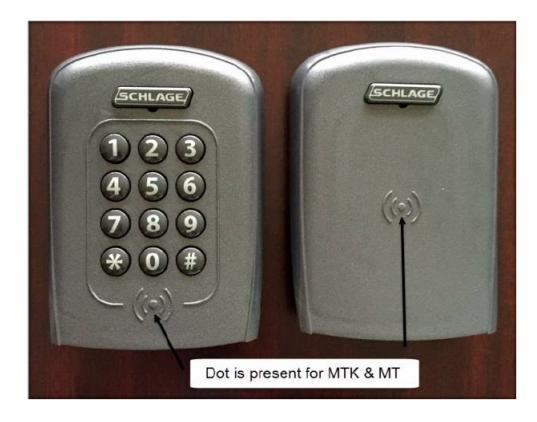
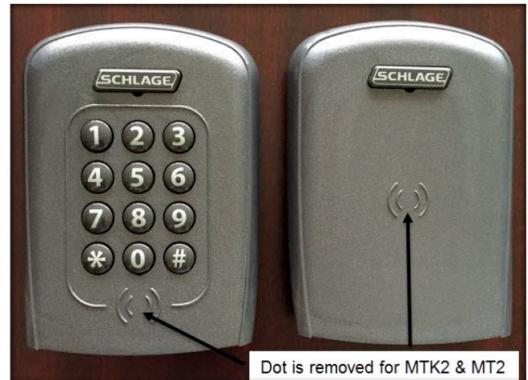
Î Note: (Multi-Tech, Multi-Tech + Keypad) and (iClass + Multi-Tech, iClass + Multi-Tech + Keypad) and (FIPS + Multi-Tech +Keypad) and (Keypad) readers are being discontinued (1st half 2016) and replaced by the (Multi-Tech 2, Multi-Tech + Keypad 2) and (FIPS + Multi-Tech +Keypad 2) and (Keypad 2) readers that provide all the same functionality as the original readers
The Multi-Tech and Multi-Tech + Keypad readers will read both proximity and smart cards. The Proximity, Proximity + Keypad ONLY and Smart Card, Smart Card + Keypad ONLY readers have been discontinued and replaced by the MultiTech, Multi-Tech + Keypad readers that provide all the same functionality as the original Proximity and Smart card readers in a single credential reader.
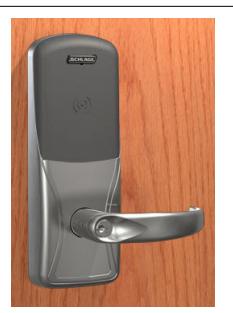

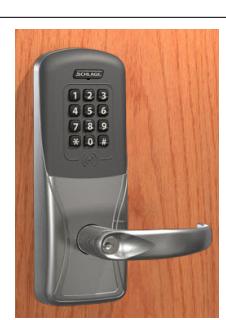
Multi-Tech Multi-Tech + Keypad
The MiK and SiK2 readers are both a solution for applications using the HID iClass smart card credential. iCLASS® is a proprietary smart card technology developed by HID that operates on ISO 15693. In order to support these requirements, iClass + Multi-Tech + Keypad reader were integrated to create the (MiK) and (SiK2). (SiK2) is not capable of reading Proximity credentials.
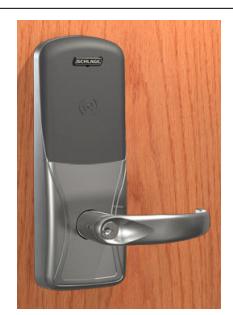
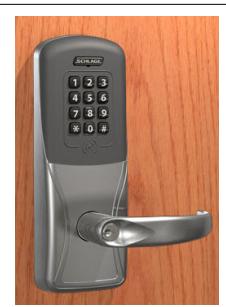
iClass + Multi-Tech iClass + Multi-Tech + Keypad
The FMK reader module is for applications which require approval by the U.S. Federal Government under HSPD-12 for FIPS 201 compliance. In order to meet these requirements, FIPS + Multi-Technology + Keypad reader were integrated to create the (FMK).
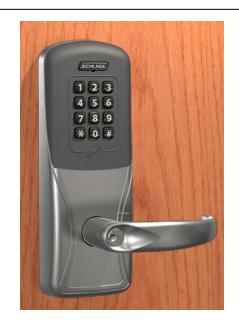
FIPS + Multi-Tech + Keypad
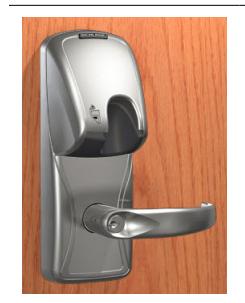
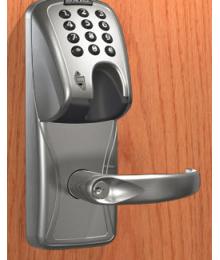
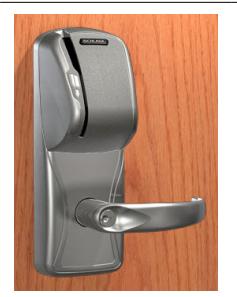
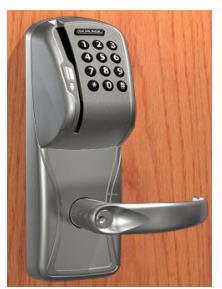
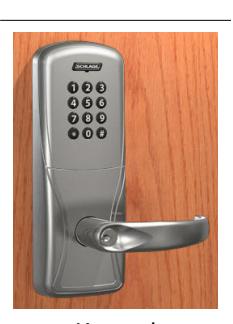
MagInsert MagInsert + Keypad
MagSwipe MagSwipe + Keypad
Keypad
Reader Types
| Reader Description | Reader Type Shown in SUS-A |
|---|---|
| Mag Insert with Keypad | MagInsert + Keypad |
| Mag Insert without Keypad | MagInsert |
| Mag Swipe with Keypad | MagSwipe + Keypad |
| Mag Swipe without Keypad | MagSwipe |
| Keypad Only | Keypad |
| Prox with Keypad | Proximity + Keypad |
| Prox without Keypad | Proximity |
| Smart with Keypad | Smart Card + Keypad |
| Smart without Keypad | Smart Card |
| FMK Reader | FIPS + Multi-Tech + Keypad |
| MT | Multi-Tech |
| MTK | Multi-Tech + Keypad |
| Mi | iClass + Multi-Tech |
| MiK | iClass + Multi-Tech + Keypad |
| MT2 | Multi-Tech 2 |
| MTK2 | Multi-Tech 2 + Keypad |
| FMK2 | FIPS + Multi-Tech 2 + Keypad |
| KP2 | Keypad 2 |
| Si2 | iClass + Smart Only 2 |
| SiK2 | iClass + Smart Only 2 + Keypad |
Lock Properties
- AD-200/250 (Offline Locks): pg 22
- AD-300/AD301/AD-302 (Networked Locks): pg 26
- AD-400/AD-401/AD-402 (Networked Locks): pg 30
AD-200/250 (Offline Locks)
| Description | |||||||
|---|---|---|---|---|---|---|---|
| The name of the Lock. Set by the door file programmed into the lock. | |||||||
| Current date and time. Initialized/set by the mobile device. | |||||||
| Model number of the device connected to the mobile device. | |||||||
| Number of Users supported by the lock (AD-200). | |||||||
| Number of void users supported by the lock (AD-250). | |||||||
| Current voltage level of the AA and Coin Cell batteries. Number of AA batteries connected to the lock. | |||||||
| Number of one time use PIN codes supported by the lock (AD-250). | |||||||
| Serial number that uniquely identifies the lock. | |||||||
| Date the lock was manufactured. | |||||||
| Used for warranty purposes; it marks the beginning of the lock's functional life. | |||||||
| Version of the current firmware file. Automatically updated when a new firmware version is loaded. | |||||||
| Current version of the printed circuit main board. | |||||||
| Version of the current bootloader. Allows new firmware to be loaded. | |||||||
| Serial number that uniquely identifies the reader. | |||||||
| Date the reader was manufactured. | |||||||
| Version of the current firmware file. Automatically updated when a new firmware version is loaded. | |||||||
| Applicable only for MTK2, FMK2 and SIK2. Current firmware version of the card detection module. | |||||||
| Current version of the printed circuit credential board. | |||||||
| Version of the current bootloader. Allows new firmware to be loaded. | |||||||
|
Type of Reader installed:
• MagInsert • Smart Card + Keypad • Multi-Tech 2 + Keypad • MagInsert + Keypad • Multi-Tech • FIPS + Multi-Tech 2 + Keypad • MagSwipe • Multi-Tech + Keypad • Keypad 2 • MagSwipe + Keypad • FIPS + Multi-Tech + Keypad • iClass + Smart Only 2 • Keypad • iClass + Multi-Tech • iClass + Smart Only 2 + • Proximity • iClass + Multi-Tech + Keypad Keypad • Proximity + Keypad • Multi-Tech 2 • Smart Card |
|||||||
AD-200/250 (Offline Locks)
| Property | Description | Default |
|---|---|---|
| Lock Type |
Classroom: Unlocks when a credential is presented and then automatically locks
after the relock delay has expired. |
Set by the
Factory |
|
Office: Unlocks when a credential is presented and then automatically locks after the
relock delay has expired. To keep the door unlocked, push the button on the inside. The button will momentarily illuminate green. To return the lock to the locked state, push the button again or present a credential to the outside. |
||
|
Privacy: To initiate the Privacy function, with the door closed, push the button on the
inside of the door. This prevents normal credentials from opening the door from the outside. |
||
|
•
The lock will go back to its normal state when the button is pushed again or when the door position switch indicates that the door has opened. |
||
|
•
When using a Mortise Deadbolt, extending the deadbolt from the inside lights a red LED on the inside trim and initiates the Privacy function which prevents normal credentials from opening the door from the outside. The lock can always be opened using a Pass-Through credential or mechanical key in case of emergency. |
||
|
Apartment: The apartment function lock is normally locked and never relocks
automatically, which prevents users from being locked out. |
||
|
•
To unlock the door from the outside, present a credential. |
||
|
•
To unlock the door from the inside, push the inside button or, if using the MD chassis, retract the deadbolt. Egress always available from inside. |
||
|
•
When lever is rotated and door is opened, the request-to-exit switch is used in conjunction with the door position switch to cause the door to return to unlocked condition. |
||
|
•
To lock the door from the outside, present a credential. |
||
|
•
To lock the door from the inside, push the inside button or, for MD chassis, extend the deadbolt. |
||
|
PIN Length
(AD-200 only) |
Maximum number of digits in the user PIN. Range of 3 to 6 digits. | 6 |
|
Allow Privacy Mode
Override (AD-250 only) |
When enabled, allows cards to override a lock that has been placed in privacy mode.
When disabled, only cards specifically assigned to this door will have access. |
Disabled |
| Ignore Keypad | If checked, key entry codes are ignored. | Disabled |
| Record Lock/Unlock |
If checked and supported by the system software, will record an audit event when the
Inside Push button is pressed. |
Disabled |
| IPB Control |
User can select any one IPB functionality from the options:
Normal Operation: This option is used to disable all other IPB Control configurations. This is the default option for IPB control configurations. This configuration is available on AD-200 and AD-250. |
Normal
Operation |
|
Disable Interior LED Status Blinking: This will disable the interior LED's status
blinking. This configuration is available on AD-200 and AD-250. |
||
|
Blink Interior Button LED when locked: The IPB will flash every 15 seconds for the
first 10 minutes; it will then flash every 30 seconds for the next 50 minutes; and it will then flash every minute after 1 hour. If a door actuation occurs, then the process is restarted. This configuration is available on AD-200 and AD-250. |
||
|
Blink Interior LED Rapidly when in Privacy Mode: Interior LED will flash rapidly while
privacy mode is enabled. This configuration is available on AD-200 and AD-250. |
||
|
Occupancy Indicator Fast Blink: If selected, Occupancy Indicator Fast Blink is
enabled on the lock. This configuration is only available on AD-200. |
||
|
Occupancy Indicator Slow Blink: If selected, Occupancy Indicator Slow Blink is
enabled on the lock. This configuration is only available on AD-200. |
||
|
Offline Lockdown Mode: If selected, Offline Lockdown Mode is enabled on the lock.
This configuration is only available on AD-200. |
| AD-200/250 (Offline Locks) |
|---|
| Battery Fail Mode | Lock state set when battery fails. As-Is, Secure/Locked, Unsecure/Unlocked | As-Is | ||
|---|---|---|---|---|
| EDIT Tab | Relock Delay |
Amount of time before the lock relocks after being unlocked by a user presenting a
valid credential. |
3 | |
| ADA Delay |
Amount of time before the lock relocks after being unlocked by a user who is flagged
as handicapped and presenting a valid credential. Can be changed in the access control system. |
30 | ||
| Property | Description | Default | ||
|
Prox in Use
(AD-200 only) |
Proximity credential card types allowed. Selections:
• HID/Kantech • GE/CASI ioProx* • GE4001 • GE4002* |
•
AWID* |
* Default
formats |
|
| Mag Track in Use |
Magnetic card track that access data is to be read from. Track 1, 2 or 3.
Track 1 not configurable for AD-200. |
Track 2 | ||
|
Enable Low Power
Wake-Up |
Active when Mag Track 1 or 3 is selected in "Mag Track in Use". By enabling Low Power
Wake-Up and recording data on track 2, this option will allow longer battery life. |
Enabled | ||
| READER Tab |
Smart Cards in Use
(AD-200 only) |
Smart card(s) to be used with the card reader.
• 14443 UID(CSN) (when selected, disables all other 14443 selections and PIV format) • 14443 Secure MiFare Classic* MTK1 • iClass credential formats for Reader Types which support Smart Cards • iClass 40-bit UID (CSN) • iClass 64-bit UID (CSN)* • HID iClass Classic* (only appears with Mi/MiK reader attached) • PIV credential formats for AD200 reader types which support Smart Cards. Range is 1 to 15. 1. 75 Bit PIV* 2. 58 Bit TWIC/CAC 3. 200 Bit FASC–N 4. 64 Bit (BCD) TWIC/CAC 5. 83 Bit TWIC/CAC 6. 66 Bit (58 Bit Format + TSM) TWIC/CAC 7. 64 Bit (58 Bit Format (no parity) + TSM) TWIC/CAC MTK2 • iClass/Felica credential formats for Reader Types which support Smart Cards • iClass/Felica 40-bit UID (CSN) • iClass/Felica 64-bit UID (CSN)* • HID iClass/iClass SE/iClass SEOS (only appears with Si2/SiK2 reader attached). Enabled by default. • PIV credential formats for AD200 reader types which support Smart Cards. Range is 1 to 15. 1. 75 Bit PIV* 2. 58 Bit TWIC/CAC 3. 200 Bit FASC–N 4. 64 Bit (BCD) TWIC/CAC 5. 83 Bit TWIC/CAC 6. 66 Bit (58 Bit Format + TSM) TWIC/CAC |
•
14443 Secure MiFare Plus* • 14443 EV1 (NOC)* • 15693 UID (CSN)* 8. 91 Bit (83 Bit Format + TSM) TWIC/ CAC 9. 40 Bit BCD 10. 40 Bit Reversed BCD 11. 64 Bit BCD 12. 64 Bit Reversed BCD 13. 128 Bit BCD 14. 128 Bit Reversed BCD 15. 58 Bit HSE 8. 91 Bit (83 Bit Format + TSM) TWIC/ CAC 9. 40 Bit BCD 10. 40 Bit Reversed BCD 11. 64 Bit BCD 12. 64 Bit Reversed BCD 13. 128 Bit BCD |
* Default
formats |
| AD-200/250 (Offline Locks) | |||||||
|---|---|---|---|---|---|---|---|
| Beeper | Indicates if the Beeper is on or off. | ON | |||||
| Apple NFC | MTK2, FMK2 and SIK2 only | Disabled | |||||
| TRA Security | (unchecked) | ||||||
| READER Tab |
Increased Card Read
Attempts |
||||||
| Property | Description | ||
|---|---|---|---|
| General Properties | |||
| Model | Model number of the device connected to the mobile device. | ||
| Power Status | Shows current auxiliary power status of OFF/ON. | ||
|
FIPS201-2 Capable
(AD-302 only) |
FIPS201-2 Capable or not. | The Yes or No value for this field indicates whether the device (i.e. Lock/Reader combination) is | |
| Main Lock | |||
| RS485 Partner ID | Identifies the participating OEM software partner. | ||
| Serial Number | Serial number that uniquely identifies the lock. | ||
| Manufacture Date | Date the lock was manufactured. | ||
| Days Since Installed | Used for warranty purposes; it marks the beginning of the lock's functional life. | ||
| Firmware Version | Version of the current firmware file. Automatically updated when new firmware file is loaded. | ||
| Hardware Version | Current version of the printed circuit main board. | ||
| Bootloader Version | Version of the current bootloader. Allows new firmware to be loaded. | ||
| Credential Reader | |||
| Serial Number | Serial number that uniquely identifies the reader. | ||
| Manufacture Date | Date the reader was manufactured | ||
| Firmware Version | Version of the current firmware file. Automatically updated when new firmware file is loaded. | ||
|
Card Detection
Firmware Version |
Applicable only for MTK2, FMK2 and SIK2. Current firmware version of the card detection module. | ||
| Hardware Version | Current version of the printed circuit main board. | ||
| Bootloader Version | Version of the current bootloader. Allows new firmware to be loaded. | ||
| Reader Type |
Type of Reader installed:
• MagInsert • MagInsert + Keypad • MagSwipe • MagSwipe + Keypad • Keypad • Proximity • Proximity + Keypad • Smart Card • Smart Card + Keypad • Multi-Tech • Multi-Tech + Keypad • FIPS + Multi-Tech + Keypad |
•
iClass + Multi-Tech + Keypad • Multi-Tech 2 • Multi-Tech 2 + Keypad • FIPS + Multi-Tech 2 + Keypad • Keypad 2 • iClass + Smart Only 2 • iClass + Smart Only 2 + Keypad |
|
| Custom Key |
•
iClass + Multi-Tech Key: Installed" or "Custom Key: Not Installed" |
If the reader supports reporting the status of custom configuration then SUS-A displays "Custom | |
| Property | Description | Default | |
|---|---|---|---|
| RS485 Address | Set the RS-485 network address of the lock. 0-255 | 0 | |
| ACP Timeout |
Time (in seconds) to wait before determining communication from the ACP has
failed. |
3 seconds | |
| Comm Loss Fail Mode |
Lock state set when communication from the ACP fails. As-Is, Secure/Locked,
Unsecure/Unlocked |
As-Is | |
| Power Fail Mode |
Lock state set when power to the lock fails. As-Is, Secure/Locked, Unsecure/
Unlocked |
As-Is | |
|
Degraded (Cache)
Mode: Card Bit Format* |
Enter the number of bits on the cards being used to enable degraded mode.
abilities. 0 = cache mode disabled |
0 | |
|
Degraded (Cache)
Mode: Full Card Number or Facility Code* |
Use the full card number or the facility codes of previously approved credentials in
the Degraded (Cache) mode. Granting access is determined by "Full Card" content or just "Facility Code". |
Full Card | |
|
Degraded (Cache)
Mode: Purge unused after 5 days* |
When enabled, deletes the cache entry after 5 days of non-use. If enabled, cards
that have not accessed the lock within 5 days will be removed. |
Disabled | |
|
Degraded (Cache)
Mode: Clear Cache* |
Deletes all valid user credentials from the Degraded (cache) memory. Allows you to
manually clear cache memory. |
n/a | |
| EDIT Tab | Max Entries Stored* |
Number of credential cards or facility codes maintained in the cache. Minimum of
5, Maximum of 1000. |
125 |
|
Disable Interior Button
LED |
If checked, interior button LED blinking is disabled. |
LED is
Enabled (unchecked) |
|
| Relock Delay |
Amount of time before the lock relocks after being unlocked by a user presenting a
valid credential. |
3 seconds | |
|
Relatch After:
Timer/Door Status |
Re-latch on:
• Timer Only (Lock when timer expires regardless of Door status or Position) • On Door Open or Timer (Lock when the Door opens or Timer expires) • On Door Close or Timer (Lock when the Door closes or Timer expires) |
Timer only | |
| Card + PIN LED mode |
Disabled
Mode 1: 2 alternating blinks Mode 2: Solid Green/2 red blinks |
1 | |
| Communication Link |
Direct to Host: Sets RS-485 communication protocol to work directly with an ACP.
Through PIB300: Sets RS-485 communication protocol through the PIB300. |
Direct to Host | |
|
FIPS201-2
Authentication |
This checkbox will allow the user to choose whether to perform the full FIPS201-2
authentication for PIV credentials. Also, since this operation is not applicable on all lock types, it appears Grayed out (un-editable) for the following lock types: AD-300, AD-301. |
unchecked |
* AD-302 does not support Cache mode; these options will be grayed out.
| Property | Description | Default | ||
|---|---|---|---|---|
| Prox in Use |
Proximity credential card types allowed. Selections:
• HID/Kantech • GE/CASI ioProx* • GE4001 • GE4002* |
•
AWID* |
* Default
formats |
|
| Mag Track in Use | Magnetic card track that access data is to be read from. Track 1, 2 or 3 | Track 2 | ||
|
Enable Low Power
Wake-Up |
Active when Mag Track 1 or 3 is selected in "Mag Track in Use". By enabling Low
Power Wake-Up and having data on track 2, this option will allow longer battery life. (Available only on battery-powered locks.) |
Enabled | ||
| READER Tab | Smart Cards in Use |
Smart card(s) to be used with the card reader.
• 14443 UID(CSN) (when selected, disables all other 14443 selections and PIV format) • 14443 Secure MiFare Classic* • 14443 Secure MiFare Plus* • 14443 EV1 (NOC)* • 15693 UID (CSN)* MTK1 • iClass credential formats for Reader Types which support Smart Cards • iClass 40-bit UID (CSN) • iClass 64-bit UID (CSN)* • HID iClass Classic* (only appears with Mi/MiK reader attached) • PIV credential formats for AD200 reader types which support Smart Cards. Range is 1 to 15. 1. 75 Bit PIV* 2. 58 Bit TWIC/CAC 3. 200 Bit FASC–N 4. 64 Bit (BCD) TWIC/CAC 5. 83 Bit TWIC/CAC 6. 66 Bit (58 Bit Format + TSM) TWIC/CAC 7. 64 Bit (58 Bit Format (no parity) + TSM) TWIC/CAC MTK2 • iClass/Felica credential formats for Reader Types which support Smart Cards • iClass/Felica 40-bit UID (CSN) • iClass/Felica 64-bit UID (CSN)* • HID iClass/iClass SE/iClass SEOS (only appears with Si2/SiK2 reader attached). Enabled by default. • PIV credential formats for AD200 reader types which support Smart Cards. Range is 1 to 15. 1. 75 Bit PIV* 2. 58 Bit TWIC/CAC 3. 200 Bit FASC–N 4. 64 Bit (BCD) TWIC/CAC 5. 83 Bit TWIC/CAC 6. 66 Bit (58 Bit Format + TSM) TWIC/CAC 7. 64 Bit (58 Bit Format (no parity) |
8. 91 Bit (83 Bit Format + TSM)
TWIC/CAC 9. 40 Bit BCD 10. 40 Bit Reversed BCD 11. 64 Bit BCD 12. 64 Bit Reversed BCD 13. 128 Bit BCD 14. 128 Bit Reversed BCD 15. 58 Bit HSE 8. 91 Bit (83 Bit Format + TSM) TWIC/CAC 9. 40 Bit BCD 10. 40 Bit Reversed BCD 11. 64 Bit BCD 12. 64 Bit Reversed BCD 13. 128 Bit BCD 14. 128 Bit Reversed BCD |
* Default
formats |
| Beeper | Indicates if the Beeper is On or Off. | ON | |
|---|---|---|---|
| Apple NFC | MTK2, FMK2 and SIK2 only | Disabled | |
| TRA Security | (unchecked) | ||
|
Increased Card Read
Attempts |
|||
| Keypad: Output Type | Wiegand or Magnetic output type. | Wiegand | |
| Keypad: Facility Code |
A facility or site code is encoded into each card to increase security.
A number from 0 to 255 on a 26-bit format card. |
1 | |
| Keypad: Keys Buffered |
Fixed number of key presses to buffer. Range in 1 to 11. Active only in keypad output
modes that support buffered key presses. See Output formats 4, 6, 9 and 10 below. |
4 | |
| READER Tab | Keypad: Output Format |
Sets the keypad data length and format mode. Range is 0 to 12.
0. Disable Keypad output 1. Mode 1: 4 Data Bits per Key without Parity (high nibble) 2. Mode 2: 4 Data Bits per Key with Parity 3. Mode 3: 8 Data Bits per Key without Parity 4. Mode 4: 8 Data Bits per Key with Parity 5. Mode 5: 4 Data Bits per Key, Buffered Key Presses without Parity 6. Mode 6: 4 Data Bits per Key, Buffered Key Presses with Parity 7. Mode 7: 26 Bit Wiegand Emulation 8. Mode 8: 4 Data Bits per Key without Parity (low nibble) 9. Mode 9: IR, 4 Data Bits per Key, Buffered Key Presses without Parity 10. Mode 10: IR, 4 Data Bits per Key, Buffered Key Presses with Parity 11. Mode 11: 8 Data Bits per Key, ASCII with parity 12. Mode 12: 32 Bit Wiegand Emulation |
1 |
| Property | Description | ||||
|---|---|---|---|---|---|
| General Properties | |||||
| Model | Model number of the device connected to the mobile device. | ||||
| Power Status | Current voltage level and number of AA batteries. | ||||
|
FIPS201-2 Capable
(AD-402 only) |
The Yes or No value for this field indicates whether the device (i.e. Lock/Reader combination) is
FIPS201-2 Capable or not. |
||||
| Main Lock | |||||
| RS485 Partner ID | Identifies the participating OEM software partner. | ||||
| Serial Number | Serial number that uniquely identifies the lock. | ||||
| Manufacture Date | Date the lock was manufactured. | ||||
| Days Since Installed | Used for warranty purposes; it marks the beginning of the lock's functional life. | ||||
| Firmware Version | Version of the current firmware file. Automatically updated when new firmware file is loaded. | ||||
| Hardware Version | Current version of the printed circuit main board. | ||||
| Bootloader Version | Version of the current bootloader. Allows new firmware to be loaded. | ||||
| W Tab | Credential Reader | ||||
| Serial Number | Serial number that uniquely identifies the reader. | ||||
| Manufacture Date | Date the reader was manufactured. | ||||
| Firmware Version | Version of the current firmware file. Automatically updated when new firmware file is loaded. | ||||
| Hardware Version | Current version of the printed circuit credential board. | ||||
| VIE |
Card Detection
Firmware Version |
Applicable only for MTK2, FMK2 and SIK2. Current firmware version of the card detection module. | |||
| Bootloader Version | Version of the current bootloader. Allows new firmware to be loaded. | ||||
| Reader Type |
Type of Reader installed:
• MagInsert • FIPS + Multi-Tech + Keypad • MagInsert + Keypad • iClass + Multi-Tech • MagSwipe • iClass + Multi-Tech + Keypad • MagSwipe + Keypad • Multi-Tech 2 • Keypad • Multi-Tech 2 + Keypad • Proximity • FIPS + Multi-Tech 2 + Keypad • Proximity + Keypad • Keypad 2 • Smart Card • iClass + Smart Only 2 • Smart Card + Keypad • iClass + Smart Only 2 + Keypad • Multi-Tech • Multi-Tech + Keypad |
||||
| Custom Key |
If the reader supports reporting the status of custom configuration then SUS-A displays "Custom
Key: Installed" or "Custom Key: Not Installed" |
||||
| Communication | |||||
| Serial Number | Serial number that uniquely identifies the communication module. | ||||
| Firmware Version | Version of the communication module firmware. | ||||
1. These properties are view-only when the mobile device is connected to the lock. Connect the mobile device to the PIM400 to make changes.
| Property | Description | Default |
|---|---|---|
| Heartbeat |
The heartbeat is a brief communication from the lock to the PIM400. It allows an
idle lock to check for messages. Range: 15 seconds - many hours. |
10 minutes |
|
The value indicates the time between the heartbeats. Set to a shorter time (lower
number) for more frequent communication. Set to a longer time (higher number) for less frequent communication. A smaller value will decrease battery life. A larger value will increase battery life. |
||
| Comm Loss Fail Mode |
Lock state set when RF communication with the linked PIM400 fails.
States: As-Is, Secure/Lock, Unsecure/Unlock |
As-Is |
|
Allow Extended Unlocks
(Locks linked to PIM400-TD2 only) |
Extended unlock permits the lock to stay in an indefinite unlock state.
Enabling the Extended Unlock feature is required to implement a scheduled unlock period from an ACP. |
Enabled |
|
Report RTX for Host to
unlock1 |
Determines how an AD-400 will handle a request to exit.
If disabled, the AD-400 will only report that a request to exit has occurred. Disable if the access point does not need to be electronically unlocked to provide egress (if equipped with a crash bar) but the access control panel needs to be notified so that a forced door does not occur. If enabled, the AD-400 will report that a request to exit has occurred, and also will query the PIM400 to determine if the AD-400 should be electronically unlocked. Use this mode if the AD-400 needs to be electronically unlocked in order to provide egress. |
Disabled
Timer only Low: RTX Low: RTE High: open Low: trouble First: 300 msec. Delay: 200 msec. Retry: 5 |
|
Relatch After:
Timer/Door Status |
Re-latch on:
• Timer Only (Lock when Timer expires (default 3 seconds) regardless of Door status or Position) • On Door Open or Timer (Lock when the Door opens or Timer expires) • On Door Close or Timer (Lock when the Door closes or Timer expires) |
|
| High Low Output | Polarity of the Request-to-Exit (RTX) signal. | |
| (Locks linked to | Polarity of the Request-to-Enter (RTE) signal. | |
| PIM400-TD2 only) | Polarity of the On Door Open, (Door Position Switch (DPS)) signal. | |
| Polarity of Trouble signal. | ||
| First, Delay, Retry |
First: First query a Lock makes to a PIM400 occurs immediately following
presentation of a credential. First is the amount of time, in milliseconds, an AD 400 should wait before making its second query to a PIM400. This setting should be slightly greater than the fastest response time from the access control panel or host. This optimizes battery life and system performance. Delay: The idle time between subsequent queries. Shorter delays may reduce |
|
|
latency. Longer delays may enhance battery life.
Retry: The maximum number of times an access point queries a PIM400 before the Lock goes back to sleep. The number of retries should be slightly greater than the longest response time from the access control panel or host. Retrys = [{Max Response Time of Panel- First}/Delay] + 1 |
||
|
Degraded (Cache)
Mode: Card Bit Format |
Enter the number of bits on the cards being used to enable degraded mode.
abilities. 0 = cache mode disabled |
0 |
1. These properties are view-only when the mobile device is connected to the lock. Connect the mobile device to the PIM400 to make changes.
| Property | Description | Default | |
|---|---|---|---|
|
Degraded (Cache)
Mode: Full Card Number or Facility Code* |
Use the full card number or the facility codes of previously approved credentials in
the Degraded (Cache) mode. Granting access is determined by "Full Card" content or just "Facility Code". |
Full Card | |
|
Degraded (Cache)
Mode: Purge unused after 5 days* |
When enabled, deletes the cache entry after 5 days of non-use. If enabled, cards
that have not accessed the lock within 5 days will be removed. |
Disabled | |
|
Degraded (Cache)
Mode: Clear Cache* |
Deletes all valid user credentials from the Degraded (cache) memory. Allows you to
n/a manually clear cache memory. |
||
| Edit Tab (Cont.) | Card + PIN LED Mode |
Disabled
Mode 1: 5 left green and right red alternating blinks Mode 2: 5 left green and right red alternating blinks, plus two beeps |
|
| Request to Enter | Report Request to Enter signal state to PIM400/401. |
Always
Enabled |
|
| Wakeup status1 |
Displays the time, in seconds, the lock listens for Wake on Radio broadcasts from its
linked PIM400/401. |
Disabled | |
|
Disable Interior Button
LED |
If checked, interior button LED blinking is disabled. |
Disabled
(unchecked) |
|
| Max Entries Stored* |
Number of credential cards or facility codes maintained in the cache. Minimum of 5,
Maximum of 1000. |
125 | |
| ACP Timeout |
Time (in seconds) to wait before determining communication from the ACP has
failed. |
10 seconds | |
| Battery Fail Mode | Lock state set when battery fails. As-Is, Secure/Lock, Unsecure/Unlock | As-Is | |
|
FIPS201-2
Authentication |
This checkbox will allow the user to choose whether to perform the full FIPS201-2
authentication for PIV credentials. Also, since this operation is not applicable on all lock types, it appears Grayed out (un-editable) for the following lock types: AD-400, AD-401. |
unchecked | |
1. These properties are view-only when the mobile device is connected to the lock. Connect the mobile device to the PIM400 to make changes.
| Property | Description | Default | |
|---|---|---|---|
| Prox in Use |
•
HID/Kantech • GE/CASI ioProx* • • |
•
AWID* |
* Default
formats |
| Mag Track in Use | Track 2 | ||
|
Enable Low Power
Wake-Up |
life. | ||
| Smart Cards in Use |
•
format) • 14443 Secure MiFare Classic* • 14443 Secure MiFare Plus* • 14443 EV1 (NOC)* • 15693 UID (CSN)* MTK1 • • iClass 40-bit UID (CSN) • iClass 64-bit UID (CSN)* • • Range is 1 to 15. 1. 75 Bit PIV* 2. 58 Bit TWIC/CAC 3. 200 Bit FASC–N 4. 64 Bit (BCD) TWIC/CAC 5. 83 Bit TWIC/CAC 6. 66 Bit (58 Bit Format + TSM) TWIC/CAC 7. 64 Bit (58 Bit Format (no parity) + TSM) TWIC/CAC MTK2 • • iClass/Felica 40-bit UID (CSN) • iClass/Felica 64-bit UID (CSN)* • attached). Enabled by default. • Range is 1 to 15. 1. 75 Bit PIV* 2. 58 Bit TWIC/CAC 3. 200 Bit FASC–N 4. 64 Bit (BCD) TWIC/CAC 5. 83 Bit TWIC/CAC 6. 66 Bit (58 Bit Format + TSM) TWIC/CAC 7. 64 Bit (58 Bit Format (no parity) + TSM) TWIC/CAC |
8. 91 Bit (83 Bit Format + TSM)
TWIC/CAC 9. 40 Bit BCD 10. 40 Bit Reversed BCD 11. 64 Bit BCD 12. 64 Bit Reversed BCD 13. 128 Bit BCD 14. 128 Bit Reversed BCD 15. 58 Bit HSE 8. 91 Bit (83 Bit Format + TSM) TWIC/CAC 9. 40 Bit BCD 10. 40 Bit Reversed BCD 11. 64 Bit BCD 12. 64 Bit Reversed BCD 13. 128 Bit BCD 14. 128 Bit Reversed BCD 15. 58 Bit HSE |
* Default
formats |
|
Proximity credential card types allowed. Selections:
GE4001 GE4002* Magnetic card track that access data is to be read from. Track 1, 2 or 3 Active when Mag Track 1 or 3 is selected in "Mag Track in Use". By enabling Low Power Wake-Up and recording data on track 2, this option will allow longer battery Smart card(s) to be used with the card reader. 14443 UID(CSN) (when selected, disables all other 14443 selections and PIV iClass credential formats for Reader Types which support Smart Cards HID iClass Classic* (only appears with Mi/MiK reader attached) PIV credential formats for AD200 reader types which support Smart Cards. iClass/Felica credential formats for Reader Types which support Smart Cards HID iClass/iClass SE/iClass SEOS (only appears with Si2/SiK2 reader PIV credential formats for AD200 reader types which support Smart Cards. |
|||
1. These properties are view-only when the mobile device is connected to the lock. Connect the mobile device to the PIM400 to make changes.
| Beeper | Indicates if the Beeper is On or Off. | ON | |
|---|---|---|---|
| Apple NFC | MTK2, FMK2 and SIK2 only | Disabled | |
| TRA Security | (unchecked) | ||
|
Increased Card Read
Attempts |
|||
| Keypad: Output Type | Wiegand or Magnetic output type. | Wiegand | |
| Keypad: Facility Code |
A facility or site code is encoded into each card to increase security. A number from
0 to 255 on a 26-bit format card. |
||
| Keypad: Keys Buffered |
Fixed number of key presses to buffer. Range is 1 to 11. Active only in keypad output
modes that support buffered key presses. See Output formats 4, 6, 9 and 10 below. |
4 | |
| READER Tab | Keypad: Output Format |
Sets the keypad data length and format mode. Range is 0 to 12.
0. Disable Keypad output 1. Mode 1: 4 Data Bits per Key without Parity (high nibble) 2. Mode 2: 4 Data Bits per Key with Parity 3. Mode 3: 8 Data Bits per Key without Parity 4. Mode 4: 8 Data Bits per Key with Parity 5. Mode 5: 4 Data Bits per Key, Buffered Key Presses without Parity 6. Mode 6: 4 Data Bits per Key, Buffered Key Presses with Parity 7. Mode 7: 26 Bit Wiegand Emulation 8. Mode 8: 4 Data Bits per Key without Parity (low nibble) 9. Mode 9: IR, 4 Data Bits per Key, Buffered Key Presses without Parity 10. Mode 10: IR, 4 Data Bits per Key, Buffered Key Presses with Parity 11. Mode 11: 8 Data Bits per Key, ASCII with parity 12. Mode 12: 32 Bit Wiegand Emulation |
1 |
1. These properties are view-only when the mobile device is connected to the lock. Connect the mobile device to the PIM400 to make changes.
Controller Properties
• PIM400 -TD2, -485, -VBB (PIM PROPERTIES): pg 38
• PIM400 -TD2, -485, -VBB (LOCK
• WRI400: pg. (page 45)
• CT5000: pg. (page 47)
WPR400
| Property | Description | |||||
|---|---|---|---|---|---|---|
| General Properties | ||||||
| Model | Model of the device connected to the mobile device. | |||||
| Power Status | Current voltage level and number of AA batteries. | |||||
| MAIN LOCK | ||||||
| RS485 Partner ID | Identifies the participating OEM software partner. | |||||
| Serial Number | Serial number that uniquely identifies the lock. | |||||
| Manufacture Date | Date the lock was manufactured | |||||
| Days Since Installed | Used for warranty purposes; it marks the beginning of the lock's functional life. | |||||
| Firmware Version | Current version of the firmware | |||||
| Bootloader Version | Version of the current bootloader. Allows new firmware to be loaded. | |||||
| Hardware Version | Current version of the printed circuit board. | |||||
| Credential Reader | ||||||
| Serial Number | Serial number that uniquely identifies the reader. | |||||
| Manufacture Date | Date the reader was manufactured. | |||||
| Firmware Version | Current version of the firmware | |||||
|
Card Detection
Firmware Version |
Applicable only for MTK2, FMK2 and SIK2. Current firmware version of the card detection module. | |||||
| Bootloader Version | Version of the current bootloader. Allows new firmware to be loaded. | |||||
| Hardware Version | Current version of the printed circuit board. | |||||
| Reader Type |
Type of Reader installed:
• MagInsert • Smart Card + Keypad • Multi-Tech 2 + Keypad • MagInsert + Keypad • Multi-Tech • FIPS + Multi-Tech 2 + Keypad • MagSwipe • Multi-Tech + Keypad • Keypad 2 • MagSwipe + Keypad • FIPS + Multi-Tech + Keypad • iClass + Smart Only 2 • Keypad • iClass + Multi-Tech • iClass + Smart Only 2 + • Proximity • iClass + Multi-Tech + Keypad Keypad • Proximity + Keypad • Multi-Tech 2 • Smart Card |
|||||
| Custom Key |
If the reader supports reporting the status of custom configuration then SUS-A displays "Custom
Key: Installed" or "Custom Key: Not Installed" |
|||||
| Communication | ||||||
| Serial Number | Serial number that uniquely identifies the communication module. | |||||
| Firmware Version | Version of the communication module firmware. | |||||
WPR400
| Property | Description | Default | |
|---|---|---|---|
|
Relatch After: Timer
Length |
Amount of time before the lock re-locks after being unlocked by a user presenting a
valid credential. |
3 seconds | |
| First, Delay, Retry |
First: First query a Lock makes to a PIM400 occurs immediately following
presentation of a credential. First is the amount of time, in milliseconds, the WPR400 should wait before making its second query to a PIM400. This setting should be slightly greater than the fastest response time from the access control panel or host. This optimizes battery life and system performance. Delay: The idle time between subsequent queries. Shorter delays may reduce latency. Longer delays may enhance battery life. |
First: 300
msec. Delay: 200 msec. Retry: 5 |
|
|
Retry: The maximum number of times the WPR400 queries a PIM400 before
the Lock goes back to sleep. The number of retries should be slightly greater than the longest response time from the access control panel or host. Retrys = [ {Max Response Time of Panel- First}/Delay] +1 |
|||
| EDIT Tab |
Degraded (Cache)
Mode: Full Card Number or Facility Code |
Use the full card number or the facility codes of previously approved credentials in
the Degraded (Cache) mode. Granting access is determined by "Full Card" content or just "Facility Code". |
Full Card |
|
Degraded (Cache)
Mode: Purge unused after 5 days |
When enabled, deletes the cache entry after 5 days of non-use. If enabled, cards
that have not accessed the lock within 5 days will be removed. |
Disabled | |
|
Degraded (Cache)
Mode: Clear Cache |
Deletes all valid user credentials from the Degraded (cache) memory. Allows you to
manually clear cache memory. |
n/a | |
| Card + PIN LED mode |
Disabled
Mode 1: 2 alternating blinks Mode 2: Solid Green / 2 red right blinks |
1 | |
| Wakeup Status |
Displays the time, in seconds, the lock listens for Wake on Radio broadcasts from its
linked PIM400. |
Disabled | |
| Max Entries Stored |
Number of credential cards or facility codes maintained in the cache. Minimum of 5,
Maximum of 1000. |
125 | |
| ACP Timeout |
Time (in seconds) to wait before determining communication from the ACP has
failed. |
10 seconds |
WPR400
| Property | Description | Default | |
|---|---|---|---|
| Prox in Use |
Proximity credential card types allowed. Selections:
• HID/Kantech • GE/CASI ioProx* • GE4001 • GE4002* |
•
AWID* |
* Default
formats |
| Mag Track in Use | Magnetic card track that access data is to be read from. Select Track 1, 2 or 3 | Track 2 | |
|
Enable Low Power
Wake-Up |
Active when Mag Track 1 or 3 is selected in "Mag Track in Use". By enabling Low
Power Wake-Up and recording data on track 2, this option will allow longer battery life. |
Enabled | |
| Smart Cards in Use |
Smart card(s) to be used with the card reader.
• 14443 UID(CSN) (when selected, disables all other 14443 selections and PIV format) • 14443 Secure MiFare Classic* • 14443 Secure MiFare Plus* • 14443 EV1 (NOC)* • 15693 UID (CSN)* |
* Default
formats |
|
|
MTK1
• iClass credential formats for Reader Types which support Smart Cards • iClass 40-bit UID (CSN) • iClass 64-bit UID (CSN)* • HID iClass Classic* (only appears with Mi/MiK reader attached) |
|||
|
•
PIV credential formats for AD200 reader types which support Smart Cards. Range is 1 to 15. 1. 75 Bit PIV* |
8. 91 Bit (83 Bit Format + TSM) | ||
|
2.
58 Bit TWIC/CAC |
TWIC/CAC
9. 40 Bit BCD |
||
|
3.
200 Bit FASC–N 4. 64 Bit (BCD) TWIC/CAC |
10. 40 Bit Reversed BCD | ||
|
5.
83 Bit TWIC/CAC |
11. 64 Bit BCD | ||
| 6. 66 Bit (58 Bit Format + TSM) | 12. 64 Bit Reversed BCD | ||
| TWIC/CAC | 13. 128 Bit BCD | ||
|
7.
64 Bit (58 Bit Format (no parity) + TSM) TWIC/CAC |
14. 128 Bit Reversed BCD
15. 58 Bit HSE |
||
| MTK2 | |||
|
•
iClass/Felica credential formats for Reader Types which support Smart Cards • iClass/Felica 40-bit UID (CSN) • iClass/Felica 64-bit UID (CSN)* |
|||
|
•
HID iClass/iClass SE/iClass SEOS (only appears with Si2/SiK2 reader attached). Enabled by default. |
|||
|
•
PIV credential formats for AD200 reader types which support Smart Cards. |
|||
|
Range is 1 to 15.
1. 75 Bit PIV* |
8. 91 Bit (83 Bit Format + TSM) | ||
|
2.
58 Bit TWIC/CAC |
TWIC/CAC | ||
|
3.
200 Bit FASC–N |
9.
40 Bit BCD |
||
|
4.
64 Bit (BCD) TWIC/CAC |
10. 40 Bit Reversed BCD | ||
|
5.
83 Bit TWIC/CAC |
11. 64 Bit BCD | ||
| 6. 66 Bit (58 Bit Format + TSM) | 12. 64 Bit Reversed BCD | ||
| TWIC/CAC | 13. 128 Bit BCD | ||
|
7.
64 Bit (58 Bit Format (no parity) |
14. 128 Bit Reversed BCD | ||
| + TSM) TWIC/CAC | 15. 58 Bit HSE |
| WPR400 | |||||
|---|---|---|---|---|---|
| Beeper | Indicates if the Beeper is On or Off. | ON | |||
| Apple NFC | MTK2, FMK2 and SIK2 only | Disabled | |||
| TRA Security | (unchecked) | ||||
|
Increased Card Read
Attempts |
|||||
| Keypad: Output Type | Wiegand or Magnetic output type. | Wiegand | |||
| Keypad: Facility Code |
A facility or site code is encoded into each card to increase security.
A number from 0 to 255 on a 26-bit format card. |
1 | |||
| Keypad: Keys Buffered |
Fixed number of key presses to buffer. Range in 1 to 11. Active only in keypad output
modes that support buffered key presses. See Output formats 4, 6, 9 and 10 below. |
4 | |||
| READER Tab | Keypad: Output Format |
Sets the keypad data length and format mode. Range is 0 to 12.
0. Disable Keypad output 1. Mode 1: 4 Data Bits per Key without Parity (high nibble) 2. Mode 2: 4 Data Bits per Key with Parity 3. Mode 3: 8 Data Bits per Key without Parity 4. Mode 4: 8 Data Bits per Key with Parity 5. Mode 5: 4 Data Bits per Key, Buffered Key Presses without Parity 6. Mode 6: 4 Data Bits per Key, Buffered Key Presses with Parity 7. Mode 7: 26 Bit Wiegand Emulation 8. Mode 8: 4 Data Bits per Key without Parity (low nibble) 9. Mode 9: IR, 4 Data Bits per Key, Buffered Key Presses without Parity 10. Mode 10: IR, 4 Data Bits per Key, Buffered Key Presses with Parity 11. Mode 11: 8 Data Bits per Key, ASCII with parity 12. Mode 12: 32 Bit Wiegand Emulation |
1 | ||
PIM400 -TD2, -485, -VBB (PIM PROPERTIES)
| Property | Description | |
|---|---|---|
| General Properties | ||
| Model | Model number of the device connected to the mobile device. | |
| Source ID | Unique identifier for the PIM400. | |
|
FIPS 201-2 Capable
(PIM-485 & PIM-VBB ONLY) |
The Yes or No value for this field indicates whether the device (i.e. Lock/Reader/PIM
combination) is FIPS201-2 Capable or not. |
|
| PIM | ||
| W Tab | RS485 Partner ID | Identifies the participating OEM software partner. |
| VIE | Firmware Version |
Version of the current firmware file. Automatically updated when a new firmware version is
loaded. |
| Bootloader version | Version of the current bootloader. Allows new firmware to be loaded. | |
| Serial No. | Serial number that uniquely identifies the device. | |
| Manufacture Date | Date the device was manufactured. | |
| Days since Installed | Used for warranty purposes; marks the beginning of the lock's functional life. | |
| Hardware Version | Current version of the printed circuit main board. | |
| Communication | ||
| Firmware Version | Version of the communication module firmware. |
PIM400 -TD2, -485, -VBB (PIM PROPERTIES)
| Property | Description | Default | |
|---|---|---|---|
| Unique ID | Set the Unique Identification number of the PIM400. Range: 1 to 65534. | ||
| Freq Channel |
Radio Frequency Channel used for communication with wireless devices. One of
ten RF channels can be set. |
1 | |
| RS-485 Address |
PIM400 -485 and PIM400-VBB ONLY. Set the RS-485 network address of the
PIM400/401. Address range 0-254 |
0 | |
| Low Door |
PIM400 -485, -VBB ONLY. Set the Low address for the range of door addresses
available for linking. Range: 0 to 255 |
0 | |
| EDIT Tab | High Door |
PIM400 -485, -VBB ONLY. Set the High address for the range of door addresses
available for linking. Range: 0 to 255 |
15 |
| Channel Switching |
Dynamic Channel Switching is used to improve immunity to RF channel
interference. One of three RF channel groups can be set. |
Disabled | |
| Wakeup |
When enabled, this feature causes wireless devices linked to the PIM400/401 to
respond within seconds to a centralized command from the access control panel. When disabled, the wireless devices will respond only during their heartbeat, which could result in a delay. Range 0 to 10 seconds. 0 = disabled |
Disabled | |
|
Output Type (PIM400-
TD2 only) |
Magnetic, Wiegand or Automatic. Outputs the Credential Card and Keypad data in
either Magnetic or Wiegand format. When Automatic is selected, the PIM400-TD2 will detect the Credential Card and Keypad data format and then send the received data in its original data format. |
Automatic | |
| Property | Description | Default | |
|
M400/401, -485, -VBB only)
LINK Tab (PI |
Select Door | Select the door address desired to be linked to the PIM400 -485. |
PIM400 -TD2, -485, -VBB (LOCK PROPERTIES)
| Property | Description | |
|---|---|---|
| General Properties | ||
| Model | Model of the device connected to the mobile device. | |
| Door Number | Allows the selection of a door connected to the PIM400 to display its properties. | |
| W Tab | Power Status | Current voltage level of the AA batteries. |
| VIE | FIPS 201-2 capable | Applicable if AD401/AD402 is linked at this door address. |
| PIM | ||
| Firmware Version | Version of the firmware. | |
| Communication | ||
| Firmware Version | Version of the communication module firmware. |
PIM400 -TD2, -485, -VBB (LOCK PROPERTIES)
| Property | Description | Default |
|---|---|---|
| Heartbeat |
The heartbeat is a brief communication from the lock to the PIM400.
The heartbeat allows an idle lock to check for messages from the PIM400. By default, this occurs every 10 minutes, but can be adjusted in the range of 15 seconds to many hours. The value indicates the time between the heartbeats. Set the value to a shorter time (lower number) to achieve more frequent communication while the lock is idle. Set the value to a longer time (higher number) to achieve less frequent communication. A smaller value will decrease battery life. A larger value will increase battery life. |
10 minutes |
| Comm Loss Fail Mode |
Lock state set when RF communication with the linked PIM400 fails.
Selections: As-Is, Secure/Lock, Unsecure/Unlock |
As-Is |
|
Allow Extended Unlocks
(PIM400-TD2 only) |
Extended unlock is a feature that permits the lock to stay in an indefinite unlock
state. Enabling the Extended Unlock feature is required to implement a scheduled unlock period from an ACP. |
enabled |
|
Report RTX for Host to
Unlock |
This feature determines how a Wireless Access Point (Door) will handle a request to
exit. If not checked (disabled), then the access point will only report that a request to exit has occurred. Use this mode if the access point does not need to be electronically unlocked in order to provide egress (for instance, the access point has a crash bar) but the access control panel needs to be notified so that a forced door does not occur. If checked (enabled), then the access point will not only report that a request to exit has occurred, but will query the PIM400 (as in a card swipe) to determine if the access point should be electronically unlocked. Use this mode if the access point needs to be electronically unlocked in order to provide egress. |
Enabled |
|
Relatch After: Timer
Length |
Amount of time, in seconds, before the lock re-locks after being unlocked by a user
presenting a valid credential. |
3 seconds |
|
Relatch After : Timer/
Door Status |
Re-latch on:
• Timer Only: Lock when timer expires regardless of Door status or Position • On Door Open or Timer: Lock when the Door opens or Timer expires • On Door Close or Timer: Lock when the Door closes or Timer expires |
Timer only |
| High Low Output | Polarity of the Request-to-Exit (RTX) signal. | Low: RTX |
| (PIM400-TD2 only) | Polarity of the Request-to-Enter (RTE) signal. | Low: RTE |
| Polarity of the On Door Open, (Door Position Switch (DPS)) signal. | High: open | |
| Polarity of Trouble signal. | Low: trouble | |
| First, Delay, Retry |
First: First query a lock makes to a PIM400 occurs immediately following
presentation of a credential. First is the amount of time, in milliseconds, an access point should wait before making its second query to a PIM400. This setting should be slightly greater than the fastest response time from the access control panel or host. This optimizes battery life and system performance. Delay: The idle time between subsequent queries. Shorter delays may reduce latency. Longer delays may enhance battery life. Retry: The maximum number of times and access point queries a PIM400 before the lock goes back to sleep. The number of retires shoudl be slightly greater than the longest response time from the access control panel or host. Retry= [{Max Response Time of Panel - First}/ Delay] + 1. |
First: 300
Delay: 200 Retry: 5 |
|
Degraded (Cache)
Mode: Card Bit Format |
Enter the number of bits on the cards being used to enable degraded mode.abilities.
0 = cache mode disabled |
0 |
| PIM400 -TD2, -485, -VBB (LOCK PROPERTIES) |
|---|
|
Degraded (Cache)
Mode: Purge unused after 5 days* |
When enabled, deletes the cache entry after 5 days of non-use. If enabled, cards that
have not accessed the lock within 5 days will be removed. |
Disabled | |
|---|---|---|---|
|
Degraded (Cache)
Mode: PIM485 Card Removal* |
PIM400 -485, -VBB ONLY.
Only displayed when a Legacy PIM is connected. If disabled only time or a full cache will remove an entry from the cache. If enabled only a full cache or receiving a RS−485 Deny Access command will remove an entry from the cache. |
Disabled | |
|
Degraded (Cache)
Mode: Full Card Number or Facility Code* |
Use the full card number or the facility codes of previously approved credentials in
the Degraded (Cache) mode. Granting access is determined by "Full Card" content or just "Facility Code". |
Full Card | |
|
Degraded (Cache)
Mode: Clear Cache* |
Deletes all valid user credentials from the Degraded (cache) memory. Allows you to
manually clear cache memory. |
n/a | |
| EDIT Tab (Cont.) | Card + PIN LED mode |
Disabled
Mode 1: 5 left green and right red alternating blinks Mode 2: 5 left green and right red alternating blinks, plus two beeps |
1 |
| Request to Enter | Report Request to Enter signal state to PIM400 | Disabled | |
| Wakeup |
Displays the time, in seconds, the Wireless Access Point Device listens for Wake on
Radio broadcasts from its linked PIM400. |
Disabled | |
| Max Entries Stored |
Number of credential cards or facility codes maintained in the cache. Minimum of 5,
Maximum of 1000. |
125 | |
| ACP timeout |
Time (in seconds) to wait before determining communication from the ACP has
failed. |
10 seconds | |
| Power Fail Mode | Lock state set when battery fails. As-Is, Secure/Lock, Unsecure/Unlock | As-Is | |
| Pin Required | TD2 Only |
Disabled
(unchecked) |
|
|
Disable Interior Button
LED |
TD2 and 485 |
Enabled
(unchecked) |
|
|
FIPS 201-2
Authentication |
Checkbox will be displayed only if AD402 is connected. | unchecked |
PIM400 -TD2, -485, -VBB (LOCK PROPERTIES)
| Property | Description | Default | |
|---|---|---|---|
| Prox in Use |
Proximity credential card types allowed. Selections:
• HID/Kantech • GE/CASI ioProx* • GE4001 |
•
AWID* |
* Default
formats |
|
•
GE4002* |
|||
| Mag Track in Use | Magnetic card track that access data is to be read from. Select Track 1, 2 or 3 | Track 2 | |
|
Enable Low Power
Wake-Up |
Active when Mag Track 1 or 3 is selected in "Mag Track in Use". By enabling Low
Power Wake-Up and recording data on track 2, this option will allow longer battery life. |
Enabled | |
| Smart Cards in Use |
Smart card(s) to be used with the card reader.
• 14443 UID(CSN) (when selected, disables all other 14443 selections and PIV format) • 14443 Secure MiFare Classic* • 14443 Secure MiFare Plus* • 14443 EV1 (NOC)* • 15693 UID (CSN)* MTK1 • iClass credential formats for Reader Types which support Smart Cards • iClass 40-bit UID (CSN) • iClass 64-bit UID (CSN)* • HID iClass Classic* (only appears with Mi/MiK reader attached) • PIV credential formats for AD200 reader types which support Smart Cards. Range is 1 to 15. 1. 75 Bit PIV* 2. 58 Bit TWIC/CAC 3. 200 Bit FASC–N 4. 64 Bit (BCD) TWIC/CAC 5. 83 Bit TWIC/CAC 6. 66 Bit (58 Bit Format + TSM) TWIC/CAC 7. 64 Bit (58 Bit Format (no parity) + TSM) TWIC/CAC MTK2 • iClass/Felica credential formats for Reader Types which support Smart Cards • iClass/Felica 40-bit UID (CSN) • iClass/Felica 64-bit UID (CSN)* • HID iClass/iClass SE/iClass SEOS (only appears with Si2/SiK2 reader attached). Enabled by default. • PIV credential formats for AD200 reader types which support Smart Cards. Range is 1 to 15. 1. 75 Bit PIV* 2. 58 Bit TWIC/CAC 3. 200 Bit FASC–N 4. 64 Bit (BCD) TWIC/CAC 5. 83 Bit TWIC/CAC |
8. 91 Bit (83 Bit Format + TSM)
TWIC/CAC 9. 40 Bit BCD 10. 40 Bit Reversed BCD 11. 64 Bit BCD 12. 64 Bit Reversed BCD 13. 128 Bit BCD 14. 128 Bit Reversed BCD 15. 58 Bit HSE 8. 91 Bit (83 Bit Format + TSM) TWIC/CAC 9. 40 Bit BCD 10. 40 Bit Reversed BCD 11. 64 Bit BCD |
* Default
formats |
|
6. 66 Bit (58 Bit Format + TSM)
TWIC/CAC 7. 64 Bit (58 Bit Format (no parity) + TSM) TWIC/CAC |
12. 64 Bit Reversed BCD
13. 128 Bit BCD 14. 128 Bit Reversed BCD 15. 58 Bit HSE |
PIM400 -TD2, -485, -VBB (LOCK PROPERTIES)
| Beeper | Indicates if the Beeper is On or Off. | ON | |
|---|---|---|---|
| Apple NFC | MTK2, FMK2 and SIK2 only | Disabled | |
| TRA Security | (unchecked) | ||
|
Increased Card Read
Attempts |
|||
| Keypad: Output Type | Wiegand or Magnetic output type. | Wiegand | |
| Keypad: Facility Code |
A facility or site code is encoded into each card to increase security. A number from 0
to 255 on a 26-bit format card. |
1 | |
| Keypad: Keys Buffered |
Fixed number of key presses to buffer. Range in 1 to 11. Active only in keypad output
modes that support buffered key presses. See Output formats 4, 6, 9 and 10 below. |
4 | |
| READER Tab | Keypad: Output Format |
Sets the keypad data length and format mode. Range is 0 to 12.
0. Disable Keypad output 1. Mode 1: 4 Data Bits per Key without Parity (high nibble) 2. Mode 2: 4 Data Bits per Key with Parity 3. Mode 3: 8 Data Bits per Key without Parity 4. Mode 4: 8 Data Bits per Key with Parity 5. Mode 5: 4 Data Bits per Key, Buffered Key Presses without Parity 6. Mode 6: 4 Data Bits per Key, Buffered Key Presses with Parity 7. Mode 7: 26 Bit Wiegand Emulation 8. Mode 8: 4 Data Bits per Key without Parity (low nibble) 9. Mode 9: IR, 4 Data Bits per Key, Buffered Key Presses without Parity 10. Mode 10: IR, 4 Data Bits per Key, Buffered Key Presses with Parity 11. Mode 11: 8 Data Bits per Key, ASCII with parity 12. Mode 12: 32 Bit Wiegand Emulation |
1 |
PIB300
| Property | Description | |
|---|---|---|
| General Properties | ||
| Model | Model of the device connected to the mobile device. | |
| PIB | ||
| W Tab | Firmware Version | Version of the firmware file. Automatically updated when a new firmware file is loaded. |
| VIE | Bootloader Version | Version of the current bootloader. Allows new firmware to be loaded. |
| Serial No. | Serial number that uniquely identifies the device. | |
| Manufacture Date | Date the device was manufactured. | |
| Days since Installed | Used for warranty purposes; marks the beginning of the lock's functional life. | |
| Hardware Version | Current version of the printed circuit main board. |
PIB300
| Property | Description | Default |
|---|---|---|
| Standard / Legacy VIP |
RS-485 network communication format: Standard (Schlage RSI RS-485 protocol)
or Legacy VIP Protocol. |
Standard |
| Number of doors | Number of doors connected to the RS-485 network. | 2 |
| Lock 1 Address | RS-485 address for Lock 1, Range: 0 to 254 | 0 |
| Lock 2 Address | RS-485 address for Lock 2, Range: 0 to 254 | 1 |
| Output Type |
Magnetic, Wiegand or Automatic. Outputs the Credential Card and Keypad data in
either Magnetic or Wiegand format. When Automatic is selected, the PIB300 will detect the Credential Card and Keypad data format and then send the received data in its original data format. |
Automatic |
|
Host Control: LED
Control |
Off= two-line led control of lock led indication
On=single-line led control of lock led indication |
Unchecked |
|
Host Control: LED
Standard |
Off=led standard (active low signal from access control panel)
On=led invert (active high signal from access control panel.) |
Unchecked |
| Host Control: LED Style |
Off=led style std. (For use on two led system.)
On=special case. If panel tries to light both leds (at the same time) neither of them lights. Beeper is not controlled by panel with this switch on. S1-1 must be set to off when this switch is set to on. |
Unchecked |
|
Host Control: Lock
Control from ACP |
Off=normally open lock control from panel
On=normally closed lock control from panel |
Unchecked |
|
Host Control: Beep Std/
Inverted |
Off=beep standard (active low signal from access control panel)
On=beep inverted (active high signal from access control panel) |
Unchecked |
|
Output Reporting: Door
Status |
Off=normally open door status output (when door closed)
On=normally closed door status output (when door closed) |
Unchecked |
|
Output Reporting:
Request to Exit (RTX) |
Off=normally open RTX output when lever not depressed
On=normally closed RTX output when lever not depressed |
Unchecked |
| Output Reporting: Spare |
Off=normally open spare output (normal = key not used/latch extended, locked
position) On=normally closed spare output (normal = key not used/latch extended, locked position) |
Unchecked |
|
Output Reporting: Spare
Status |
Off=spare output provides status of key use (rta) - if lock is equipped w/option
On=spare output provides status of latch bolt monitor (lbm) - if lock is equipped w/ option |
Unchecked |
|
Output Reporting: Spare
Provides |
Off=spare output does not provide troubles status. Selection on 9 is used
On=spare output provides troubles status. Selection on 9 is ignored |
Unchecked |
WRI400
| Property | Description | ||
|---|---|---|---|
| General Properties | |||
| Model | Model number of the device connected to the mobile device. | ||
| Main Lock | |||
| RS485 Partner ID | Identifies the participating OEM software partner. | ||
| Serial Number | Serial number that uniquely identifies the WRI400. | ||
| W Tab | Manufacture Date | Date the WRI400 was manufactured. | |
| VIE | Days Since Installed | Used for warranty purposes; marks the beginning of the WRI400 functional life. | |
| Firmware Version | Version of the current firmware file. Automatically updated when new firmware file is loaded. | ||
| Hardware Version | Current version of the printed circuit main board. | ||
| Bootloader Version | Version of the current bootloader. Allows new firmware to be loaded. | ||
| Communication | |||
| Serial Number | Serial number that uniquely identifies the communication module. | ||
| Firmware Version | Version of the communication module firmware. | ||
| Property | Description | Default | |
| Heartbeat |
The heartbeat is a brief communication from the WRI400 to the PIM400.
It allows the WRI400 to check for messages. Range: 1 s. – 65535 s. |
10 minutes | |
|
The value indicates the time between the heartbeats. Set to a shorter time (lower
number) for more frequent communication. Set to a longer time (higher number) for less frequent communication. |
|||
| A smaller value will decrease battery life. A larger value will increase battery life. | |||
| Comm Loss Fail Mode |
WRI400 state set when the RF communication with the linked PIM400 fails. States:
As-Is, Secure/Lock, Unsecure/Unlock |
As-Is | |
|
Allow Extended
Unlocks |
Extended unlock permits the WRI400 to stay in an indefinite unlock state (available
only in a PIM400-TD2). |
Enabled | |
|
Enabling the Extended Unlock feature is required to implement a scheduled unlock
period from an Access Control Panel. |
|||
| Report RTX for Host | Determines how the WRI400 handles a request to exit. | Enabled | |
| EDIT Tab | to unlock |
If disabled, the WRI400 will only report that a request to exit has occurred. Disable
if the WRI400 does not need to be electronically unlocked to provide egress (if equipped with a crash bar) but the access control panel needs to be notified so that a forced door does not occur. |
|
|
If enabled, the WRI400 will report that a request to exit has occurred, and also will
query the PIM400 to determine if it should be electronically unlocked. Use this mode if the WRI400 needs to be electronically unlocked in order to provide egress. |
|||
| Relatch After |
Amount of time before the WRI400 re-locks after being unlocked by a user presenting
a valid credential. |
3 seconds | |
|
The value set in the mobile device is only used if the Access Control Panel (ACP)
responds with a "Momentary Unlock" command. When the Access Control Panel sends the number of seconds to unlock the WRI400 then the relatch after value set in the mobile device is ignored. |
|||
| Relatch After: Timer/ | Timer Only: Locks the WRI400 when timer expires regardless of its status or position. | Timer Only | |
| Door Status |
On Door Open or Timer: Locks WRI400 when it opens or Timer expires.
On Door Close or Timer: Locks WRI400 when it closes or Timer expires. |
| WRI400 | ||||
|---|---|---|---|---|
|
Output (PIM400-
TD2) On Door Open |
Signaled through the PIM400-TD2 to the Access Control Panel, it sets the polarity of
the Request to Enter (RTE) signal. |
Active High | ||
|
Output (PIM400-
TD2) On Request to Exit: Active High/Active Low |
Signaled through the PIM400-TD2 to the Access Control Panel, it sets the polarity of
the Request to Exit (RTX) signal. |
Active Low | ||
|
Output (PIM400-
TD2) On Trouble: Active High/Active Low |
Signaled through the PIM400-TD2 to the Access Control Panel, this sets the polarity
of the Trouble signal. |
Active Low | ||
|
WRI400 - Input
Request to Enter: Active Open/Active Close |
This sets the polarity of the Request To Enter signal into the WRI400. Default is when
the switch is closed and the WRI400 reads and reports a Request to Enter. |
Active Close | ||
|
WRI400 - Input
Request to Exit: Active Open/Active Close |
This sets the polarity of the Request To Exit signal into the WRI400. Default is when
the switch is closed and the WRI400 reads and reports a Request to Exit. |
Active Close | ||
|
Reader 1 Tamper:
Active Open/Active Closed |
This sets the polarity of the Reader 1 Tamper signal into the WRI400. Default is when
the switch is closed and the WRI400 reads and reports a Reader 1 Tamper. |
Active Close | ||
| EDIT Tab (cont.) |
Reader 2 Tamper:
Active Open/Active Closed |
This sets the polarity of the Reader 2 Tamper signal into the WRI400. Default is when
the switch is closed and the WRI400 reads and reports a Reader 2 Tamper. |
Active Close | |
|
Door Position Switch
(DPS): Active Open/ Active Closed |
This sets the polarity of the Door Position Switch (DPS) signal into the WRI400.
Default is when the switch is closed and the WRI400 reads and reports the door closed. |
Active close | ||
| First, Delay, Retry |
First: First query the WRI400 makes to a PIM400 occurs immediately following
presentation of a credential. This parameter is the amount of time, in milliseconds a WRI400 should wait before making its second query to a PIM400. This setting should be slightly greater than the fastest response time from the access control panel or host to any message originated by the WRI400. This optimizes battery life and system performance. Delay: The idle time between subsequent queries. Shorter delays may reduce latency, but also decrease battery life. Longer delays may enhance battery life. Retry: The maximum number of times the WRI400 queries a PIM400 before it goes back to sleep. The number of retries should be slightly greater than the longest |
First: 300
msec. Delay: 200 msec. Retry: 5 times |
||
|
response time from the access control panel or host.
Retries = [{Max Response Time of Panel - First}/ Delay] +1 |
||||
|
Degraded (Cache)
Mode: Card Bit Format |
Enter the number of bits on the cards being used to enable degraded mode.abilities.
0 = cache mode disabled |
0 | ||
|
Degraded (Cache)
Mode: Full Card Number or Facility Code |
Use the full card number or the facility codes of previously approved credentials in the
Degraded (Cache) mode. Granting access is determined by "Full Card" content or just "Facility Code". |
Full Card | ||
|
Degraded (Cache)
Mode: Purge unused after 5 days |
When enabled, deletes the cache entry after 5 days of non-use. If enabled, cards that
have not accessed the lock within 5 days will be removed. |
Disabled | ||
| WRI400 | ||||
|---|---|---|---|---|
|
Degraded (Cache)
Mode: PIM485 Card Removal |
PIM400 -485, -VBB ONLY
Only displayed when a PIM400−485 is connected. If disabled, both ACP's refusing access (no access grant) and ACP's explicit deny access (Deny Access Command) will remove an entry. If enabled, only ACP's explicit deny access command will remove an entry from the cache. |
Disabled | ||
|
Degraded (Cache)
Mode: Clear Cache |
Deletes all valid user credentials from the Degraded (cache) memory. Allows you to
manually clear cache memory. |
n/a | ||
| Max Entries Stored |
Number of credential cards or facility codes maintained in the cache. Minimum of 5,
Maximum of 1000 |
125 | ||
| ACP Timeout |
Time (in seconds) to wait before determining communication from the access control
panel has failed. |
10 seconds | ||
| Wakeup Status |
Displays the time, in seconds, the WRI400 listens for Wakeup on Radio broadcasts
from its linked PIM400. |
Disabled | ||
| EDIT Tab (cont.) |
Strike Relay:
Normally Open (Secure) Normally Closed (Secure) |
When Normally-closed (Secure), the normally-closed side of the relay is the secure
side. (Needs to read a valid credential before changing the relay polarity.) |
Normally
Closed (Secure) |
|
|
Aux Relay:
Normally Open (Secure) Normally Closed (Secure) |
When Normally-closed (Secure), the normally-closed side of the relay is the secure
side. (The auxiliary relay polarity will change as soon as saved, a credential is not required.) |
Normally
Closed (Secure) |
||
| Keys Buffered | 4 | |||
| Reader 1 Facility Code | 1 | |||
| Reader2 Facility Code | 1 | |||
CT5000
| Property | Description | |
|---|---|---|
| Lock Name | The name of the CT5000. Set by the door file programmed into the CT5000. | |
| Date & Time | Current date and time. Initialized/set by the mobile device. | |
| General Properties | ||
| Model | Model number of the CT5000 connected to the mobile device. | |
| Max Users | Number of Users supported by the CT5000. | |
| Max Audits | Number of audits supported by the CT5000. | |
| W Tab | Power Status | Current voltage level of the Coin Cell battery. |
| VIE | CT5000 | |
| Serial Number | Serial number that uniquely identifies the CT5000. | |
| Manufacture Date | Date the CT5000 was manufactured. | |
| Days Since Installed | Used for warranty purposes; marks the beginning of the CT5000 functional life. | |
| Firmware Version | Version of the current firmware file. Automatically updated when new firmware file is loaded. | |
| Hardware Version | Current version of the printed circuit main board. | |
| Bootloader Version | Version of the current bootloader. Allows new firmware to be loaded. |
CT5000
| Property | Description | Default |
|---|---|---|
| Lock Type |
Classroom: Unlocks when a credential is presented and then automatically locks after
the relock delay has expired. The CT5000 can only be Classroom Type. |
Classroom |
| PIN Length | Maximum number of digits in the user PIN. Range of 3 to 6 digits. | 6 |
| Ignore Keypad | If checked, key entry codes are ignored. | Disabled |
| Relock Delay |
Amount of time before the CT5000 relocks after being unlocked by a user presenting
a valid credential or the Request to Exit being released. |
3 seconds |
|
CT5000-Input
Request to Exit: Active Open/Active Closed |
This sets the polarity of the Request To Exit signal into the CT5000. Default is when
the switch is closed and the CT5000 reads and reports a Request to Exit. |
Active close |
|
CT5000-Input
Reader Tamper 1: Active Open/Active Closed |
This sets the polarity of the Reader 1 Tamper signal into the CT5000. Default is when
the switch is closed and the CT5000 reads and reports a Reader 1 Tamper. |
Active close |
|
CT5000-Input
Reader Tamper 2: Active Open/Active Closed |
This sets the polarity of the Reader 2 Tamper signal into the CT5000. Default is when
the switch is closed and the CT5000 reads and reports a Reader 2 Tamper. |
Active close |
|
Door Position Switch
(DPS): Installed |
If unchecked, the Door Position Switch (DPS) is disabled and the Door Prop Delay,
Anti-Tailgate, Request to Exit Clears Alarm, and Alarm are also disabled. By default, the CT5000 assumes there is no Door Position Switch (DPS) connected. |
Disabled |
|
Door Position Switch
(DPS): Active Open/ Active Closed |
This sets the polarity of the Door Position Switch (DPS) signal into the CT5000
(Open or Closed). Default is when the switch is closed and the CT5000 reads and reports the door closed. |
Active Open |
| Door Prop Delay |
The Prop Delay setting is the time to allow the door to be held open before the alarm
relay triggers the alarm. |
30 seconds |
|
Door Prop Delay:
Enabled/Disabled |
When enabled, the alarm relay will activate after the door has been open more time
than the number of seconds specified in the Door Prop Delay time. |
Disabled |
| Anti-Tailgate |
Anti-Tailgate is designed to automatically relock the door when the door re-closes, no
matter how much time is left on the relock delay (requires a Door Position Switch). |
Disabled |
|
Request to Exit Clears
Alarm |
During an alarm event, enabling request to exit disables the alarm. | Disabled |
|
Alarm Relay:
Normally Open (Secure) Normally Closed (Secure) |
When Normally-closed (Secure), the normally-closed side of the relay is the secure
side. (The alarm relay polarity will change as soon as saved, a credential is not required.) |
Normally
Closed (Secure) |
|
Aux Relay:
Normally Open (Secure) Normally Closed (Secure) |
When Normally-closed (Secure), the normally-closed side of the relay is the secure
side. (The auxiliary relay polarity will change as soon as saved, a credential is not required.) |
Normally
Closed (Secure) |
|
Strike Relay:
Normally Open (Secure) Normally Closed (Secure) |
When Normally-closed (Secure), the normally-closed side of the relay is the secure
side. (Needs to read a valid credential before changing the relay polarity.) |
Normally
Closed (Secure) |
|
Coin Cell Nuisance
Delay |
Enabled
(checked) |
CO-Series Locks
Supported Locks
Î Not supported in version 1.0. Support is planned in future versions.
All chassis for the following models are supported.
CO-Series Locks
CO-200 CO-220 CO-250
This function works with CO-Series devices only.
Couple mobile device to Lock
CO-Series locks can be coupled, or authenticated, with the mobile device. This provides enhanced security by ensuring that the lock will only communicate with mobile device to which it has been coupled. Once the lock has been coupled, the coupling password is passed to the device from the mobile device during programming. Each lock will retain only one coupling password; therefore, only one mobile device can be coupled with the lock.
- Î mobile devices with the same coupling password can program the same devices. Each mobile device with a different coupling password must be coupled with each device it will program.
- 1 Connect the mobile device to the lock using the SUS-A cable.
- 2 Insert the mechanical key into the lock. Then rotate and hold the key.
- 3 Continue holding the key and press the Schlage button three (3) times. Then release the key.
- 4 On the mobile device, select Device Options.
- 5 On the mobile device, select Couple mobile device to Device.
- 6 When Coupling is successful, a message will be displayed on the screen.
Program a Lock
- 1 Connect the mobile device to the lock or controller and establish communication between the mobile device and the device.
- 2 Select Device Options.
- 3 Select Program Lock.
-
4
Select the door file that should be associated with the lock or controller.
- Î Door files are downloaded to the mobile device when synchronized with the access control software.
- 5 Select OK.
The mobile device will use a default Coupling Password (123456) when coupling with a device. The Coupling Password should be changed to provide increased security for your locks. See Coupling Password on page 14 for more information.
If a device is not in Coupling mode, SUS-A will display a device specific message with instructions for placing the device into Coupling mode.
CO-Series Locks Collect Audits
Collect Audits
Collecting audits on the mobile device does not delete the audits from a lock.
Collected audits will be transferred from mobile device to your Access Control Software the next time they are synchronized.
When Auto Update is enabled, as soon as the Schlage button is pressed twice and the communication with the Schlage Utility Software starts, the lock will automatically:
- update lock's date/time
- collect audits
- update access rights
When Manual Update is enabled, follow the steps below to collect audits and update the lock access rights.
Î See Audit Retrieval Mode on page 13 for more information.
Collect Audits when Date/Time and Lock Access Rights are Up-to-Date
-
1
Confirm mobile device is connected to lock.
- Î See Transferring Door and Audit Files on page 10 for more information.
- 2 Double-click the displayed name of the connected lock.
-
3
The audit collection will begin.
- Î If no previous audit exists, skip to step 7.
- 4 If a previous audit exists, a message will appear asking to overwrite previous audit. Click YES to override audits and skip to step 7.
- 5 Click NO if you do not want to override the audit.
- 6 Acknowledge the message advising to synchronize the lock with system software. Audit collection will be stopped.
- 7 A progress indicator will be displayed while the audit is being collected. A message will be displayed once the process is complete.
Collect Audits when Date/Time and Lock Access Rights are Not Up-to-Date
-
1
Confirm mobile device is connected to lock.
- Î See Connecting the Mobile Device on page 9 for more information.
- 2 Double-click the displayed name of the connected lock.
- 3 When asked to update date and time of the device, click YES. A progress indicator will be displayed while date and time is being updated.
- 4 A message will appear to confirm the successful update.
- 5 The audit collection will begin. A progress indicator will be displayed while the audit is being collected.
- 6 The access rights update will begin. A progress indicator will be displayed while lock is being updated.
- 7 A message will be displayed once the process is complete.
View Properties
- 1 Connect the mobile device to the lock or controller.
- 2 Select Device Options.
- 3 Select Properties for the connected device.
-
4
The View tab will be displayed.
- Î See Lock Properties on page 52 for more information.
CO-Series Locks Edit Properties
Edit Properties
- Connect the mobile device to the device.
- Select Device Options.
- Select Properties for the connected device.
- Select the Edit tab.
-
Edit the properties as desired.
- Î See Lock Properties on page 52 for more information.
- Select Save before exiting the tab.
View Reader Properties
- Connect the mobile device to the device.
- Select Device Options.
- Select Properties for the connected device.
-
Select the Reader tab.
- Î See Lock Properties on page 52 for more information.
Edit Reader Properties
- Connect the mobile device to the device.
- Select Device Options.
- Select Properties for the connected device.
- Select the Reader tab.
- Edit the properties as desired.
-
Select Save before exiting the tab.
- Î See Lock Properties on page 52 for more information.
Update Firmware
Î See Updating Firmware on page 11 for more information.
CO-Series Locks Lock Properties
Lock Properties
CO-200/220/250
| Property | Description | |||
|---|---|---|---|---|
| Lock Name | The name of the Lock. Set by the door file programmed into the lock. | |||
| Date & Time | Current date and time. Initialized/set by the mobile device. | |||
| General Properties | ||||
| Model | Model number of the device connected to the mobile device. | |||
| Max Users | Number of Users supported by the lock (CO-200/220) | |||
| Max Void List | Number of void users supported by the lock (CO-250) | |||
| Max Audits | Number of Audits supported by the lock. | |||
| W Tab | Power Status | Current voltage level of the AA and Coin Cell batteries. | ||
| VIE | Main Lock | |||
| Serial Number | Serial number that uniquely identifies the lock. | |||
| Manufacture Date | Date the lock was manufactured. | |||
| Days since Installed | Used for warranty purposes; marks the beginning of the lock's functional life. | |||
| Firmware Version | Version of the current firmware file. Automatically updated when new firmware file is loaded. | |||
| Hardware Version | Current version of the printed circuit main board. | |||
| Bootloader Version | Version of the current bootloader. Allows new firmware to be loaded. | |||
| Credential Reader | ||||
| Reader Type | Type of Reader installed: Keypad, MagInsert, MagSwipe, Proximity, and Keypad Variations | |||
| Property | Description | Default | ||
| EDIT Tab | Lock Type |
Classroom Security (CO-220 Only): Allows lock to be placed into secure lockdown
by the a paired fob. Once in lockdown, only a Passthrough credential can be used to gain access. Office: Unlocks when a credential is presented and then automatically locks after the relock delay has expired. To keep the door unlocked, push the button on the inside. The button will momentarily illuminate green. To return the lock to the locked state, push the button again or present a credential to the outside. Privacy: To initiate the Privacy function, with the door closed, push the button on the inside of the door. This prevents normal credentials from opening the door from the outside. The lock will go back to its normal state when the button is pushed again or when the door position switch indicates that the door has opened. When using a Mortise Deadbolt, extending the deadbolt from the inside lights a red LED on the inside trim and initiates the Privacy function which prevents normal credentials from opening the door from the outside. The lock can always be opened using a Pass-Through credential or mechanical key in case of emergency. Storeroom: Lockset is normally secure. Inside lever always allows free egress. Valid Toggle credentials may be used to alternate (toggle) the state of the lock between passage (unlocked) and secured (locked). Unlocks when a normal credential is presented and then automatically locks after the relock delay has expired. |
Set by the
Factory |
|
|
PIN Length
(CO-200/220 only) |
Maximum number of digits in the user PIN. Range of 3 to 6 digits. | 6 | ||
|
Allow Privacy Mode
Override (CO-250 only) |
When enabled, allows cards override a lock that has been placed in privacy mode.
When disabled, only cards specifically assigned to this door will have access. |
Disabled | ||
| Ignore Keypad | If checked, key entry codes are ignored. | Disabled | ||
| Record Lock/Unlock1 |
If checked and supported by the system software, will record an audit event when the
Inside Push button is pressed. |
|||
CO-Series Locks Lock Properties
| CO-200/220/250 | |||
|---|---|---|---|
| Battery Fail Mode | Lock state set when battery fails. As-Is, Secure/Locked, Unsecure/Unlocked | As-Is | |
| EDIT Tab (Cont.) |
Coin Cell Battery
Nuisance Delay |
Lock state set after coin cell battery replacement. If unchecked, nuisance delay is
disabled. |
Disabled
(unchecked) |
| Relock Delay |
Amount of time before the lock relocks after being unlocked by a user presenting a
valid credential. |
3 | |
| ADA Delay (CO-250) |
Amount of time before the lock relocks after being unlocked by a user who is flagged
as handicapped and presenting a valid credential. Can be changed in the access control system. |
30 | |
| IPB Control |
User can select any one IPB functionality from the options:
Normal Operation: This option is used to disable all other IPB Control configurations. This is the default option for IPB control configurations. This configuration is available on CO-200 and CO-250. |
Normal
Operation |
|
|
Blink Interior Button LED when locked: The IPB will flash every 15 seconds for the
first 10 minutes; it will then flash every 30 seconds for the next 50 minutes; and it will then flash every minute after 1 hour. If a door actuation occurs, then the process is restarted. This configuration is available on CO-200 and CO-250. |
|||
|
Occupancy Indicator Fast Blink: If selected, Occupancy Indicator Fast Blink is
enabled on the lock. This configuration is only available on CO-200. |
|||
|
Occupancy Indicator Slow Blink: If selected, Occupancy Indicator Slow Blink is
enabled on the lock. This configuration is only available on CO-200. |
|||
|
Offline Lockdown Mode: If selected, Offline Lockdown Mode is enabled on the lock.
This configuration is only available on CO-200. |
|||
| Property | Description | Default | |
| READER Tab | Prox in Use | Proximity credential card types allowed. Selections: HID/KantechIO, GE/CACY, AWID | ALL selected |
| Mag Track in Use |
Magnetic card track that access data is to be read from. Track 1, 2 or 3 (Track 1 not
configurable for CO-200) |
Track 2 | |
|
Enable Low Power
Wake-Up |
Active when Mag Track 1 or 3 is selected in "Mag Track in Use". By enabling Low Power
Wake-Up and recording data on track 2, this option will allow longer battery life. |
Enabled | |
| Beeper | Indicates if the Beeper is on or off. | ON |
Legacy Locks
Supported Legacy Locks
Î Only BE367 and FE210 are supported in version 1.0.
KC2 CM BE367 FE210
CL
Program a Lock or Controller
-
1
Connect the mobile device to the lock using the HH-Serial Cable and CIP if using the BM150. Both the BM-150 and BM-170 can also use the HH-2PIN Serial Cable.
- Î See Connecting the Mobile Device on page 9 for more information.
- 2 Select Device Options.
- 3 Select Program Lock.
-
4
Select the door file that should be associated with the lock.
- Î Door files are downloaded to the mobile device when synchronized with the access control software.
- 5 Select OK.
-
6
Wait for the screen asking for the programming credential. Then present the programming credential to the lock.
- Î The lock will flash red and green alternating several times, indicating it has entered programming mode.
- Î Consult the lock user guide that came with your lock for more information about programming mode.
- 7 Select OK. Lock programming will begin.
Collect Audits and Update a Lock
Collecting audits on the mobile device does not delete the audits from a lock.
Collected audits will be transferred from mobile device to your Access Control Software the next time they are synchronized.
When Auto Update is enabled, as soon as the Schlage button is pressed twice and the communication with the Schlage Utility Software starts, the lock will automatically update lock's date/time, collect audits and update access rights.
When Manual Update is enabled, follow the steps below to collect audits and update the lock access rights.
Î See Connecting the Mobile Device on page 9 for more information.
Collect Audits when Date/Time and Lock Access Rights are Up-to-Date
-
1
Confirm mobile device is connected to lock.
- Î See Connecting the Mobile Device on page 9 for more information.
- 2 Double-click the displayed name of the connected lock.
-
3
The audit collection will begin.
- Î If no previous audit exists, skip to step 7.
- 4 If a previous audit exists, a message will appear asking to overwrite previous audit. Click YES to override audits and skip to step 7.
- 5 Click NO if you do not want to override the audit.
- 6 Acknowledge the message advising to synchronize the lock with system software. Audit collection will be stopped.
- 7 A progress indicator will be displayed while the audit is being collected. A message will be displayed once the process is complete.
Collect Audits when Date/Time and Lock Access Rights are Not Up-to-Date
-
1
Confirm mobile device is connected to lock.
- Î See Connecting the Mobile Device on page 9 for more information.
- 2 Double-click the displayed name of the connected lock.
- 3 When asked to update date and time of the device, click YES.
- 4 When asked for a valid programming credential, present the credential and then click OK. A progress indicator will be displayed while date and time is being updated.
- 5 A message will appear to confirm the successful update.
- 6 When asked for a valid programming credential (second time), present the credential and then click OK. The audit collection will begin. A progress indicator will be displayed while the audit is being collected.
- 7 The access rights update will begin. A progress indicator will be displayed while lock is being updated.
- 8 A message will be displayed once the process is complete.
View Properties
- 1 Connect the mobile device to the lock or controller.
- 2 Select Device Options.
- 3 Select Properties for the connected device.
-
4
The View tab will be displayed.
- Î See Lock Properties on page 57 for more information.
All non-lock legacy controllers require the null converter (PIMWA-CV). See Connecting the Mobile Device on page 9 for more information.
Legacy Locks Edit Properties
Edit Properties
-
1
Connect the mobile device to the lock or controller.
- Î See Connecting the Mobile Device on page 9 for more information.
- 2 Select Device Options.
- 3 Select Properties for the connected device.
- 4 Select the Edit tab.
-
5
Edit the properties as desired.
- Î See Lock Properties on page 57 for more information.
- 6 Select Save.
-
7
Wait for the screen asking for the programming credential. Then present the programming credential to the lock.
- Î The lock will flash red and green alternating several times, indicating it has entered programming mode.
- Î Consult the lock user guide that came with your lock for more information about programming mode.
- 8 Select OK. Lock properties will be saved.
Update Firmware
1 Connect the mobile device to the device you want to update.
- Î See Connecting the Mobile Device on page 9 for more information.
- 2 Select Device Options.
- 3 Select Firmware Update.
-
4
Select the desired firmware file from the list.
- Î Firmware updates are available at www.schlage.com/support to be downloaded to the computer that synchronizes with the mobile device. See Transferring Door and Audit Files on page 10 for details on how to obtain firmware files online and update to the mobile device.
- 5 Select OK at the bottom of the screen.
-
6
Wait for the screen asking for the programming credential. Then present the programming credential to the device.
- Î The lock will flash red and green alternating several times, indicating it has entered programming mode.
- Î Consult the lock user guide that came with your lock for more information about programming mode.
- 7 Select OK to proceed when prompted.
-
8
A progress indicator will be displayed during the firmware update. A message will be displayed briefly once the firmware update is complete.
- Î Updating Lock firmware will require the user to reset the lock before proceeding. See Change Lock Class on page 66 for more information.
Consult the directions that came with your lock for information about entering programming mode.
Legacy Locks Demo mode
Demo mode
Test Mode can be used for troubleshooting.
-
1
Connect the mobile device to the controller.
- Î See Connecting the Mobile Device on page 9 for more information.
- 2 Select Device Options.
- 3 Select Demo mode.
| Lock Properties | ||
|---|---|---|
| Property | Description | Editable? |
| Lock Name |
Name of the Lock
Can be edited in the access control system. |
No |
| Firmware Version |
Version of the current firmware file
Automatically updated when a new firmware version is loaded. |
No |
| Date & Time | Current date and time Lock setting | Yes |
| Relock Delay |
Amount of time before the lock relocks after being unlocked
by a user presenting a valid credential |
Yes |
| Prop Delay |
Amount of time a door can be open before the prop delay
alarm is activated |
Yes |
Troubleshooting
General Troubleshooting
If you are having trouble with the SUS-A and/or the mobile device, please check the following before contacting customer support:
| Component | Problem | Solution |
|---|---|---|
| Cable |
SUS-A is not communicating with
the lock/component. |
The SUS-A cable must be properly connected to
the lock and the mobile device. See Connection Examples on page 13 for more information. |
|
PC and mobile
device |
Firmware files are not available in
the Update Firmware menu. |
Make sure the files have been copied to the Schlage
Utility Software folder in the mobile device. |
|
SUS-A is not running properly or
is intermittent. |
Make sure the mobile device has adequate memory
available. |
|
|
The mobile device will not
transfer files. |
Enable file tranfer on the mobile device. See Enable
File Transfer on page 62 for more information. |
|
| System |
PIM400 and Access Control
Panel are not communicating. |
mobile device must not be connected to either the
AD-400 or the PIM400. Disconnect the mobile device from hardware prior to testing system. |
|
mobile device goes to sleep while
connected to a CO Lock. |
Wake the device up and press the Schlage button
four (4) times to resume communication. |
| No. | Error | Solution |
|---|---|---|
| E100 | Enter a valid password | No password was entered. Enter the correct password. |
| E101 | Incorrect password |
The password entered was incorrect. Enter the correct
password. |
| E102 |
Incorrect password entered three
times. Wait for 30 seconds before next retry |
An incorrect password was entered three times. Wait
thirty (30) seconds. Then enter the correct password. |
| E103 | The old password is incorrect |
When attempting to change the password, the old
password entered was incorrect. |
| E104 | Password field cannot be left blank |
When attempting to change the password, no
password was entered. |
| E105 | Password must be at least 4 characters |
When attempting to change the password, the
password entered was too short. |
| E106 | Passwords do not match |
When attempting to change the password, the second
password entered did not match the first password entered. |
| E107 |
Old password and new password are
identical |
When attempting to change the password, both
passwords are the same. The new password must be different. |
| No Device Connected |
The Options menu was tapped when no lock was
connected to the mobile device. Connect the mobile device to a device and try again. |
|
| E201 | This device is not connected |
A device name, other than the device to which the
mobile device is currently connected, was selected and then the Options menu item was tapped. Options can be viewed only for the lock that is currently connected. |
Troubleshooting Error Codes
| No. | Error | Solution |
|---|---|---|
| E202 |
Unrecognized device connected or
incompatible SUS version. Please visit www.schlage.com/support to download the latest SUS version and try again |
SUS is unable to recognize this device. The version of
SUS on the handheld is currently incompatible with this device. Please visit www.schlage.com/support to download the latest SUS version and try again. |
| E300 | Collecting audit failed |
The mobile device was disconnected from the lock
before audit collection was complete. The mobile device must remain connected to the lock until collection is complete. |
| E301 | Synchronizing lock data failed |
The mobile device was disconnected from the lock
before synchronization was complete. The mobile device must remain connected to the device until synchronization is complete. OR |
|
No valid programming credential was presented to
the lock. A valid programming credential must be presented before the device can be programmed. |
||
| E302 | Updating lock's date and time failed |
The mobile device was disconnected from the lock
before date/time update was complete. The mobile device must remain connected to the device until date/ time update is complete. OR |
|
No valid programming credential was presented to
the lock. A valid programming credential must be presented before the date/time can be updated. |
||
| E303 |
Your mobile device is not authenticated
to perform this action. Couple mobile device with the device to authenticate |
This message appears when the device is not coupled
with the mobile device and an action requiring authentication was performed (feature change, firmware update, lock synchronization, etc.). |
| E304 | Retrieving lock properties failed |
The mobile device was disconnected from the lock
before the Retrieving Properties process was complete. The mobile device must remain connected to the lock until the process is complete. |
| E305 | Retrieving PIB properties failed |
The mobile device was disconnected from the PIB300
before the Retrieving Properties process was complete. The mobile device must remain connected to the PIB300 until the process is complete. |
| E306 | Retrieving PIM properties failed |
The mobile device was disconnected from the
PIM400/401 or Legacy PIM before the Retrieving Properties process was complete. The mobile device must remain connected to the PIM400/401 or Legacy PIM until the process is complete. |
| E307 | Retrieving door properties failed |
The mobile device was disconnected from the Door
before the Retrieving Properties process was complete. The mobile device must remain connected to the Door until the process is complete. |
| E400 |
Data files for French language are
missing |
When attempting to change the language to French,
the French language files cannot be found. Contact customer support. |
| E401 |
Data files for Spanish language are
missing |
When attempting to change the language to Spanish,
the Spanish language files cannot be found. Contact customer support. |
| E500 |
Please set the Relock delay and Prop
delay |
The relock delay and prop delay must be greater than
zero (0). Change the delay(s) to a value greater than zero (0). |
Troubleshooting Error Codes
| No. | Error | Solution |
|---|---|---|
|
Lock1 and Lock2 address cannot be
identical |
The Save menu item was tapped but no values were
changed. Change at least one value, or tap back to cancel. |
|
| E502 | Saving properties failed |
The mobile device was disconnected from the lock
before the saving properties function was complete. The mobile device must remain connected to the lock until the saving properties process is complete. OR |
|
No valid programming credential was presented to
the lock. A valid programming credential must be presented before the properties can be saved. |
||
| E503 |
The Unique ID should be in range 0 -
65535 |
The PIM400 or Legacy PIM address entered was
greater than 65535. Enter a value less than 65535 and try again. |
| E504 |
The Unique ID should be in range
1-65534 |
The PIM400 or Legacy PIM address is incorrect. Enter a
value less than 65535 and try again. |
| E505 |
The RS485 address should be in range
0- 254 |
The RS485 address entered was greater than 254.
Enter a value less than 254 and try again. |
| E506 |
The Relock Delay value should be in
range 0- 255 |
The Relock Delay entered was greater than 255. Enter a
value less than 255 and try again. |
| E507 |
Reserved address 170 cannot not be
used for RS485 address |
The RS485 address entered is incorrect. Enter a value
less than 254 and different than 170. |
| E508 |
Difference between high door and low
door cannot be equal or greater than 16 |
While setting the addresses of the Low and High doors
make sure that the difference between both is less than 16. |
| E509 |
High door cannot be lesser than low
address |
The address of the High door MUST be greater than the
Low door. |
| E510 |
The ADA Delay value should be in range
0- 255 |
The ADA Delay entered was greater than 255. Enter a
value less than 255 and try again. |
| E600 | Please select the firmware file |
No firmware file was selected before the OK menu
item was tapped when attempting to update the lock's firmware. Select a firmware file and try again. |
| E601 | Updating firmware failed |
The mobile device was disconnected from the lock
before the firmware update was complete. The mobile device must remain connected to the lock until the firmware update is complete. |
|
No valid programming credential was presented to
the lock. A valid programming credential must be presented before the firmware update can be done. |
||
|
SUS may need to be updated in order to perform
firmware updates to this device. Please check www.schlage.com/support for the latest version. |
||
| E602 | No files to select |
The mobile device does not have any files to select
from or they were put in the incorrect folder. |
| E603 | File integrity check failed |
While updating Firmware or Programming a lock,
the SUS software detected that the file being used is corrupted. Download/Create the file again and upload it into the mobile device. |
| E604 | Cannot open file | |
| E605 | Cannot read file | |
| E606 | Invalid file |
Troubleshooting Error Codes
| No. | Error | Solution |
|---|---|---|
| E607 | Please select the lock class file |
While attempting to change a lock class, inside the
Firmware Package Screen – no selections were made. Select a lock class and try again. |
| E700 | Please select the door |
While attempting to program a lock, no door was
selected. Select a door and try again. |
| E701 | Programming lock failed |
The mobile device was disconnected from the lock
before the lock setup was complete. The mobile device must remain connected to the lock until the lock setup is complete. |
|
No valid programming credential was presented to
the lock. A valid programming credential must be presented before the lock can be set up. |
||
| E702 |
The door file is invalid due to incorrect
data present; for example, blank lines. This can occur for multiple reasons, including manually editing the door file. |
Use SMS to regenerate the door file & load the new
door file into the SUS. Then retry programming. |
| E703 |
Door file contains invalid data for the
AD200 lock model. Verify the correct lock and door files are selected or regenerate the door file and try again. Click OK to continue. |
The Doorfile used contains IButton Data. This data is
not valid for an AD200 Lock. Ensure the correct door/ doorfile is selected or regenerate the doorfile. |
| E704 |
The selected Door file contains format
errors. Click OK to Continue or Cancel to exit and try again using a new door file. |
The doorfile contains errors that may interfere with
normal operation. Programming is allowed to proceed if OK is selected. It is recommended that the doorfile be generated again by the access software in order to ensure the expected function of the lock. |
| E800 | Device is not in coupling mode |
AD series: Hold down the Interior Push Button and
press the Tamper switch (sw1) 3 times. PIM400/PIB300 devices: Hold down LINK1 switch (s2) and press LINK2 switch (s3) 3 times. CO Series: Rotate mechanical key and hold while pressing Schlage button 3 times. |
|
WRI400/CT5000 devices: Hold down the SCHLAGE
switch (s1) and press the LINK switch (s2) 3 times. WPR400: Hold down the IPB switch (s2) and press the TMP switch (s3) 3 times. |
||
|
While trying to couple the mobile device with the
device, the message pops up when the connected device was not in coupling mode. Follow the instructions to put the connected device in coupling mode and try again. |
||
| E801 | Lock not responding correctly |
Verify cable is properly connected to lock.
If trying to program, verify Program Mode has been entered properly. |
|
If programming a KC-2 Deadbolt for the first time be
sure the latch bolt is retracted. |
||
|
While communicating with the lock, the SUS has
detected some problems, follow the presented instructions to correct the problem. |
||
| E802 | Device does not support this action | |
| E810 | Saving from device failed. | Please try again. |
Troubleshooting Enable File Transfer
Error Codes
| No. | Error | Solution |
|---|---|---|
| E900 | Cannot open or read file |
SUS was not able to read this file. If this was a firmware
package, SUS is currently incompatible with this firmware package. Please visit www.schlage.com/ support to download the latest SUS version and try again. |
Enable File Transfer
Some mobile devices are set to allow charging only via USB by default. If you connect your device to your PC and do not see any files in the file explorer, then your device is set for charging only. This must be changed to allow file transfer. You will likely have to perform these steps each time you reconnect your device.
1 Pull down from the top of the screen to access the notification menu. You will see a notification for Android System. If USB charging is displayed, you must change it to allow file transfer. Tap on the notification to expand the item.
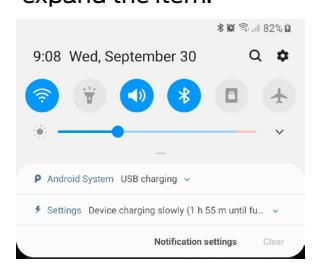
2 Tap the expanded item to open the Settings menu.
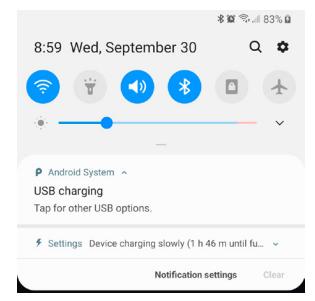
3 Choose Transferring files under Use USB for to allow for file transfer.
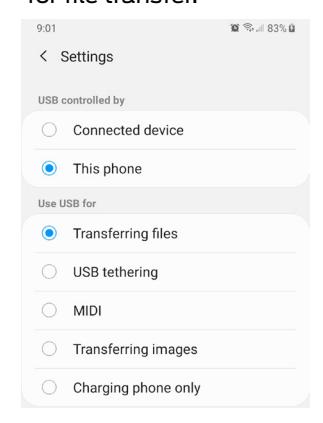
Glossary
BCD
Acronym for Binary Coded Decimal, an encoding method for representing decimal numbers where each digit is represented by four bits.
CAC
Acronym for Common Access Card, a U.S. Department of Defense smart card issued as standard identification, and for access to computers, networks and some facilities.
Cache Mode
How the reader will handle stored card information if there is loss of communication to its controller.
Card Conversion
Card data filters and converters that provide data that can be accepted by the access control system.
CM Lock
A Computer Managed offline lock, for example the Schlage CM 5500 series.
CSN
Acronym for the Card Serial Number, a unique, unencrypted identification number contained on the integrated chip in each smart card.
DCS
Acronym for Dynamic channel switching - can be selected to decrease the chance of interference but will decrease battery life.
Delay
The idle time between subsequent queries. - Shorter delays may reduce latency. - Longer delays may enhance battery life.
Door Prop Delay
The time allowed between opening a Door and closing it. If the Door is open longer then the Door prop delay an alarm is released. The delay can be set individually for each Door and is programmed through the program files.
Extend Unlock
This setting is required to respond to scheduled unlocks from an access control panel.
Fail Safe/Secure
The condition of a lock or latch when a loss of RF communications occurs between the PIM400/401 or Legacy and an access point.
FASC-N
Acronym for Federal Agency Smart Credential Number, an identifier used on all government issued credentials.
FC Mode
Allows access by Facility (Site) code.
First
The first query an access point makes to a PIM400/401 or Legacy PIM occurs immediately following a card swipe. - "First" is the amount of time, in milliseconds, an access point should wait before making its second query to a PIM400/401 or Legacy. This setting should be slightly greater than the fastest response time from the access control panel or host. This optimizes battery life and system performance.
GUI
Acronym for Graphical User Interface.
Heartbeat
The time interval that access points communicate to PIM400/401 or Legacy PIM when there is no activity. The Heartbeat is displayed in the format days, hours, minutes, seconds. Affects battery life.
Hi Lo Output
These settings control the PIM400/401-TD2 open collector outputs sent to an access control panel on detection of Request-to-Exit (RTX), Door Position Switch (DPS), and Trouble. The WPIM switches these signals between an open collector and ground state.
Latch Type
Configuration of an access point depending on lock or latch type issued or used.
Mode
Configuration of an access point for standard operation or for factory testing.
No Purge
Reader will remember the first 20 cards swiped for degraded mode access.
PIM
Acronym for Panel Interface Module.
PIV
Acronym for Personal Identification Verification, refers to control and security standards set by the National Institute of Standards and Technology (NIST) for Federal employees and long-term contractors.
Relatch Time
The interval between the unlocking and relocking of an access point. Controlled by the access point, not the host system.
Relock delay
The time span from unlocking a lock after presenting a Credential until relocking. The relock delay can be set for each Door individually between 1 and 254 seconds. The relock delay setting is transferred to the lock through the program file.
TSA
Acronym for Transportation Security Administration.
TSM
Acronym for Transaction Status Message.
TWIC
Acronym for Transportation Worker Indentification Credential.
Request to Exit
Whenever a Door is opened from the safe side a request to exit is required. In the simplest version this means operating a mechanism that unlocks the door (for example turning the doorknob). Most electronic locks use a switch to detect a request to exit. This can be a passive infrared sensor, a push button, an electronic exit bar, or the doorknob contact itself. This switch has either a normally open or a normally closed contact. Based on this configuration the system has to be set up correctly, otherwise a request is permanently reported unless someone activates the switch.
Retry
The maximum number of times an access point queries a PIM400/401 or Legacy PIM before the access point goes back to sleep The number of retries should be slightly greater than the longest response time from the access control panel or host.
Rxt
Determines whether the access point module queries for unlock authorization on a Request to Exit activation.
Rxt Sift
Determines whether a WA56XX or WA993 reports Request to Exit activations in unlocked state.
UID
Acronym for the Unique Identifier, a unique, unencrypted identification number contained on the integrated chip in each smart card. (May also be referred to as CSN.)
WAPM
Acronym for Wireless Access Point Module.
File Transfer Guide
Going from Pideon HHD to SUS-A Cable solution
Using this process, the old HHD address is retained and can be available if you need to return to using an HHD for door programming.
1. Change the program folder location.
SUS-A Process
Before generating program files, set the Schlage Express programming method to no longer use the Pocket PC folder.
- 1.1 Go to Settings > Program Settings > Programming tab.
-
1.2
Select Locks will be Programmed with this computer. This folder is where all manually transferred files will be placed.
- Î This will force all programming files use the SchlageExpress/Export folder on the PC.
HHD Process
- 1.1 Go to Settings > Program Settings > Programming tab.
-
1.2
Select Locks will be programmed with a Pocket PC.
- Î This will force all programming files to use the special HHD folder address that is coordinated with Windows Mobile Device Center for automatic file transfers.
-
2. Make necessary door programming changes in schlage express.
- 2.1 Make all necessary access and door setting changes in Schlage Express.
- 2.2 Generate Door Files for the selected set of doors to program (Tour).
-
3. Transfer door programming files from the PC folder to the Android mobile device (before touring).
-
3.1
Connect the android mobile device to the PC using a standard USB data cable.
- Î The SUS-A Cable cannot be used for file transfers (only door programming).
-
3.2
On the PC, browse to the SchlageExpress/Export folder using file explorer.
- Î If necessary, on the mobile device, change the USB setting to allow file transfer. Pull down the Notifications screen and look for Android System > charging this device via USB. Open the menu and Select File Transfer / Android Auto. See Enable File Transfer on page 62 for more information.
- 3.3 Select and COPY ALL .Dxx (door files) and the capindex.ndx file.
- 3.4 Browse to the android mobile device Schlage Utility Software folder.
- 3.5 PASTE all COPIED files.
- 3.6 Disconnect and go Touring.
-
3.1
Connect the android mobile device to the PC using a standard USB data cable.
See Transferring Door and Audit Files on page 10 for more information.
4. Transfer door audit and program files from the mobile device the PC (after touring).
-
4.1
Connect the mobile device to the PC using a standard USB data cable.
- Î The SUS-A Cable cannot be used for file transfers (only door programming).
-
4.2
On the PC, Browse to the android mobile device Schlage Utility Software folder using file explorer.
- Î If necessary, on the mobile device, change the USB setting to allow file transfer. Pull down the Notifications screen and look for Android System > charging this device via USB. Open the menu and Select File Transfer / Android Auto. See Enable File Transfer on page 62 for more information.
- 4.3 Select and COPY ALL .Axx (audit files) the capindex.ndx file and the Uplink.log files.
- 4.4 Browse to the SchlageExpress/Export folder.
- 4.5 PASTE all COPIED files.
- 4.6 Disconnect your mobile device.
5. Verify success.
- 5.1 Open Schlage Express and log in.
- 5.2 On the Main Screen, the Doors Requiring Programming indicator has been updated with the latest tour information.
- 5.3 Confirm that new audit information is now available.
Import/Export Configuration
About Import/Export Configuration Feature
The Schlage Utility Software for Android (SUS-A) includes the Import/Export Configuration feature.
Users may quickly change and copy "Device Properties" settings across multiple devices so that a group of devices may have the exact same settings applied.
An Import/Export Configuration file may be initiated from and copied to locks and devices, saved on the mobile device, transferred to another mobile device, and saved to a computer or network drive.
Supported Locks and Accessories
| AD-200 | WPR400 | CO-200 |
|---|---|---|
| AD-250 | CT5000 | CO-220 |
| AD-300 | PIB300 | CO-250 |
| AD-400 | PIM400-TD2 | |
| WRI400 | PIM400-485 |
Prerequisites
- The mobile device used must be coupled before the Import/Export Configuration file may be saved or retrieved. See Connecting the Mobile Device on page 9 for more information.
- The "source" lock or device must be installed and working as desired with all property settings configured as required by the user.
-
The Import/Export Configuration file can be saved and restored for a
specific hardware class only.
For example:
- Î A Import/Export Configuration created from an AD-200 Mag Swipe lock will not be available when the SUS-A is communicating with an AD-200 Prox lock.
- Î A Import/Export Configuration created from an AD-200 Prox lock will not be available with an AD-300 Prox lock.
Saving a Import/Export Configuration will also capture the following device status parameters:
- Lock Firmware Version
- Reader Firmware Version
- Lock Serial number
- Reader Serial number
- Card Detection Firmware Version
- Boot Loader Version
- Days Since Installed
- AA Battery Pack Type
- AA Battery Voltage
- Coin Cell Voltage
This information is saved within the Import/Export Configuration file, and can be viewed with any text viewer by the user.
When naming the Import/Export Configuration, use normal Windows OS naming conventions.
Create an Import/Export Configuration
-
1
Connect the mobile device to the device with desired properties.
- Î If the device properties have not been programmed, configure the device properties as desired. Refer to AD-Series Lock Properties on page 22 , or CO-Series Lock Properties on page 52 .
- 2 Select Device Options.
- 3 Select Lock Properties for the connected device.
- 4 Select the Edit or Reader tab.
- 5 Select Import/Export Configuration at the bottom of the screen.
- 6 Select Save From Device to create a Import/Export Configuration file from the properties of this device.
-
7
Enter a name for the Import/Export Configuration file.
- Î The name should describe the device configuration this Template is intended to work with and clearly identify the hardware configuration. (Example: AD200-PRK main entrances.)
- 8 Tap OK to save. The SUS-A will display the location of the saved Template file.
Before copying, a Import/Export Configuration file must be saved to the SUS-A /My Documents/ and must be a hardware configuration match with the receiving device.
See Transferring Device Template Export (.DTE) and Device Data log(. DDL) Files to PC on page 11 for more information.
Copy a Saved Import/Export Configuration
-
1
Connect the mobile device to the device that will receive the saved properties settings.
- Î Be sure that the receiving device is of the same hardware configuration as that of the source of the Import/Export Configuration. (See Prerequisites on page 68 for more information.)
- 2 Select Device Options.
- 3 Select Lock Properties for the connected device.
- 4 Select the Edit or Reader tab.
- 5 Select Import/Export Configuration at the bottom of the screen.
- 6 Select Save To Device to copy and save a Import/Export Configuration file to the connected device.
-
7
Select the Import/Export Configuration file name.
- Î If the Import/Export Configuration name is not available, check to be sure that the receiving device is of the same hardware configuration as that of the source of the Import/Export Configuration. (See Prerequisites on page 68 for more information. )
- 8 Tap OK to save.
- 9 Tap YES on the confirmation window, then tap OK again to finish.
- Î Saving an Import/Export Configuration file to a PIM or PIB will require re-linking of all previously linked devices
Diagnostic Data Log
About Diagnostic Data Log Feature
This new feature provides a simple method for AD-Series customers to quickly gather and save important lockset information in a file. This Diagnostic Data file can then be shared with Technical Services for setup and configuration review and for analysis of issues from the field.
The Diagnostic Data file will store the device settings and status of the last 50 devices that were successfully connected. All information is then available for review while not actually connected with the device and can be saved off-line and sent to Technical Services for further analysis.
Prerequisites
• The mobile device used must be coupled before the Diagnostic Data Log file may be saved. See Connecting the Mobile Device on page 9 for more information.
Diagnostic Data Log Menu
- Î NOTE: CO-Series products and non-lock AD-Series products do not support the Diagnostic Data Log feature
- 1 Schlage Utility Software for Android (SUS-A) provides a Device Options menu. This Diagnostic Data Log menu will be available when the SUS-A is connected and communicating with AD-Series locksets.
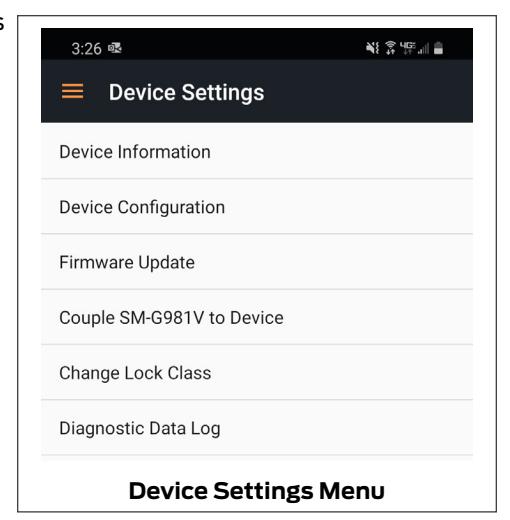
-
2
When the Diagnostic Data log menu is selected, the customer must then provide a name for the file and then select "OK" to continue.
- Î NOTE: Be sure to provide a sufficiently descriptive name for the file so that you and others will know which AD-Series device and location the file pertains to.
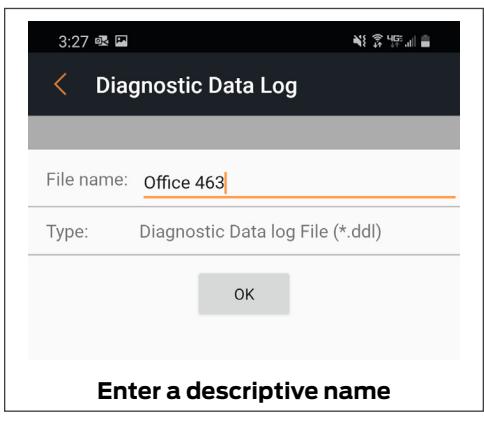
3 Next, the SUS-A will request all data from the AD-Series device and save the file.
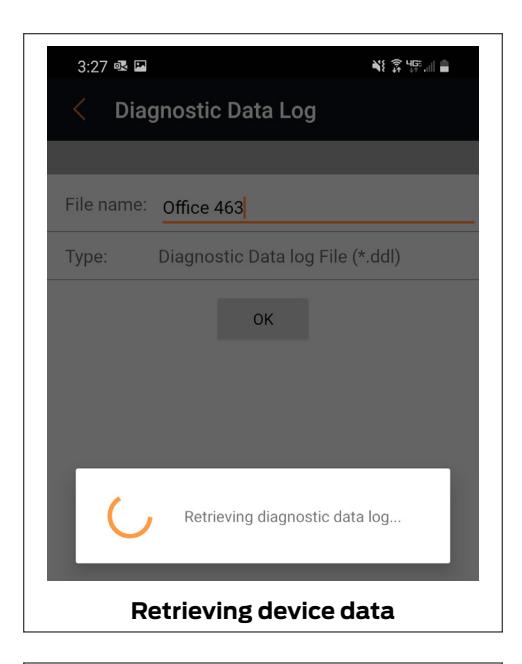
- 4 Once the file is generated, the customer should copy and forward the Diagnostic Data file to Technical Services for detailed analysis.
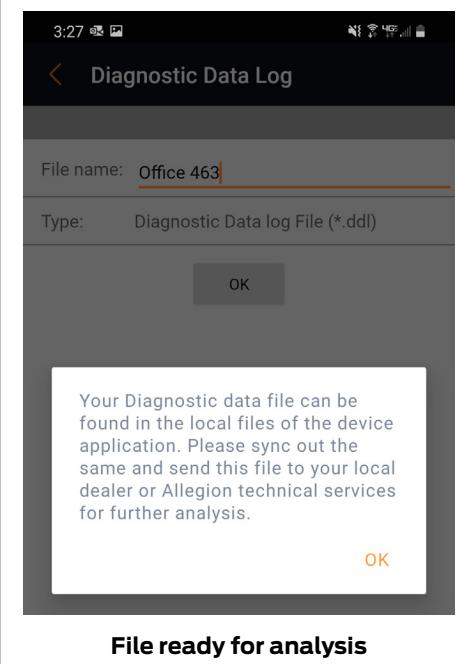
Index
| A | C | F |
|---|---|---|
| AD-200 6, 15, 22, 5 | Cache Mode 63 | Fail Safe 63 |
| AD-201 5 | Card Conversion 63 | Fail Secure 63 |
| AD-250 6, 22, 5 | CIP 54 | FC Mode 63 |
| AD-300 5, 6, 15, 26, 68 | CL 6, 54 | FE210 5, 6, 7, 9, 54 |
| AD-301 15 | CL993 5 | Files 10 |
| AD-302 5, 15, 30, 32, 41 | CL5100 5 | Transfer and update 10 |
| AD-400 5, 15, 30, 68 | CL5200 5 | FIPS 5, 15, 30, 32, 41 |
| AD-401 15 | CL5500 5 | FIPS201 5, 15, 30, 32, 41 |
| AD-402 5, 15, 30, 32, 41 | CL5600 5 | FIPS201-1 5, 15, 30, 32, 41 |
| AD-Series Controllers 15 | CM 6, 54, 63 | FIPS201-2 5, 15, 30, 32, 41 |
| Edit Properties 51 | CM993 5 | Firmware 11 |
| Functions 6 | CM5100 5 | Update using mobile device 11 |
| PIM400 Link Mode 19 | CM5200 5 | Update using PC 11 |
| Program 17, 49 | CM5500 5 | First 64 |
| Properties 35 | CM5600 5 | |
| Supported 5, 15 | CM5700 5 | |
| View Properties 50 | CM Lock 63 | |
| AD-Series Locks 5, 15 | CO-200 5, 6, 49, 68 | G |
| Collect Audits 17 | CO-220 5, 6, 49, 68 | Glossary 63 |
| Edit Properties 51 | CO-250 5, 6, 49, 68 | GUI 64 |
| Edit Reader Properties 51 | Copy | |
| Functions 6 | Device Template 69 | |
| Program 17, 49 | Create | H |
| Properties 22, 52 | Device Template 69 | Heartbeat 64 |
| Supported 5, 15 | CT500 5, 6 | Hi Lo Output 64 |
| View Properties 50 | CT1000 5 | |
| View Reader Properties 51 | CT5000 5, 6, 15, 68 | |
| Customer Service ii | ||
| I | ||
| Install | ||
| B | SUS-A 8 | |
| BE367 5, 6, 7, 9, 54 | D | |
| DCS 63 | ||
| Delay 63 | K | |
| Device Template | KC2 5, 6, 54 | |
| Copy 69 | KC2-5100 5 | |
| Create 69 | KC2-5500 5 | |
| Diagnostic Data Log 19, 70 | KC2-9000 5 | |
| Door Prop Delay 63 | ||
E
Extend Unlock 63
Index
|
L
Latch Type 64 Legacy Controllers Demo Mode 57 Edit Properties 56 Functions 6 Program 54 Supported 5, 54 Update Firmware 56 View Properties 55 Legacy Locks Collect Audits 55 Demo Mode 57 Edit Properties 56 Functions 6 Program 54 Properties 57 Supported 5, 54 Update Firmware 56 View Properties 55 Log In Manager 8 |
S
Schlage Utility Software Language 14 Options 13 Programming Password 14 SUS Password 13 Schlage Utility Software for Android Install 8 Update 8 SUS-A Install 8 Update 8 SUS Password 8, 13 Synchronization Software 68 T Transfer Device configuration 11 Diagnostic data log 11 Files 10 Troubleshooting 58 |
|
M
Mobile device 9 Connecting 9 AD-Series 9 CO-Series 9 Update 10 Mode 64 |
U
Update Mobile Device 10 SUS-A 8 |
|
N
No Purge 63 |
W
WAPM 6, 65 Warranty iii WPR400 5, 15, 35, 68 WRI400 5, 15, 68 |
|
P
PIB300 5, 6, 15, 43, 68 PIM 6, 8, 16, 19, 30, 31, 38, 39, 63, 64, 65 PIM400 5, 6, 15, 16, 19, 31, 32, 36, 39, 40, 41 PIM400-485 68 PIM400-TD2 68 PIMWA-CV 55 Programming Password 8, 14, 15, 16, 49 |
|
|
R
Relatch Time 64 Relock delay 64 Request to Exit 65 |
About Allegion
Allegion (NYSE: ALLE) creates peace of mind by pioneering safety and security. As a $2 billion provider of security solutions for homes and businesses, Allegion employs more than 7,800 people and sells products in more than 120 countries across the world. Allegion comprises 23 global brands, including strategic brands CISA®, Interflex®, LCN®, Schlage® and Von Duprin®.
For more, visit www.allegion.com .