Installation Instructions for UL Fire-Rated Hinge Studs – 75006020
Open the original PDF document
View PDF

ROTON UL FIRE–RATED STUDS PART NO: 75006020 ROTON MODEL: 780-045, -046, -053, -054 REVISION: 05/31/17
HAGER Companies, 139 Victor Street, St. Louis, MO 63104 (800) 325-9995
ROTON Hinge U.L. Fire-Rated Studs – 780-045, -046, -053, -054
These instructions outline how to install the optional stainless steel studs (4) for ROTON Hinge models 780- 045, 780-046, 780-053 and 780-054. All four studs must be used in order to comply with U.L. requirements for composite wood fire doors rated up to 90 minutes and metal fire doors rated up to 3 hours.
Materials Needed
- Stainless steel studs (4).
- Drill, 7/8" diameter bit, #16 (.177") bit, 12-24 thread tap.
- #10 spanner screwdriver.
Installation
- 1. Install the hinge in accordance with the standard installation instructions furnished with the hinge.
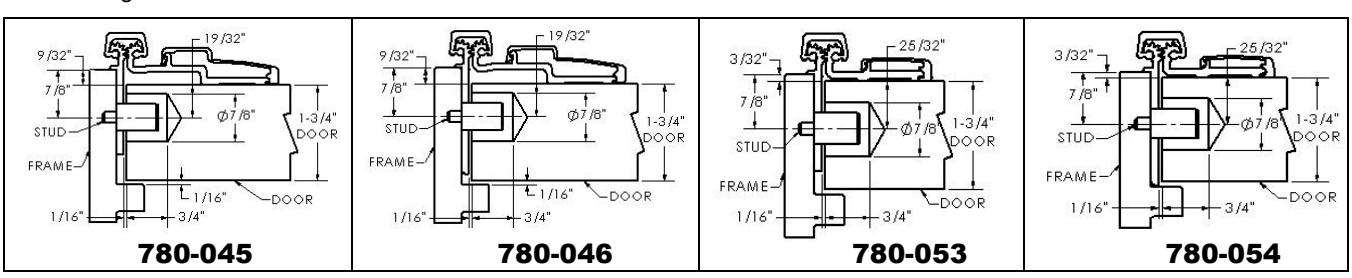
- 2. On the frame leaf, drill tap 12-24 in the center of the four ¾" diameter holes.
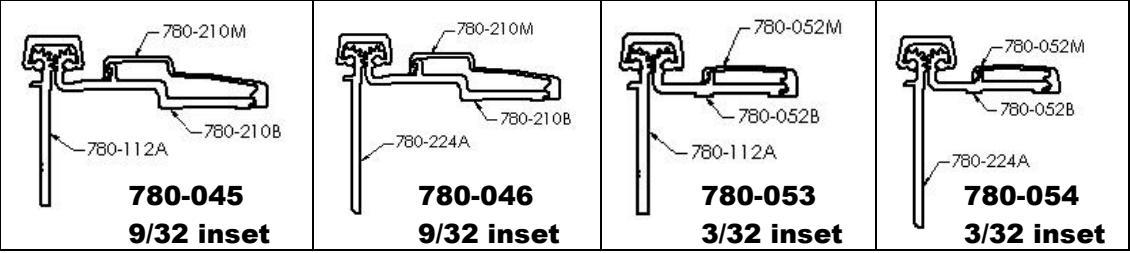
- 3. On the door leaf, drill a 7/8" diameter by 3/4" deep is the horizontal location from the edge of the door. The horizontal location is the center line of the door minus the inset. The Vertical location is on the chart listed below. The first measurement is from the top of the hinge to the centerline of hole #1. The second, third and fourth holes are measured from centerline to centerline.
| Horizontal location | Location (for 1.75 door) |
|---|---|
| 780-045 and 046 | 19/32" |
| 780-053 and 054 | 25/32" |
| Vertical Location | 79" | 83" | 85" | 95" | 119" |
|---|---|---|---|---|---|
| Hole #1 | 13-7/8" | 15-7/8" | 16-7/8" | 16-3/4" | 13-3/8" |
| Hole #2 | 10-1/4" | 10-1/4" | 10-1/4" | 20-1/2" | 30-3/4" |
| Hole #3 | 30-3/4" | 30-3/4" | 30-3/4" | 20-1/2" | 30-3/4" |
| Hole #4 | 10-1/4" | 10-1/4" | 10-1/4" | 20-1/2" | 30-3/4" |
- 4. Insert a stud into each of the four #12-24 threaded holes on the frame and tighten securely using a #10 spanner screwdriver.
- 5. Close the door slowly to assure that the studs are properly aligned. Any minor interference can be corrected using a rat-tail file.