Edwards Signaling RJ-31X Telephone Jack Installation Technical Bulletin
Open the original PDF document
View PDF

RJ-31X TELEPHONE JACK INSTALLATION
Purpose
This bulletin details the proper installation and testing of a modular RJ-31X jack.
Description
An RJ-31X jack is designed to facilitate wiring of an alarm panel and premise telephone on the same phone line while assuring that the processing of alarm signals has priority (line seizure) over a voice call.
How they work
When no connector is plugged into the RJ-31X jack, the telco ring and tip signals (input terminals 4 and 5) are fed directly to the output terminals (1 and 8) feeding the premise telephone set. When a dialer (DACT) is plugged into the RJ-31X socket the ring and tip signals are fed via the modular cable directly to the dialer's line seizure relay. If the dialer is not in use, the ring and tip signals are fed back down the modular cable to RJ-31X output terminals (1 and 8) to the telephone set. During an alarm condition, the line-seizure relay in the dialer operates; disconnecting the telephone set and connecting the internal dialer electronics to the phone line, then dials the central monitoring station (CMS). A telco feature known as "called party disconnect" lets the dialer disconnect a call that originated off premise in order to re-establish a dial tone for calling the Central Monitoring Station (CMS).
Wiring diagram
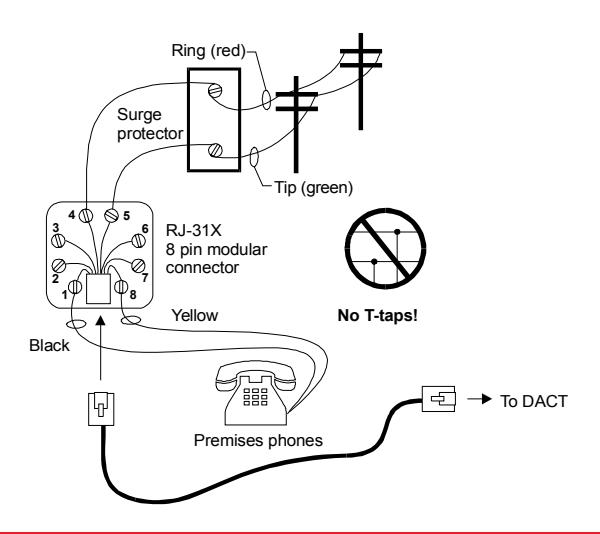

RJ-31X TELEPHONE JACK INSTALLATION
2
Required hardware
- · RJ-31X Jack
- · Telephone or Test set (butt set)
Testing
To verify correct wiring and operation, the best tool for the job is a lineman's test set also known in the industry as a "butt set." Monitor the signals on the RJ-31X as follows:
- · During a non-alarm condition, a dial tone should be present on input terminals 4 and 5 and output terminals 1 and 2. Remember to set the test set to the "monitor" position, as the "talk" position creates an off-hook condition that may interfere with the dialer. Most test sets are equipped with red and black insulators on the five-way clips as a reminder of the correct polarity for the green/red pair and the black/yellow pairs.
- · Verify telephone set disconnects during an alarm by connecting the test set to output terminals 1 and 8 and verify the dial tone goes dead during an alarm.
- · You can monitor the entire process by connecting the test set to terminals 4 and 5.
- · Test for unauthorized wiring ahead of the RJ-31X by unplugging the phone line from the dialer but leave the patch cord plugged into the RJ-31X. Listen for a dial tone on all phones connected to the circuit. Any phone with a dial tone is improperly connected ahead of the RJ-31X jack and must be rewired to the output terminals. be rewired to terminals.
- · If you have a two-line system, repeat the process for the second line. Once your wiring has been verified, a full system test should be conducted to verify CMS primary and secondary phone numbers as well as customer account numbers are correctly programmed into the dialer.
Reference materials
- · NFPA72, 2002 §8.5.3.2.1 Digital Alarm Communicator Transmitter (DACT)
- · FSDACT: See FireShield Manual P/N 3100353