Edwards Signaling Light Output White Paper
Open the original PDF document
View PDF

A light output/light source discussion
Viewer Effective Light Output (VELO)
Effective signaling depends on both perception and understanding of the signal being transmitted. In the case of audible signals it is important to select a tone (e.g. bell, horn, siren) that not only conveys meaning but is also distinguishable from ambient (or background) sounds. Loudness is also an important factor – enough to be perceived over ambient dB but not too much that either distortion or listener damage occur.
These same type of factors affect visible signal selection. Ambient or background light may affect the choice of light source (e.g. steady, flashing, rotating, or strobe) while message type may dictate color choice (e.g. red for stop or danger).
Viewer perception (specifically the ability of the viewer to effectively see and comprehend the visual signal) is perhaps the most important feature of any visual signal.
Edwards' AdaptaBeacons have thus been designed to maximize viewer perceptibility. This focus on Viewer Effective Light Output (VELO) is most noticeable in the Edwards lens design. The unique double fresnel lens results in four illumination characteristics that significantly enhance viewer perception.
- 1. The refractive feature of the inner fresnels causes the lens to fill; resulting in a rectangular column of light. This increases the "dwell" time of illumination thus significantly enhancing retinal retention.
- 2. Light sources are positioned in the focal point of the lens thus enabling the lens-magnifying ring to effectively project the visual signal.
- 3. The refractive external fresnels function also to diffuse the light. This enhances visibility for viewers located adjacent to the beacon.
- 4. By ensuring that the lens is filled with light any "hot" spots are eliminated. This is particularly important to viewer perception when strobe light sources are involved. While hotspots generate high light output numbers, they generally result in decreased viewer perception (as viewers squint or turn away in order to avoid the flash). Additionally, the glare tends to wash out lens color resulting in a "white" flash – thus minimizing the color-coded message.
Light Output Data
All manufacturers light output information (Edwards included) needs to be evaluated against many criteria including: distance at which light is to be viewed, lens color, amount of lens pigmentation, viewer perceptibility, and in the case of strobes, VELO.
Currently there are no standardized agency testing criteria for measuring light output of general (non-fire alarm) visual signals. For this reason Edwards has opted to specify strobe tube output in joules, resultant effective candela, and peak candela ratings. See Table 1 for Edwards Strobe Light Output Data.
Strobe Tube Life Data
Strobe tube manufacturers all supply tube life data. Edwards has opted, when using this information, to report effective tube life to only a 25% decrease in light output. (Obviously the greater the decrease the longer will be the stated tube life). See Table 1 for Edwards Strobe Tube Life Data.
Table 1. Edwards Strobe Tube Light Output and Life
| Cat. No. |
Strobe Tube
Cat. No. |
Tube Life
(hrs)* |
Joules |
Effective
Candela** |
Peak
Candela |
|---|---|---|---|---|---|
| 57EDF Series | 92-ST | 3,000 | 23 | 1265 | 2,300,000 |
| 89STR Series | Not Replaceable | 1,000 | 3 | 150 | 300,000 |
| 89SMSTR Series | Not Replaceable | 1,000 | 3 | 150 | 300,000 |
| 90 Series | 92-LST | 5,000 | 14 | 770 | 1,400,000 |
| 91B Series | 91B-ST | 3,000 | 3 | 165 | 300,000 |
| 92EX Series | 92-LST | 5,000 | 14 | 770 | 1,400,000 |
| 92EXB Series | 92-LST | 5,000 | 14 | 770 | 1,400,000 |
| 92EXC Series | 92-LST | 5,000 | 14 | 770 | 1,400,000 |
| 92-N5 Series | 92-LST | 5,000 | 14 | 770 | 1,400,000 |
| 92-R5 & -S1 Series | 92-ST | 3,000 | 8 | 440 | 800,000 |
| 92PLC Series | 92-LST | 5,000 | 14 | 770 | 1,400,000 |
| 92PLC-DF Series | 92-ST | 3,000 | 8 | 440 | 800,000 |
| 93 Series | 92-ST | 3,000 | 8 | 440 | 800,000 |
| 93DF Series | 92-ST | 3,000 | 11 | 605 | 1,100,000 |
| 94 Series | 92-ST | 3,000 | 8 | 440 | 800,000 |
| 94DF Series | 92-ST | 3,000 | 11 | 605 | 1,100,000 |
| 94DDV2 Series | 92-ST | 3,000 | 8 | 440 | 800,000 |
| 94DV2 Series | 92-ST | 3,000 | 8 | 440 | 800,000 |
| 95 Series | 92-LST | 5,000 | 14 | 770 | 1,400,000 |
| 96B Series | 91B-ST | 3,000 | 3 | 165 | 300,000 |
| 96DV2 Series | 91B-ST | 3,000 | 3 | 165 | 300,000 |
| 97 Series | 92-ST | 3,000 | 8 | 440 | 800,000 |
| 97DF Series | 92-ST | 3,000 | 8 | 440 | 800,000 |
| 97DEX Series | 92-ST | 3,000 | 8 | 440 | 800,000 |
| 97DEXB Series | 92-ST | 3,000 | 8 | 440 | 800,000 |
| 97DEXC Series | 92-ST | 3,000 | 8 | 440 | 800,000 |
| 97DEXC-GW | 92-ST | 3,000 | 8 | 440 | 800,000 |
| 97DEXBC-GW | 92-ST | 3,000 | 8 | 440 | 800,000 |
| 97DEXCC-GW | 92-ST | 3,000 | 8 | 440 | 800,000 |
| 97EX Series | 92-ST | 3,000 | 8 | 440 | 800,000 |
| 97EXB Series | 92-ST | 3,000 | 8 | 440 | 800,000 |
| 97EXC Series | 92-ST | 3,000 | 8 | 440 | 800,000 |
| 98B Series | 91B-ST | 3,000 | 3 | 165 | 300,000 |
| 99B Series | 91B-ST | 3,000 | 10 | 550 | 1,000,000 |
| 101 Series | 91B-ST | 3,000 | 3 | 165 | 300,000 |
| 102 Series | Not Replaceable | 3,000 | 3 | 165 | 300,000 |
| 104ST Series | 91B-ST | 3,000 | 3 | 165 | 300,000 |
| 105ST Series | 91B-ST | 3,000 | 3 | 165 | 300,000 |
| 105HIST Series | 92-ST | 3,000 | 8 | 440 | 800,000 |
| 867STR Series | Not Replaceable | 1,000 | 3 | 150 | 300,000 |
| 868STR Series | Not Replaceable | 1,000 | 3 | 150 | 300,000 |
| 869STR Series | Not Replaceable | 1,000 | 3 | 150 | 300,000 |
* Calculated at operating power to 75% efficiency.
** Also known as candela seconds. Refer to Technical Reference Appendix for calculation base.
Edwards Incandescent and Halogen Bulb Light Output
For halogen bulbs, the manufacturer's lumen rating is specified. (This measures effective light output in all directions). See Table 2 for bulb light output ratings.
Halogen and Incandescent Bulb Life
Light source life is also an area of some confusion as there are no current industry standards for measurement. At the same time ambient conditions (e.g. voltage & vibration) and duty cycles can significantly effect bulb life. Improper handling can also dramatically decrease both bulb and tube life.
When reporting bulb life Edwards is using manufacturer supplied data (which assumes a 100% constant duty cycle) and then interpolating the effects of the average flash rate (again assuming a constant duty cycle). See Table 2 for bulb Life ratings.
Table 2. Edwards Incandescent and Halogen Bulb Light Output and Life
| Mfrs. | |||||
|---|---|---|---|---|---|
| Lumen | Calculated | Projected | |||
| Cat. No. | Bulb No. | Bulb Rating | Rating | Lamp Life* | Lamp Life** |
| 48FIN-E1 | Industry Trade 94 | 15W | 189 | 700 | 1,520 |
| 48FIN-G1-20WH | 50LMP-20WH | 20W Halogen | 226 | 20,000 | 25,000 |
| Series | or Industry Trade 1692 | ||||
| 15W | 110 | 1,000 | 6,350 | ||
| 48FIN-G5-20WH | 50LMP-20WH | 20W Halogen | 226 | 20,000 | 25,000 |
| Series | or Industry Trade 1692 | ||||
| 15W | 110 | 1,000 | 6,350 | ||
| 48FIN-N5-25WH | 50LMP-25WH | 25W Halogen | 175 | 20,000 | 25,000 |
| Series | or Industry Trade 25T8DC | ||||
| 48SIN-E1 | Industry Trade 94 |
25W
15W |
235
189 |
1,000
700 |
1,000
1,520 |
| 48SIN-G1-20WH | 50LMP-20WH | 20W Halogen | 226 | 20,000 | 20,000 |
| Series | or Industry Trade 1692 | ||||
| 15W | 110 | 1,000 | 6,350 | ||
| 48SIN-G5-20WH | 50LMP-20WH | 20W Halogen | 226 | 20,000 | 20,000 |
| Series | or Industry Trade 1692 | ||||
| 15W | 110 | 1,000 | 6,350 | ||
| 48SIN-N5-25WH | 50LMP-25WH | 25W Halogen | 175 | 20,000 | 20,000 |
| Series | or Industry Trade 25T8DC | ||||
| 25W | 235 | 1,000 | 1,000 | ||
| 49-N5-40WH Series | 50LMP-40WH | 40W Halogen | 265 | 20,000 | 25,000 |
| 49-R5 Series | P-041917-0039 | ||||
| or Industry Trade | 25W | 232 | 200 | 120 | |
| 25T8/240V/DC/CL | |||||
| 50-G5-20WH Series | 50LMP-20WH | 20W Halogen | 226 | 20,000 | 25,000 |
| 50-N5-40WH Series | 50LMP-40WH | 40W Halogen | 265 | 20,000 | 25,000 |
| 50-R5 Series | P-041917-0039 | ||||
| or Industry Trade | 25W | 232 | 200 | 120 | |
| 25T8/240V/DC/CL | |||||
| 50SIN-N5-40WH | 50LMP-40WH | 40W Halogen | 265 | 20,000 | 25,000 |
| 51-E1 Series | Industry Trade 94 | 15W | 189 | 700 | 1,520 |
| 51-G1 Series | Industry Trade 1638 | 25W | 402 | 500 | 3,180 |
| 51-G5-20W Series | Industry Trade 1638 | 25W | 402 | 500 | 3,180 |
| 51-N5-40W Series | 50LMP-40W (6 ea) or | 40W | 266 | 1,500 | 3,920 |
| P-041695-0118 (1ea) | |||||
| 51SIN-G1 Series | Industry Trade 1638 | 25W | 402 | 500 | 3,180 |
| 51SIN-N5-40W Series | 50LMP-40W (6 ea) or | 40W | 266 | 1,500 | 3,920 |
| P-041695-0118 (1ea) | |||||
| 52-N5 Series | 50LMP-40WH | 40W Halogen | 265 | 20,000 | 25,000 |
| 52-G5 Series | 50LMP-20WH | 20W Halogen | 226 | 20,000 | 25,000 |
| 52-R5 Series | P-041917-0039 | ||||
| or Industry Trade | 25W | 232 | 200 | 120 | |
| 25T8/240/DC/CL | |||||
| 52EX-N5-40W Series | 50LMP-40W (6 ea) or | 40W | 266 | 1,500 | 3,920 |
| P-041695-0118 (1ea) | |||||
| 52EXB-N5-40W | 50LMP-40W (6 ea) or | 40W | 266 | 1,500 | 3,920 |
| Series | P-041695-0118 (1ea) | ||||
| 52EXC-N5-40W | 50LMP-40W (6 ea) or | 40W | 266 | 1,500 | 3,920 |
|
Series
53-E1 Series |
P-041695-0118 (1ea)
Industry Trade 1076 |
25W | 402 | 200 | 430 |
| 53-G1 Series | Industry Trade 1638 | 25W | 402 | 500 | 3,180 |
| 53DR-GW | Industry Trade 1638 | 25W | 402 | 500 | 3,180 |
| 53DC-GW | Industry Trade 1638 | 25W | 402 | 500 | 3,180 |
| 53DEX-G1 Series | Industry Trade 1638 | 25W | 402 | 500 | 3,180 |
| 53DEXB-G1 Series | Industry Trade 1638 | 25W | 402 | 500 | 3,180 |
|---|---|---|---|---|---|
| 53DEXC-G1 Series | Industry Trade 1638 | 25W | 402 | 500 | 3,180 |
| Mfrs. | |||||
| Lumen | Calculated | Projected | |||
| Cat. No. | Bulb No. | Bulb Rating | Rating | Lamp Life* | Lamp Life** |
| 53EX-E1 Series | Industry Trade 1076 | 25W | 402 | 200 | 430 |
| 53EX-G1 Series | Industry Trade 1638 | 25W | 402 | 500 | 3,180 |
| 53EXB-E1 Series | Industry Trade 1076 | 25W | 402 | 200 | 430 |
| 53EXB-G1 Series | Industry Trade 1638 | 25W | 402 | 500 | 3,180 |
| 53EXC-E1 Series | Industry Trade 1076 | 25W | 402 | 200 | 430 |
| 53EXC-G1 Series | Industry Trade 1638 | 25W | 402 | 500 | 3,180 |
| 58-N5-100WH Series | 100Q/CL/DC/ 120V | 100W | 1800 | 1,000 | 2,610 |
| Halogen | |||||
| 101FIN-E1 Series | Industry Trade 94 | 15W | 189 | 700 | 1,520 |
| 101FINH-G1 Series | 50LMP-9WH-D | 9W Halogen | 52 | 12,000 | 15,000 |
| 101FINH-N5 Series | 50LMP-12WH-D | 12W Halogen | 70 | 20,000 | 25,000 |
| 101SIN-E1 Series | Industry Trade 94 | 15W | 189 | 700 | 1,520 |
| 101SINH-G1 Series |
50LMP-9WH-D
or |
9W Halogen | 52 | 12,000 | 15,000 |
| Industry Trade | |||||
| 101SINH-N5 Series | 50LMP-12WH-D | 12W Halogen | 70 | 20,000 | 25,000 |
| or Industry Trade | |||||
| 102LS-FIN-G1 | Industry Trade 303 | 10W | 66 | 10,000 | 10,000 |
| 102LS-FINH-G1 | 50LMP-9WH | 9W Halogen | 52 | 12,000 | 15,000 |
| 102LS-FIN-N5 | 50LMP-10W | 10W | 66 | 2,500 | 2,500 |
| 102LS-FINH-N5 | 50LMP-12WH | 12W Halogen | 70 | 20,000 | 25,000 |
| 102LS-SIN-G1 | Industry Trade 303 | 10W | 66 | 10,000 | 10,000 |
| 102LS-SINH-G1 | 50LMP-9WH | 9W Halogen | 52 | 12,000 | 15,000 |
| 102LS-SIN-N5 | 50LMP-10W | 10W | 66 | 2,500 | 2,500 |
| 102LS-SINH-N5 | 50LMP-12WH | 12W Halogen | 70 | 20,000 | 25,000 |
| 104FINH-G1 Series | 50LMP-9WH-D | 9W Halogen | 52 | 12,000 | 15,000 |
| or Industry Trade 1692 | 15W | 110 | 1,000 | 6,350 | |
| 104FINH-G5 Series | 50LMP-9WH-D | 9W Halogen | 52 | 12,000 | 15,000 |
| or Industry Trade 1692 | |||||
| 15W | 110 | 1,000 | 6,350 | ||
| 104FINH-N5 Series | 50LMP-12WH-D | 12W Halogen | 70 | 20,000 | 25,000 |
| or Industry Trade 15T7DC | |||||
| 15W | 99 | 1,000 | 1,630 | ||
| 104SINH-G1 Series | 50LMP-9WH-D | 9W Halogen | 52 | 12,000 | 15,000 |
| or Industry Trade 1692 | |||||
| 15W | 110 | 1,000 | 6,350 | ||
| 104SINH-G5 Series | 50LMP-9WH-D | 9W Halogen | 52 | 12,000 | 15,000 |
| or Industry Trade 1692 | |||||
| 15W | 110 | 1,000 | 6,350 | ||
| 104SINH-N5 Series | 50LMP-12WH-D | 12W Halogen | 70 | 20,000 | 25,000 |
| or Industry Trade 15T7DC | |||||
| 15W | 99 | 1,000 | 1,630 | ||
| 105FINH-G1 Series | 50LMP-20WH | 20W Halogen | 226 | 20,000 | 25,000 |
| 105FINH-G5 Series | 50LMP-20WH | 20W Halogen | 226 | 20,000 | 25,000 |
| 105FINH-N5 Series | 50LMP-25WH | 25W Halogen | 175 | 20,000 | 20,000 |
| 105SINH-G1 Series | 50LMP-20WH | 20W Halogen | 226 | 20,000 | 25,000 |
| 105SINH-G5 Series | 50-LMP-20WH | 20W Halogen | 226 | 20,000 | 25,000 |
| 105SINH-N5 Series | 50LMP-25WH | 25W Halogen | 175 | 20,000 | 20,000 |
* Calculated by the manufacturer at continuous operation at operating voltage.
Edwards LED Light Output
For LEDs, the manufacturer's lumen rating per LED is used as the basis for calculations. However it should be noted that with LEDs light output ratings are relatively meaningless as LED viewing angle and lens optics have a more significant effect on viewer perceptibility.
** Projected at 65FPM and 50% duty cycle.
Table 3. Edwards LED Light Output and Life
| Cat. No. | LED Color | LED Life (hrs) | Lumen Rating |
|---|---|---|---|
| 101FLED-G1 | Red | 100,000 | 28 |
| 101FLED-G1 | Amber | 100,000 | 38 |
| 101FLED-G1 | Blue | 100,000 | 35 |
| 101FLED-G1 | Green | 100,000 | 102 |
| 101FLED-N5 | Red | 100,000 | 28 |
| 101FLED-N5 | Amber | 100,000 | 38 |
| 101FLED-N5 | Blue | 100,000 | 35 |
| 101FLED-N5 | Green | 100,000 | 102 |
| 101SLED-G1 | Red | 100,000 | 28 |
| 101SLED-G1 | Amber | 100,000 | 38 |
| 101SLED-G1 | Blue | 100,000 | 35 |
| 101SLED-G1 | Green | 100,000 | 102 |
| 101SLED-N5 | Red | 100,000 | 28 |
| 101SLED-N5 | Amber | 100,000 | 38 |
| 101SLED-N5 | Blue | 100,000 | 35 |
| 101SLED-N5 | Green | 100,000 | 102 |
| 102FLED-G1 | Red | 100,000 | 135 |
| 102FLED-G1 | Amber | 100,000 | 346 |
| 102FLED-G1 | Blue | 100,000 | 135 |
| 102FLED-G1 | Green | 100,000 | 135 |
| 102FLED-N5 | Red | 100,000 | 135 |
| 102FLED-N5 | Amber | 100,000 | 346 |
| 102FLED-N5 | Blue | 100,000 | 135 |
| 102FLED-N5 | Green | 100,000 | 135 |
| 102SLED-G1 | Red | 100,000 | 135 |
| 102SLED-G1 | Amber | 100,000 | 346 |
| 102SLED-G1 | Blue | 100,000 | 135 |
| 102SLED-G1 | Green | 100,000 | 135 |
| 102SLED-N5 | Red | 100,000 | 135 |
| 102SLED-N5 | Amber | 100,000 | 346 |
| 102SLED-N5 | Blue | 100,000 | 135 |
| 102SLED-N5 | Green | 100,000 | 135 |
| 48FLED-G1 | Red | 100,000 | 28 |
| 48FLED-G1 | Amber | 100,000 | 38 |
| 48FLED-G1 | Blue | 100,000 | 35 |
| 48FLED-G1 | Green | 100,000 | 102 |
| 48FLED-N5 | Red | 100,000 | 28 |
| 48FLED-N5 | Amber | 100,000 | 38 |
| 48FLED-N5 | Blue | 100,000 | 35 |
| 48FLED-N5 | Green | 100,000 | 102 |
| 48SLED-G1 | Red | 100,000 | 28 |
| 48SLED-G1 | Amber | 100,000 | 38 |
| 48SLED-G1 | Blue | 100,000 | 35 |
| 48SLED-G1 | Green | 100,000 | 102 |
| 48SLED-N5 | Red | 100,000 | 28 |
| 48SLED-N5 | Amber | 100,000 | 38 |
| 48SLED-N5 | Blue | 100,000 | 35 |
| 48SLED-N5 | Green | 100,000 | 102 |
| 103-RBA-G1 | Red | 100,000 | 120 |
| Blue | 100,000 | 90 | |
| Amber | 100,000 | 307 | |
| 103-RGA-G1 | Red | 100,000 | 120 |
| Green | 100,000 | 90 |
| Amber | 100,000 | 307 |
|---|---|---|
| Cat. No. | LED Color | LED Life (hrs) | Lumen Rating |
|---|---|---|---|
| 103-RBA-N5 | Red | 100,000 | 120 |
| Blue | 100,000 | 90 | |
| Amber | 100,000 | 307 | |
| 103-RGA-N5 | Red | 100,000 | 120 |
| Green | 100,000 | 90 | |
| Amber | 100,000 | 307 | |
| 103I-RBA-G1 | Red | 100,000 | 120 |
| Blue | 100,000 | 90 | |
| Amber | 100,000 | 307 | |
| 103I-RGA-G1 | Red | 100,000 | 120 |
| Green | 100,000 | 90 | |
| Amber | 100,000 | 307 | |
| 103I-RBA-N5 | Red | 100,000 | 120 |
| Blue | 100,000 | 90 | |
| Amber | 100,000 | 307 | |
| 103I-RGA-N5 | Red | 100,000 | 120 |
| Green | 100,000 | 90 | |
| Amber | 100,000 | 307 | |
| 104FLED-G1 | Red | 100,000 | 28 |
| 104FLED-G1 | Amber | 100,000 | 38 |
| 104FLED-G1 | Blue | 100,000 | 35 |
| 104FLED-G1 | Green | 100,000 | 31 |
| 104FLED-N5 | Red | 100,000 | 28 |
| 104FLED-N5 | Amber | 100,000 | 38 |
| 104FLED-N5 | Blue | 100,000 | 35 |
| 104FLED-N5 | Green | 100,000 | 31 |
| 104SLED-G1 | Red | 100,000 | 28 |
| 104SLED-G1 | Amber | 100,000 | 38 |
| 104SLED-G1 | Blue | 100,000 | 35 |
| 104SLED-G1 | Green | 100,000 | 31 |
| 104SLED-N5 | Red | 100,000 | 28 |
| 104SLED-N5 | Amber | 100,000 | 38 |
| 104SLED-N5 | Blue | 100,000 | 35 |
| 104SLED-N5 | Green | 100,000 | 31 |
| 105FLED-G1 | Red | 100,000 | 28 |
| 105FLED-G1 | Amber | 100,000 | 38 |
| 105FLED-G1 | Blue | 100,000 | 35 |
| 105FLED-G1 | Green | 100,000 | 102 |
| 105FLED-N5 | Red | 100,000 | 28 |
| 105FLED-N5 | Amber | 100,000 | 38 |
| 105FLED-N5 | Blue | 100,000 | 35 |
| 105FLED-N5 | Green | 100,000 | 102 |
| 105SLED-G1 | Red | 100,000 | 28 |
| 105SLED-G1 | Amber | 100,000 | 38 |
| 105SLED-G1 | Blue | 100,000 | 35 |
| 105SLED-G1 | Green | 100,000 | 102 |
| 105SLED-N5 | Red | 100,000 | 28 |
| 105SLED-N5 | Amber | 100,000 | 38 |
| 105SLED-N5 | Blue | 100,000 | 35 |
| 105SLED-N5 | Green | 100,000 | 102 |
Technical Reference Information Light Output Descriptions
When comparing two different warning lights, the first question usually asked is how bright are these lights and how do they compare to one another? This can be a complicated question when one is comparing very different light sources such as rotating incandescent lights and xenon strobe lights. Three different commonly used specified "intensity" ratings are discussed below.
- 1. PEAK CANDELA or PEAK CANDLEPOWER This quantifies the maximum light intensity generated by a flashing light during its light pulse. It indicates nothing about how bright the light appears to the human eye. Peak candela alone cannot be used to directly compare two warning lights. In addition there is no set multiplication factor for converting peak candela, a unit of luminous intensity, to either candela seconds or effective candela, both units of luminous energy.
- 2. CANDELA SECONDS or CANDLEPOWER SECONDS This quantifies the actual light energy contained in a pulse of light. Candela seconds is used by SAE (Society of Automotive Engineers) and by most State Highway Patrol Divisions to specify the minimum requirements of light output from a flashing light because flash energy has been shown to be a relatively accurate and fair way of comparing radically different types of lights such as incandescent rotators and xenon strobe lights.
- 3. EFFECTIVE CANDELA or EFFECTIVE CANDLEPOWER Effective candela is based on candela seconds and attempts to equate the brightness of a flashing light source to the brightness of a steady burning source. If a flashing light has an effective candela rating of 100 then it will be visible at the same distance as a 100 candela steady burn source. The National Bureau of Standards, the FAA, and the Illuminating Engineering Society use effective candela in specifying intensities of flashing light sources because this rating is the most meaningful when it becomes necessary to predict the visible range of flashing lights verses steady burn light sources.
Since one unit of "this" doesn't really equal two units of "that", the lighting manufacturing industry in general assimilates for easy laymen terms the following:
50 Candela assimilates to 100,000 Peak Candlepower which assimilates to 1 Joule
Just remember, a Joule is a measurement of electric energy, while Candlepower is a measurement of apparent brightness. Therefore, these comparisons are only approximate.
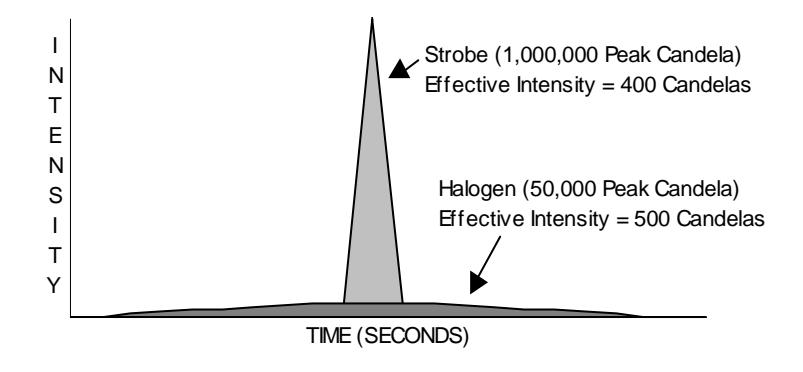
As shown in the diagram on the right, a strobe will have a much higher peak candela rating than a halogen rotator. However, the overall effective intensity is determined by the area under the curve. In comparing the two lights, the halogen rotator would have a higher perceived brightness of the two lights.
Strobe vs. Halogen Rotator Intensities
Technical Reference Information Output Flash Brightness
Approximate Effective Candela Rating per Joule:
| Lens Color | Strobe Output | Halogen Output |
|---|---|---|
| Clear | 45-55 Candela/Joule | 45-55 Candela/Joule |
| Amber | 30-40 Candela/Joule | 32-43 Candela/Joule |
| Blue | 17-23 Candela/Joule | 7-10 Candela/Joule |
| Green | 15-20 Candela/Joule | 7-15 Candela/Joule |
| Red | 7-10 Candela/Joule | 10-15 Candela/Joule |
Please note that the actual light output of a typical strobe warning light will depend upon a number of factors. These factors can vary the light output by a factor of 10 or more for a given number of Joules per flash. Joules is a measurement of electric energy, while Candela is a measurement of apparent brightness. Some of the factors involved are:
- -Color of lens
- -Size and efficiency of lens
- -Physical shape of strobe lamp and arrangement within the lens (optical coupling)
- -Efficiency of the strobe lamp itself
Determining Effective Candela:
| Candela/Joule Rating | ||||||||||
|---|---|---|---|---|---|---|---|---|---|---|
| 10 | 15 | 20 | 25 | 30 | 35 | 40 | 45 | 50 | ||
| Flash | 3 Joules | 30 | 45 | 60 | 75 | 90 | 105 | 120 | 135 | 150 |
| Power | 10 Joules | 100 | 150 | 200 | 250 | 300 | 350 | 400 | 450 | 500 |
| 15 Joules | 150 | 225 | 300 | 375 | 450 | 525 | 600 | 675 | 750 | |
Example: For a 10 Joule light in an Amber lens:
10 Joules x 40 Candela/Joule = 400 Effective Candela since 50 Candela assimilates to 100,000 Peak Candlepower = 400 Effective Candela x 100,000/50 = 800,000 Peak Candela