Edwards Signaling EPBMPB & WPBMPB Series Installation Instructions
Open the original PDF document
View PDFChemetronics ®
HEAT DETECTORS
Series 500 Special Assemblies Weather Proof • Explosion Proof Moisture Proof • Explosion/Moisture Proof
- Rate-of-Rise and/or Fixed Temperature
- One Circuit, Normally Open
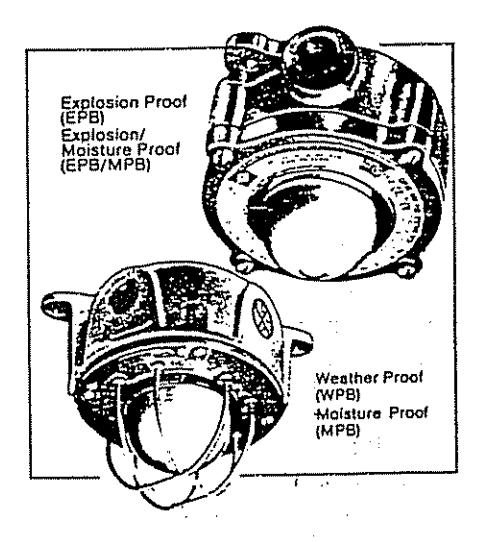
Series 500 Special Assembly Fire Detectors
are designed for use in applications requiring protection against weather, moisture (internal condensation), and explosive atmospheres.
A Series 500 unit is a dualaction, ultra-sensitive, electric fire detection thermostat.
It employs two independent methods of detection — rate-of-rise and fixed temperature.
The rate-of-rise method detects fires that rapidly grow in intensity. This method quickly responds to abnormally fast temperature increases.
The fixed-temperature method detects fires that build temperatures to a high level at a slow rate. This method responds to a specific temperature setting.
The Series 500 is an "open circuit" device designed to close an electrical circuit upon activation. The compact, simply designed unit is rugged and
unaffected by vibration. All metal parts are brass or aluminum, mounted on a durable, mineral-filled, phenolic base. No exposed metal parts carry current. Electrical contacts are all silver clad and of ample size.
Large line terminals and wire ways are provided in the base for easy and efficient installation in either open wiring or concealed wiring systems.
There are two dual action models with different fixed temperature element settings. Two other models are available with the same fixed temperature settings but without the rate-of-rise element.
Available in a wide variety of models as described on table, back page.
Principles of Operation
The rate-of-rise element consists of an air chamber, flexible metal diaphragm, and restricted orifice vent that can
be closely calibrated to control air flow rate in and out of the chamber.
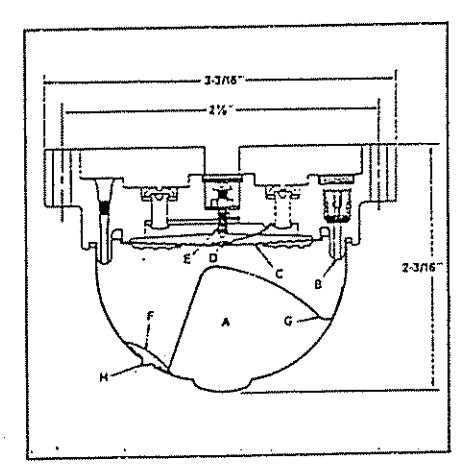
Air chamber (A) expands and contracts as ambient room temperature changes. Under normal temperature fluctuations, the unit "breathes" through calibrated vent (B). Under rapid temperature rise conditions, air expands faster than it can be vented, building up enough pressure to move thin metal diaphragm (C) until flexible silver contact (D) closes the electrical circuit against stationary contact (E).
If fieat is subsequently removed, pressure is relieved through the vent, and contacts restore to normal.
The fixed temperature element is entirely independent of rate-of-rise. It consists of a phosphor-bronze spring held under tension by standard fusible solder.
Spring (G) is held under tension by a spot of fusible eutectic alloy (F). When heated to its rated temperature, the alloy melts, releasing spring (G) and closing the contacts.
The shell provides a simple visual indication when a unit has been activated by high heat.
If the fixed temperature element operates, spring (G) is released, opening an easily visible hole (H) on the shell to signal the need for replacement.
TIL FILE SVSIGINS TO
Series 500 Special Assemblies
Weather Proof Models (WPB)
Cast metal back box, gasket, and special steel cover plate with attached standard mechanism. Crossed wire guard. Four wire entrances threaded for 1/2 inch rigid conduit.
Moisture Proof Models (MPB)
Provide features of weather proof models plus protection against condensation within conduit system. Emerging wire points sealed with epoxy.
Explosion Proof Models (EPB)
Cast metal back box, matching cover plate, and modified mechanism. Back box has two opposing wire entrances, threaded for 1/2 inch rigid conduit. Box, cover and base precision-machined for extremely close-tolerance fit.
Explosion Proof and Moisture Proof Models EPB-MPB
Combine features of explosion proof models and moisture proof models.
Explosion Proof Classifications
Explosion proof models are UL and FM listed for the following classifications: Class I, Group C. Atmospheres containing ethyl-ether vapors, ethylene, or cyclopropane.
Class I, Group D. Atmospheres containing gasoline, hexane, naphtha, benzine, butane, propane, alcohols, acetone, benzol, lacquer solvent vapors, natural gas.
Class II, Group E Atmospheres containing metal dust of aluminum, magnesium, or their commercial alloys.
Class II, Group F. Atmospheres containing carbon black, coal, or coke dust.
Class II, Group G. Atmospheres containing flour, starch, or grain dust.
Important Special Notes
Application: Heat detectors should be used for property protection. Reliance should not be placed solely on heat detectors for life safety. Where life safety is involved, smoke detectors must also be used.
Battery Back-Up: Heat detectors should be electrically supervised with battery back-up at the panel.
Testing: The rate-of-rise mechanism may be subject to reduced sensitivity over time. Annual testing of the rate-ofrise operation is recommended.
Replacements: When a special assembly model requires replacement, the entire assembly must be replaced as a unit, including box, plate and head (shell).
Chemetron Fire Systems, Inc. No. 7-000-0158 Printed in U.S.A. 10/86/10M
SPECIFICATIONS, SERIES 500 Special Assemblies
Model Cade No Markino On Shell
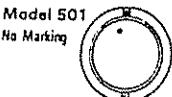
White Cot
Rate of rise and fixed
but not 150°F /66°C1
Model 503 Black Dot
Model 504 Black Dot on White
(<del>©</del>)
Description Rate-of-rise and Free Temperature, 136°F (58°C)
Normal temperature fluctuations and ceiling temperatures not exceeding 100°F (38°C)
Temperature, 190°F (88°C) Normal temperatures fluctures bors and cailing temperatures exceeding 100° (38°C)
Unusually violent temperature fluctuations and cailing problem of exceeding 100°F (38°C)
136°F [58°C].
Fixed Temperature Unity
Unusually violent temperature fluctuations and calling temperatures exceeding 100°F (38°C) but not 150°F (65°C)
Fixed Temperature Only
190°F (88°C).
Spacing
Application
Maximum Spacing Allowance, 50 tt x 50 ft (UL) 30 ft x 30 ft (FM.)
Maximum Scacino Allowance 15 ft x 15 ft (U.L. and F.M.)
Refer to NFPA Standard 72E for application requirements.
SPECIAL ASSEMBLY MODELS
| Weather Proof | Model WPB 501 | Model WPB 502 | Model WPB 503 | Model WPB 504 |
|---|---|---|---|---|
| Moisture Proof | Model MPB 501 | Model MPB 502 | Madel MPB 503 | Model MPB 504 |
| Explosion Proof |
Model EPB 501
Class I, Group C • Cl |
Model EPB 502
ass I, Group D • Class II. |
Model EPB 503
Group E • Class II, Group |
** / * |
|
Explosion and
Moisture Proof |
Madel EP8-MPB 501 | Model EPS-MPB 502 | Model EPB-MPB 503 | Model EPR-MPR SNA |
Dimensions
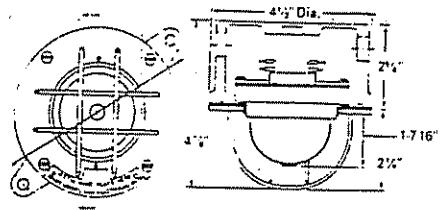
Weather Proof (WP8) Moisture Proof (MP8)
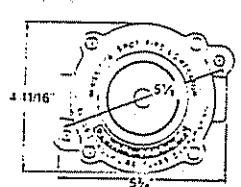
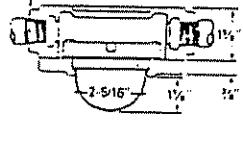
514
Explosion Proof (EPB) Explosion/Moisture Proof (EPB-MP8)
Series 500 Testing Methods
Models 501 and 502 can be tested by the application of quick heat from any convenient source. A common portable hair dryer is recommended. However, do not apply heat that exceeds the fixed temperature rating of the detector.
Models 503 and 504 cannot be tested. However, the fusible alloy element is generally considered so reliable that testing is not necessary.
Listings/Approvals
- U.L. Listed
- F.M. Approved
- Approved, Board of Standards and Appeals, N.Y.C.
- Approved, Fire Marshal, State of California
- Designed in accordance with NFPA Code 72E
The seller makes no warranties, express or implied including, but not limited to, the implied warranties of merchantability and fitness for a particular purpose, except as expressly stated in seller's sales contract or sales acknowledgement form.
Electrical Rating:
In all circuits, current flow through Series 500 should be limited to not exceed the following values:
3.0 AMP at 6-125 volts A.C.
1.0 AMP at 6-28 volts D.C.
0.3 AMP at 125 volts D.C.
0.1 AMP at 250 volts D.C.
Ordering Information
Please specify:
Series
Model
Temperature Rating
CHEMETRON Fire Systems **
Chemetron Fire Systems, Inc.
1000 Governors Highway University Park, Illinois 60466 Telephone: (312) 534-1000 Telex: 210261 CHEM UR
A FIGGIE INTERNATIONAL COMPANY 2
1-000-272-6287