Edwards Signaling AE Bulletin Voice Evacuation Basics
Open the original PDF document
View PDF


AEBN: 120210-9
Date: December 2, 2010
Subject: Fire Alarm Voice Evacuation Basics
NFPA requires that fire alarm notification appliances (in public mode) produce a minimum of 15dBA above ambient sound levels, or 5dBA above the maximum sound level having a duration of at least 60 seconds. Therefore, in large areas or areas with high ambient noise levels, you may think you have to always use very loud, high wattage speakers. Although this may be true to some degree, there's more to it than that.
There's a difference between audibility and intelligibility . While a single speaker may be loud enough to meet the audibility requirement, it may be so loud that it's not intelligible (sounds distorted) or is uncomfortably loud to people near the speaker. In some cases it may be better to use multiple speakers of a lower wattage spread through out a covered area, and you might even need less power to do it!
First, some sound basics...
- A sound output level using a dB scale does not take into account the hearing characteristics of the human ear. If using this scale, it must be associated with a frequency (ie 80dB at 1000Hz) for it to have any meaning. Although the general range for human hearing is between 20Hz and 20,000Hz, the human ear perceives the loudness of different frequencies differently, with the ear least sensitive to frequencies at the upper and lower ends . A 5,000Hz tone at 40dB, for example, would actually sound louder than a 100Hz tone at 40dB.
- A sound output level using a dBA scale is measured using a filter that adjusts the response (A-Weighting) so that the meter responds closer to the way a human ear would perceive the sound. The same 100Hz tone at 40dBA would now sound as loud as the 5,000Hz tone at 40dBA.
- A 3dBA change in sound output is about the smallest change the human ear can perceive.
- It requires twice as much power (wattage) to produce a 3dBA increase.
- A 10dBA increase in sound output is perceived by the human ear to be approximately twice as loud.
- It requires 10 times as much power to double the perceived loudness.
- Each time you double the distance from the source, you loose 6dBA. Conversely, each time you halve the distance, you gain 6dBA.

So how can you save on amplifiers by using more speakers? Here are a couple of examples…
Example #1 :
Let's say an office area that's 20ft across needs a minimum of 80dBA to meet the required signal level for evacuation. You decide to use a speaker that produces 88dBA at 10ft using a 2 watt tap. Double the distance to 20ft, and now you're at 82dBA (88dBA - 6dBA for doubling the distance), which meets the 80dBA minimum target.
Now let's see what happens if you use 2 speakers mounted on opposite walls… Each time you reduce the speaker power by half, the sound output only decreases by 3dBA. So if the speaker produces 88dBA at 10ft using the 2 watt tap, it will produce 85dBA at 1 watt, and 82dBA at 1/2 watt. Since the room is 20ft across, 2 speakers on opposite walls (each one covering 10ft) tapped at a 1/2 watt will give the same coverage as 1 speaker tapped at 2 watts, for half the total wattage!
Example #2 :
You need to cover an area like a machine shop or manufacturing plant that's 40 feet across. You determine this will require a minimum of 87dBA throughout. You've got a speaker that will produce 99dBA at 10ft using a 15 watt tap. If you do the math, 99dBA at 10ft equals 93dBA at 20ft, which equals 87dBA at 40ft. 87dBA meets the requirements.
However, 99dBA is very loud and would cause discomfort to anyone standing near the speaker when the system goes into alarm. If you reduce the wattage, the dBA will decrease, making it more comfortable for those people close to the speaker. But you still need to get the proper coverage (87dBA minimum throughout).
Using the 15 watt tap you get 87dBA at 40ft. So at 8 watts you would get 84dBA, and at 4 watts you would get 81dBA. But if you halve the distance to 20ft and mount a speaker at opposite ends of the room, you'll get the same 87dBA (81dBA + 6dBA for halving the distance). This would not only reduce the discomfort level to people near a single, very loud speaker, it would also reduce the total wattage needed from 15 to 8!

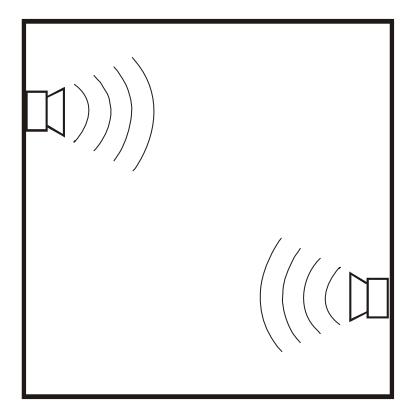
It should also be noted that when you are mounting speakers on opposite walls, you should not have any two be directly opposite each other. The speakers should be mounted off center from one another, or staggered, as shown below for best results.
(View looking down into room)
This bulletin is intended to be a guide, and the information given assumes ideal conditions. Actual room acoustics and speaker placement can effect sound dispersion. Sound will travel differently in rooms with hard surfaces verses rooms with carpeting and curtains. To achieve proper results, dBA measurements should be taken to get ambient sound levels before starting the design/layout, and then again after installation during an "alarm" condition to be sure you have proper coverage.