Edwards Signaling AE Bulletin E-FSA Panel Cross Zoning
Open the original PDF document
View PDF


AEBN: 091710
Date: September 17, 2010
Subject: E-FSA Panel Activation Count (Cross Zoning)
With cross zoning, multiple (2 or more) alarm input devices must activate before a programmed output device will activate. This can be useful when you want to be sure an event has occurred (a fire) before action is taken (activate an output). For example, in an elevator lobby you may have two smoke detectors. In order for the elevator control relay to activate and recall the elevator, both smoke detectors must go into alarm. With version 2.0 (or higher) panel firmware and v3.2 (or higher) FSA-CU configuration utility, you can now perform cross zoning functions.
In the Correlation section of the FSA-CU there is an Activation Count window in the upper right side. Activation Count determines how many input devices that are part of the correlation group must activate before all the output devices in that correlation group will activate. If the Activation Count is 2, then two of those inputs must go into alarm before the outputs will activate.
You can have as many input devices be part of the correlation group as you want, and have the Activation Count be any number (up to the number of input devices in the group). If there are 20 devices in the correlation group, and the Activation Count is 2, then only two (any two) of those devices must alarm for the outputs to trip. If the Activation Count is 20, then all the devices must alarm before the outputs trip.
Some things to note… An input device can be part of more than one correlation group. In a general alarm scenario, you would have one correlation group that includes all the alarm input devices and all the signal circuits. The Activation Count for this would be 1 (any one input alarm would trip all signals). You can also have certain devices that require cross zoning, as in the elevator recall example. The two smoke detectors in the elevator lobby would not only be part of the general alarm group (if either alarm, all the signals would sound), they would also be part of a cross zoning group ( both must activate for the relay to trip).
Also note that when an alarm input device activates, the panel will display an alarm (and call a central station is so equipped) regardless of what the Activation Count is. Activation Count only controls when outputs (signals, relays, etc) are turned on. Activation Count is not the same as alarm verification (a single smoke detector must sense smoke for an extended length of time before the detector itself goes into alarm).


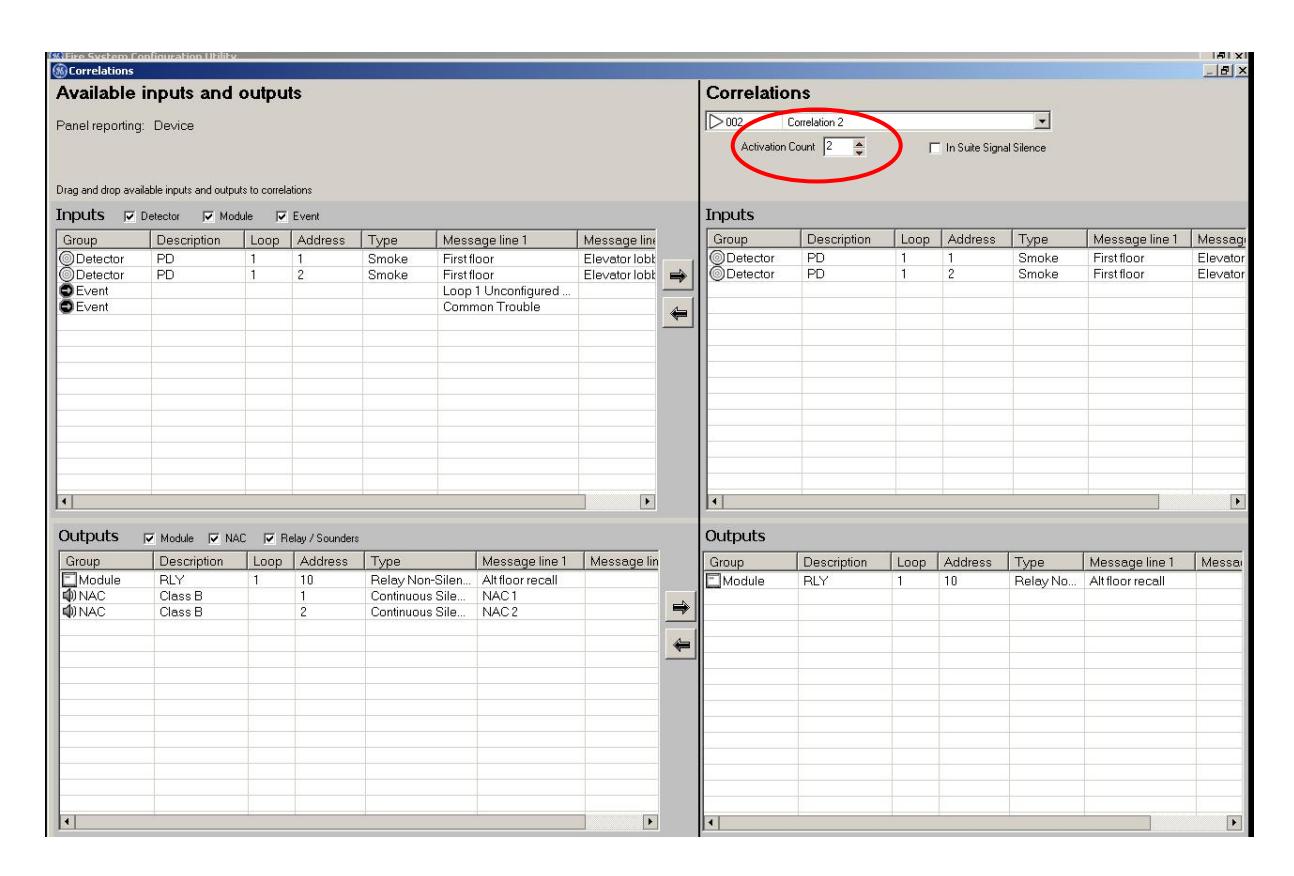
In the above snapshot from the FSA-CU there are 2 elevator lobby smoke detectors that are part of correlation group 2 (upper right). The Activation Count is set for 2, which means that both detectors must alarm before the relay at address 10 trips (lower right).