Edwards Signaling AE Bulletin Door Holders and Fire Alarm
Open the original PDF document
View PDF


AEBN: 111610
Date: November 16, 2010
Subject: Door Holders and Fire Alarm Panels
There is more than one way to power and control door holders used with fire alarm systems. Typical operation would be when there is an alarm, power would be dropped to the door holders, which would release and close the fire doors. Often this is done on a global basis (any alarm will drop power to all door holders), but sometimes the door holders may be controlled in groups.
The following are some examples of how you can wire door holders, with pros and cons to each…
Example 1:
This first example may be the easiest (and most common). Power is taken from the panel's aux power ( not signal power) . One leg of power is wired through the normally closed alarm contact. Upon alarm, the contact opens, dropping power to the door holders.
The draw back here is the power for the door holders will be backed up by the panel's batteries. This means you will have to figure the door holders' current draw into the battery calculations, which may significantly increase your battery size. Door holder power does not have to be battery backed up, because if there is a loss of power, the doors will close (fail safe). If you have multiple door holders, which in turn would require you to use a larger battery, you may want to consider using an external (non-battery backed up) power source.
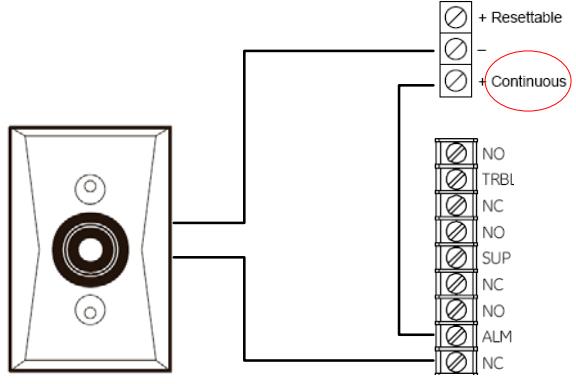
Panel's aux power and common alarm relay

Example 2:
Here the panel's common alarm relay is still being used to control the power to the door holders, but now the power is from an external source that is not battery backed up. With this arrangement you have to be sure that the panel's contacts are rated for whatever power source you use. The Edwards E-FSC conventional and E-FSA addressable series panels' contacts, for example, are rated for 24Vdc and 30Vdc respectively, 1 amp,
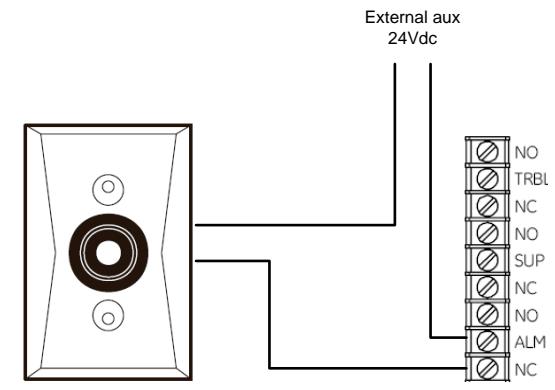
External power source and panel's alarm relay
Example 3:
With the E-FSA addressable panel, you can use an addressable relay module to control the power to the door holders. Because the relay module has a wider contact rating (2A @ 30Vdc; .5A @ 120Vac), you will have more choices for a power source, including a simple transformer (Edwards' 1500 series door holders can be powered from 24Vdc, 24Vac, or 120Vac). You can also mount the relay module wherever it's convenient. With this example, however, you will have to program the E-RLY relay module to activate during an alarm (the common alarm relay in the panel automatically activates upon any alarm).
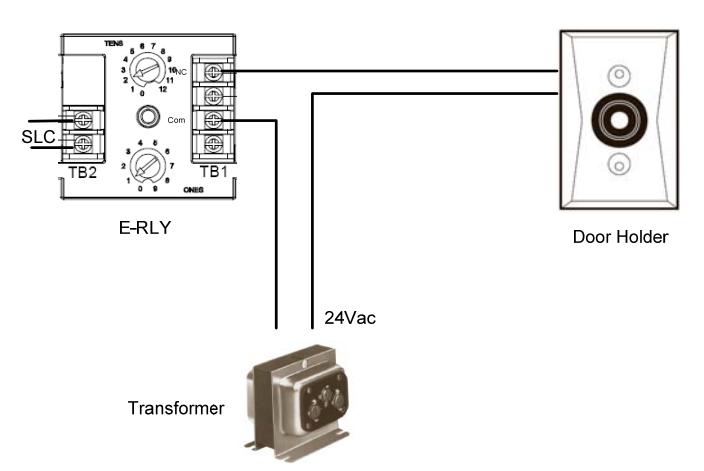
External power source and addressable relay

While these are not the only ways to control door holders, the basic operation will be the same regardless: Drop power to door holders to close the fire doors during an alarm. Whichever way you choose, be sure not to exceed the relay contact's rating or the total current available from the power source. Also note that because the door holders will operate in "fail safe" mode, the circuit wiring does not have to be supervised (a break in the wiring will drop power to holders, closing the door).
For additional information, refer to the fire alarm panel's manual and device's installation instructions.