Edwards Signaling 970524 Technical Bulletin
Open the original PDF document
View PDF


Edwards Signaling Products 90 Fieldstone Court Cheshire, CT 06410 (203) 699-3000 FAX (203) 699-3108
Technical Bulletin No.: 970524 Date: 2/4/00
Product: Chameleon Product Category: AdaptaBeacons
Subject: PLC Connectivity of 103 Chameleon
The Chameleon 103I Series features an on-board processor with an internal jumper, which allows the single unit to function as either a steady or flashing visual signal. Either a PLC or contact closure can activate any one or all three lights. The first light activated will illuminate either steady or flashing (determined by the internal jumper position). When a second light is activated, the Chameleon cycles between the two colors and activation of a third light causes it to cycle between all three colors.
The 103 model performs similar to the 103I, but all signal operation in the 103 is controlled directly through a PLC's ladder logic, rather than through the Chameleon's internal processor. The PLC will control which color LED's are on, how long they are on and whether they are steady-on or flashing.
For PLC connectivity, there are two considerations that need to be addressed for proper operation of the Chameleon Multi-status Indicator. The first consideration has to do with the type of output card utilized on your PLC. Both the 103 and the 103I require the PLC to have a Sinking Output card. For the Chameleon to operate properly you must have a Sinking Output. The illustration below shows a Sinking Output.
NOTE: It is important to make sure the Output Card on your PLC has a Sinking Output.
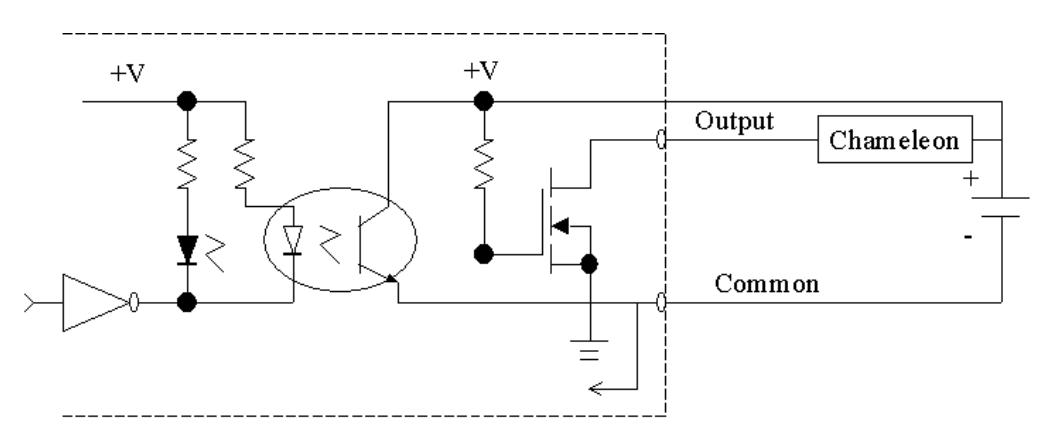
The second consideration has to with 120VAC units. A resistor has to be added to the circuit to eliminate any leakage current that can false activate the Chameleon. The following calculation will guide you in determining the proper size resistor to use with your specific PLC.
Step 1:
ILPLC – IMLChameleon + 2 mA = IDissipated
Where;
ILPLC = Leakage Current from your PLC
IMLChameleon = Maximum Allowable
Leakage Current for the
Chameleon
2 mA = Tolerance Factor
IDissipated = The amount of current to be dissipated
Step 2:
VOutput / IDissipated = R
Where;
VOutput = 120VAC Output from your PLC
IDissipated = The amount of current to be
dissipated
R = Resistor value to dissipate leakage
current
Step 3:
P = IDissipated * VOutput
Where;
P = Wattage rating for your dissipating
resistor
VOutput = 120VAC Output from your PLC
IDissipated = The amount of current to be
dissipated
Example:
Your 120 VAC PLC output card has a leakage current of 15 mA. What size resistor will you need to use to dissipate the leakage current?
Step 1:
ILPLC – IMLChameleon + 2 mA = IDissipated
15 mA – 5 mA + 2 mA = 12 mA
Step 2:
VOutput / IDissipated = R
120VAC / 12 mA = R
R = 10,000 ohms
Step 3:
P = IDissipated * VOutput
P = 12 mA * 120 VAC
P = 1.44 watts
Therefore, your resistor needs to be
10,000 ohms and 1.5 watts.
PLC Electrical Characteristics
As with any product being connected to the output card of a PLC, there are certain electrical characteristics that must be taken into consideration.
-
1. Operating Voltage the voltage that must be applied to the unit for it to function properly.
- Criteria The operating voltage must be within the range of the PLC output card.
- What if the signal is rated higher than the PLC output card? The signal will not function properly.
- What if the signal is rated lower than the PLC output card? The signal could be damaged by over voltage and the PLC card could also be damaged.
-
2. Surge (inrush/duration) The instantaneous current surge that occurs each time the signal is turned on. It is defined as a current over a period of time.
- Criteria Both current magnitude and time duration of the surge inrush, for the signal, must be within the range specified for the PLC output card.
- What if the signal surge current falls within the range, but the time duration for the surge is beyond the range compared to the PLC output card and vice versa? - The user should consult with the PLC manufacturer for additional data. Failure to do so could damage the output card.
-
3. Continuous-on Current The current that the signal will draw in continuous operation.
- Criteria For Triac outputs there are two criteria to consider, the minimum load required by the output card to keep it turned on and the continuous-on current that the card can safely supply. The continuouson current for the signal must fall between the minimum load current and the continuous- on current of the PLC, for the signal to function.
- What if the signal's continuous-on current is below the minimum load current for the PLC? - The signal will not function because the PLC will not turn on.
- What if the signal's continuous-on current is above the continuous on current rating for the PLC? - The PLC output card could be damaged due to excessive current draw.
-
4. Off State Leakage Current The current that leaks from the PLC in it's off state.
- Criteria The off state leakage current from the PLC must be less than the maximum allowable off state leakage current for the signal.
- What if the off state leakage current from the PLC is greater than the maximum allowable off state leakage current for the signal? - The signal may turn on and false activate.
Electrical Characteristics for the 103 Series Chameleon
| Operating | Max. off state | Continuous | Surge | |
|---|---|---|---|---|
| Voltage | leakage current | on current | (Inrush/duration) | |
| Cat. No. | Volts | mA | mA | A/mSeconds** |
| 103-RBA-G1 | 24V DC | 5 | 65 | 0.070/8 |
| 103-RGA-G1 | ||||
| 103-RBA-N5 | 120V AC | 5 | 55 | 0.100/8 |
| 103-RGA-N5 |
Electrical Characteristics for the 103I Series Chameleon
| Operating | Max. off state | Continuous | Surge | |
|---|---|---|---|---|
| Voltage | leakage current | on current | (Inrush/duration) | |
| Cat. No. | Volts | mA | mA | A/mSeconds** |
| 103I-RBA-G1 | 24V DC | 5 | 55 | 0.070/8 |
| 103I-RGA-G1 | ||||
| 103I-RBA-N5 | 120V AC | 5 | 45 | 0.100/8 |
| 103I-RGA-N5 |
* All AC volts at 60 Hz ** Amps/milliseconds
* All AC volts at 60 Hz ** Amps/milliseconds