Edwards Signaling 5522M-AQ – 5523M-AQ and 5522M-Y6 – 5523M-Y6 Installation Instruction
Open the original PDF document
View PDF

5522M and 5523M Duotronic Signal Installation Sheet
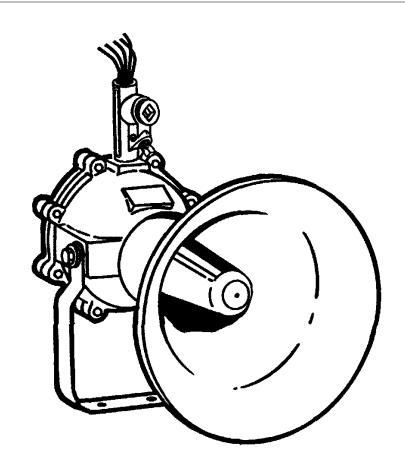
Description
The 5522M and 5523M Duotronic Signals are high decibel signaling appliances intended for indoor use where distinctive audible signals are required in hazardous locations. The 5522M series are horns and the 5523M series are sirens. The units are rated at an average 110 dB.
The 5522M and 5523M series are UL and cUL listed for use in the hazardous locations shown in Table 2.
The flange bolts of all series of the signals are sealed in accordance with UL requirements to prevent disassembly and tampering.
This equipment is suitable for use in Class I, Division 1, Groups B, C, and D; Class I, Division 2, Groups A, B, C, and D hazardous locations for General Signaling Service.
Installation
Install and wire this device in accordance with applicable national and local codes, ordinances, and regulations, and in a manner acceptable to the local authority having jurisdiction.
When the device is used in general signaling applications, you must install it in accordance with these instructions, and with the applicable requirements of NFPA 70 in the US or CSA C22.1 in Canada.
When the device is used in Division 2 applications, you must install it in accordance with the NFPA 70 Article 501-4b.
WARNINGS
- Explosion hazard. Do not disconnect equipment unless power has been removed or the area is known to be nonhazardous.
- Explosion hazard. Substitution of any components may impair suitability for Class I, Division 2.
- Explosion hazard. Do not disconnect equipment while the circuit is live or unless the area is known to be free of ignitable concentrations.
- To prevent fire, shock and component damage, no work, including circuit board removal, should be performed while the circuit is energized.
To install the signal:
- 1. Choose the mounting location. The horn or siren can be mounted on any solid surface. Ensure that the mounting location provides adequate clearance to enable adjustment of the signal to the desired position after mounting. The signal position can be adjusted within an approximate 180-degree range vertically or horizontally depending on the mounting of bracket.
- 2. Mount the unit in the selected location using its mounting bracket and three bolts (not supplied). See Figure 1 for the unit size and the location of mounting holes.
- 3. Adjust the signal direction as desired, by loosening the two bolts shown in Figure 1. Rotate the signal to the desired position, and then tighten the bolts.
-
4. Wire the unit as shown in Figure 2
- a. Remove cover from the conduit outlet box (not supplied). Note that the outlet box must be suitable for use in the hazardous location.
- b. Feed the two power supply wires through the 1/2 in. NPT conduit (not supplied) into the outlet box.
- c. Feed the signal's two power connection wires either directly into the outlet box or, if desired, through a 1/2 in. flexible type coupling (not supplied) and then into box.
WARNING: Do not apply power to the unit until installation is completed and the housing cover and outlet box cover are secured.
- d. Secure the outlet box to the signal's 1/2 14 NPT sealed nipple either directly or by flexible coupling, and then secure the conduit to outlet box.
- e. Connect the power supply wires using two wire nuts (not supplied). Polarity need not be observed when making connections for a DC voltage source.
- 5. Replace the cover securely on the conduit outlet box.
- 6. Apply power to the signal and verify that it sounds correctly.
Figure 1: Signal dimensions and mounting details
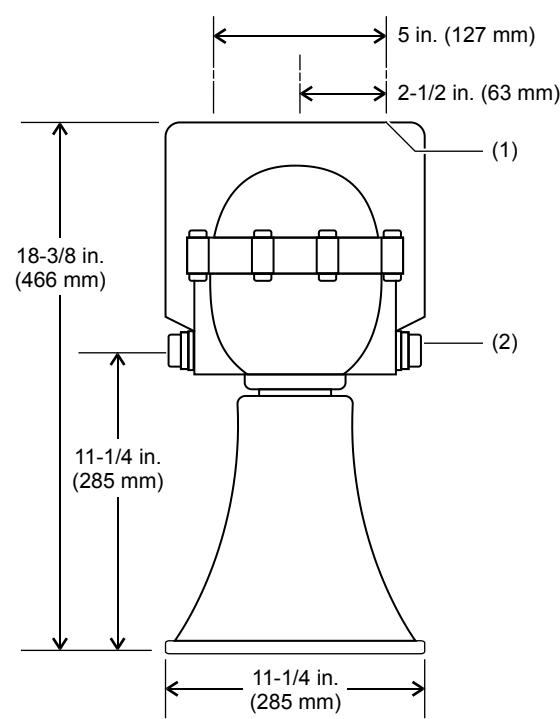
- (1) 1/2 in. (13 mm) mounting holes (3X)
- (2) Bolts for adjusting signal direction (2X)
Figure 2: Wiring installation and connections
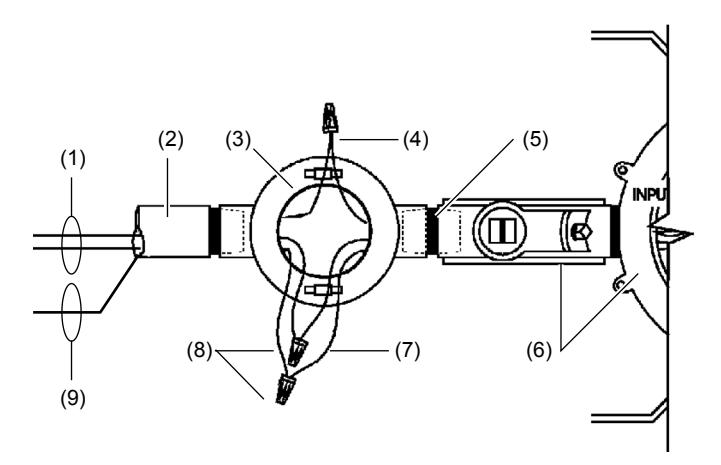
- (1) Power supply wires from selected AC or DC voltage source for signal (2X)
- (2) 1/2 in. NPT conduit (not supplied) attached to outlet box
- (3) Outlet box suitable to hazardous location
- (4) Green wire for earth ground
- (5) 1/2 14 NPT nipple (not supplied)
- (6) Adaptatone signal
- (7) Power connection wires from signal (2X)
- (8) Wire nuts (not supplied)
- (9) To earth ground
Maintenance and testing
Examine the unit semi-annually for external accumulation of dirt. Clean if necessary.
Test the signal monthly or at the intervals required by applicable regulations and codes.
Specifications
| Refer to Table 1 |
| Refer to Table 1 |
| 18.4 lb. (8.4 kg) |
| −31 to 104°F (−35 to +40°C) |
| −40 to 151°F (−40 to +66°C) |
[1] Hazardous locations and variable ambient conditions apply only where UL Listings are accepted.
Table 1: Input power
| Model | Voltage | Current (A) |
|---|---|---|
| 5522M-AQ | 24 VDC | 0.32 |
| 5523M-AQ | 24 VAC 50/60 Hz | 0.95 |
| 5522M-Y6 | 125 VDC | 0.130 |
| 5523M-Y6 | 250 VDC | 0.130 |
| 120 VAC 50/60 Hz | 0.260 | |
| 240 VAC 50/60 Hz | 0.260 |
Table 2: Hazardous locations
| Model number | Hazardous location | Temperature code |
|---|---|---|
|
5522M-AQ
5522M-Y6 5523M-AQ 5523M-Y6 |
Class I, Div. 1, Groups B, C,
and D |
T5 (100°C, 212°F) |
|
Class I, Div. 2, Groups A, B,
C, D |
Regulatory information
| Ratings |
ANSI/ISA 12.12.01
CAN/CSA C22.2 No. 30 CAN/CSA C22.2 No. 205 UL 464 |
|---|---|
| UL 1203 | |
| UL 1480 |
Contact information
For contact information, see www.edwardssignaling.com.