Edwards Signaling 301-BT Series Installation Instructions
Open the original PDF document
View PDF

GuardSwitch Series 300 Safety Interlock Switch 301-BT Installation Sheet
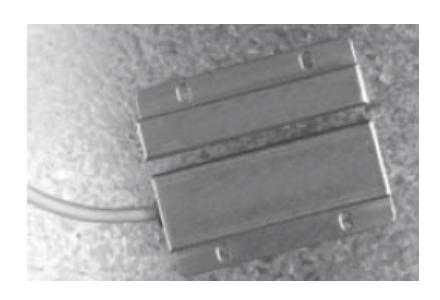
Description
The GuardSwitch Series 300 Safety Interlock Switch 301-BT is designed for use with safety monitored relays or monitored circuits. To achieve the optimum defeat resistant features of the switch, both the switch circuit (Circuit 1) and the tamper circuit (Circuit 2) must be connected. An optional third circuit can be provided to indicate at the panel which guard is open.
Notes
- Environmental: Pollution Degree II.
- Correct use of this control device is an essential part of proper machine cycle control.
- Failure to follow all instructions could lead to serious bodily injury or death.
- Maintenance to be done by qualified personnel only.
- The connecting cables between the INT devices and the switches must be located in an IP 23 type enclosure (minimum).
- The mounting for the switch and the actuator magnet must be accomplished per this specification.
- Nonremovable hardware must be used for installation.
- The housing of the switch must be connected to the PE (primary earth) ground circuit via a lock washer on the mounting screw. The PE ground symbol must be placed adjacent to the screw.
To verify switch operation with an ohmmeter:
Set range at 20 MΩ (switches with triac output, set range at 20 kΩ). For a normally open switch, the meter will read a high impedance with the actuator away. It will read very high to infinity range (triac switches will read high kΩ to infinity range) with the actuator within sense range. You will see the opposite reading for a normally closed switch.
Installation
Use nonremovable screws, bolts, or nuts to mount the switch and actuator. Do not over-torque mounting hardware. See Figure 1 for dimensions.
Caution: When used without a Sentrol INT relay, particular care must be taken to determine the actual load of the switch circuit. High voltage transients from coils, motors, contactors, and solenoids must be considered. Transient protection, such as back-to-back zener diodes (TransZorb) or an RC network, is recommended for such loads to ensure that maximum ratings of the switch are not exceeded. Not recommended for use with tungsten filament loads because of high current inrush surges. Line capacitance and load capacitance must be considered.
Excessive line capacitance can be caused by cable lengths over 50 ft. when using a maximum 48 VAC. A resistor can be added in series to limit the inrush current (at least 48 Ω for 24 V applications).
The resistor can be added in series just before the load.
The voltage drop and the power rating of the resistor must be considered.
Voltage drop = I × R Wattage = I² × R (I = maximum continuous current of the load)
To install the switch:
- 1. Position the switch and actuator so the labels are reading in the same direction (see Figure 2).
- 2. Mount the switch on the stationary frame of the machine and mount the actuator on the moveable guard, door, or gate. Keep the switch and actuator within the listed sense range. See "Ordering information" on page 4 for sense ranges. See Figure 3 for recommended mounting configurations.
- 3. Mounting on a ferrous material will affect the sense range a minimum of 50%. However, a 1/4 in. nonferrous spacer positioned under the magnet and/or switch should restore most of the lost sense range.
- 4. For best protection against operator defeat, mount with nonremovable screws, bolts, or nuts. See ordering information for details.
- 5. When mounting the switch on an ungrounded machine, ground the switch housing by connecting your ground lead to one of the switch mounting screws.
Figure 1: Dimensions
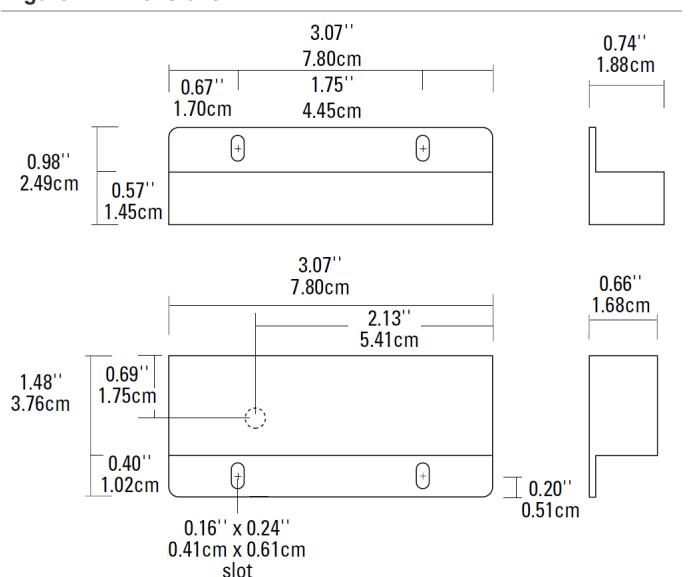
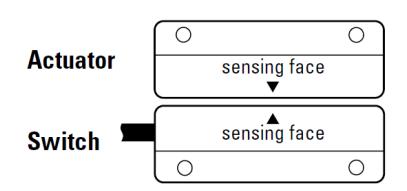
Figure 3: Mounting configurations
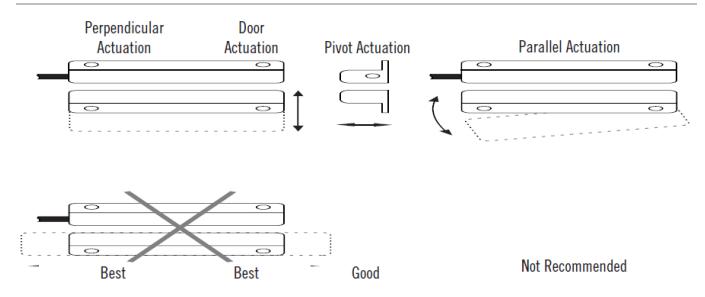
Figure 4: Circuits
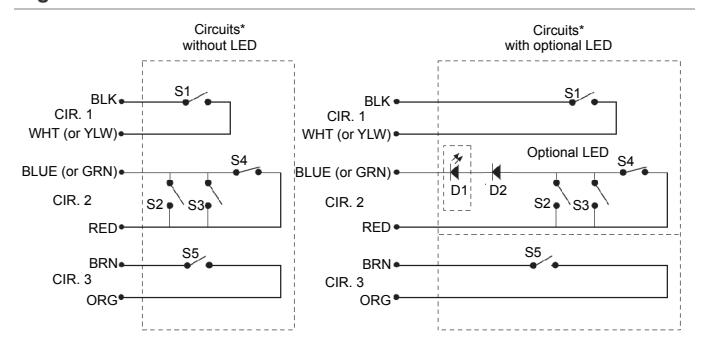
*Circuits shown with magnet actuator away from switch.
| S1, S5 | Normally open reed switch, closed when actuator is within 0.6" | |||
| S2, S3 | Normally open reed switches, will close if misaligned or tampered with a standard magnet | |||
| S4 | Biased closed reed switch, open when actuator is between 0.3" and 0.6" | |||
| NO circuit | Black, white, or yellow wires. | |||
| NC biased tamper circuit | Red, blue, or green wires. | |||
| NO monitor circuit | Orange and brown wires. | |||
Note: For white and blue colors, see the optional color codes shown in Figure 4.
Figure 5: Wiring for category 3
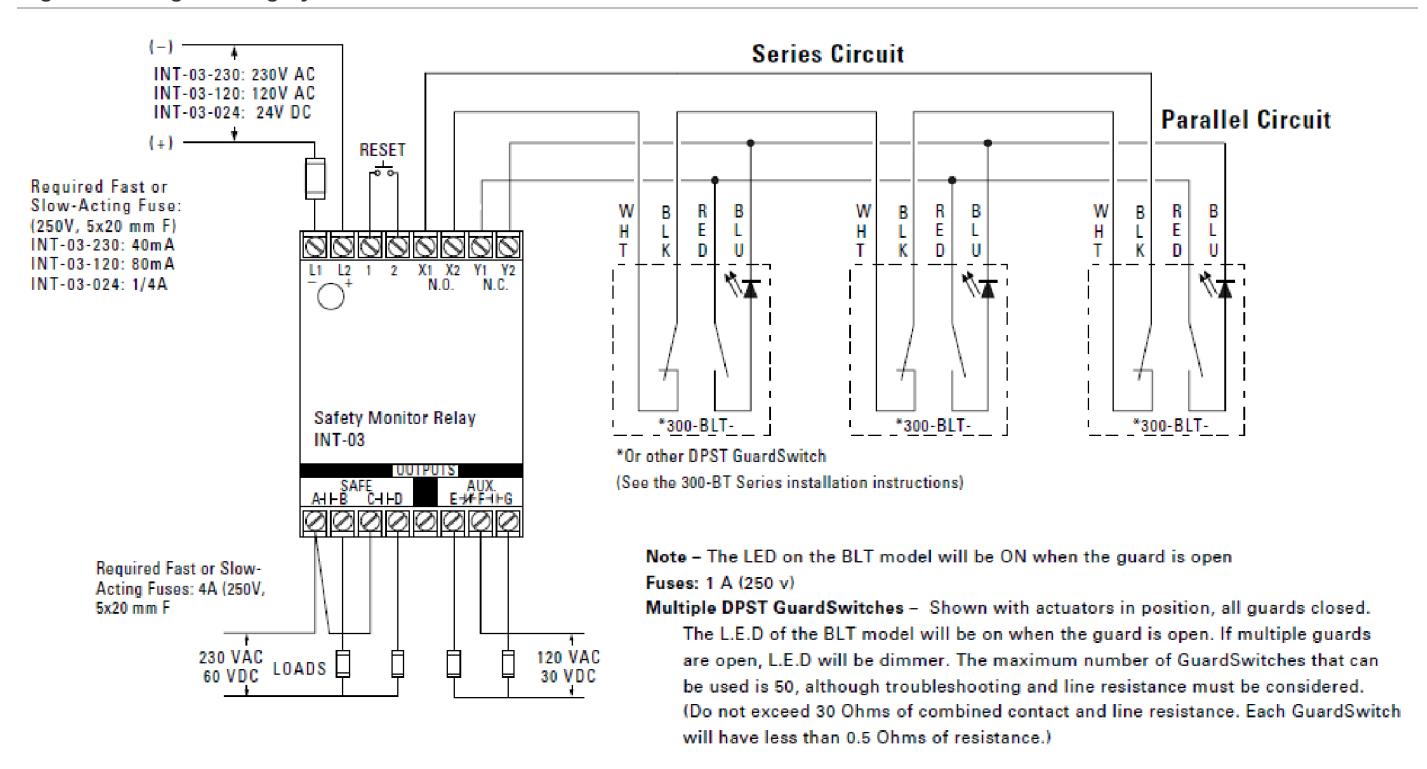
Note: For white and blue colors, see the optional color codes shown in Figure 4.
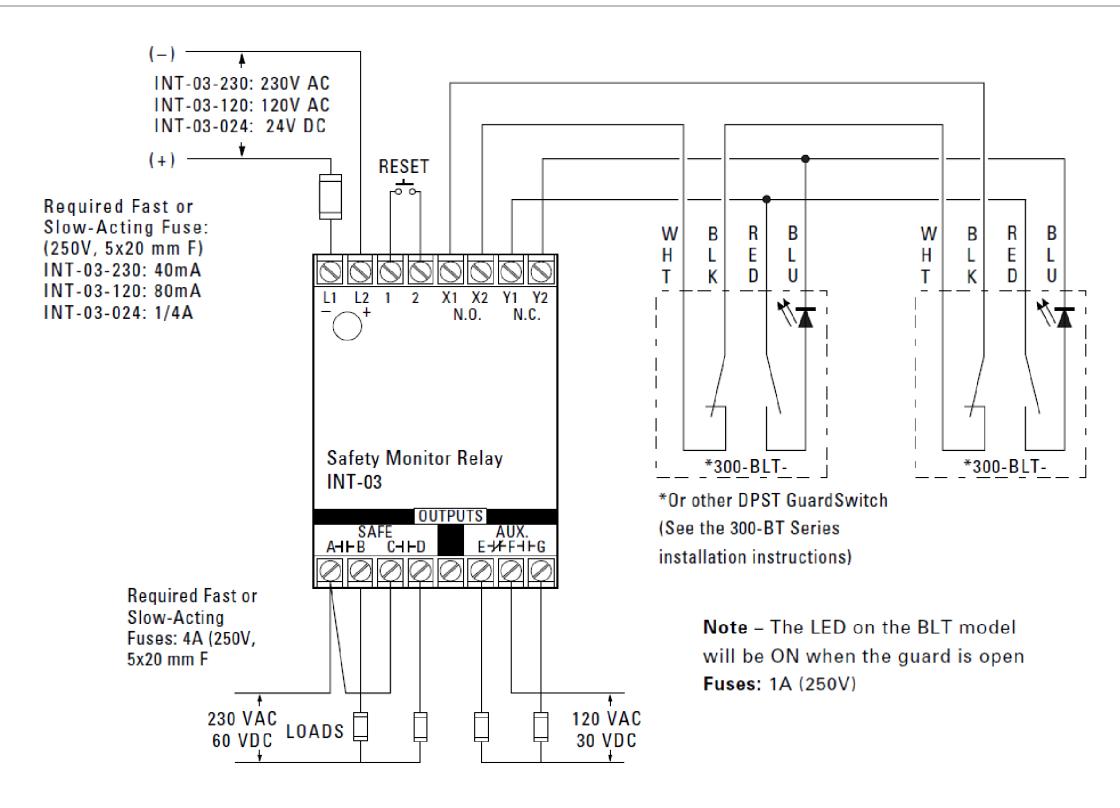
Note: For white and blue colors, see the optional color codes shown in Figure 4.
Specifications
General specifications
| Enclosure | 304 folded stainless steel |
|---|---|
|
Temperature
range |
−40°F to 180°F (−40°C to 80°C) |
| Environmental |
Hermetically sealed contact switch, encapsulated
in polyurethane |
| NEMA rating | 1, 2, 4, 4X, 5, 12, 12K |
| Protection class | IP 66 |
| Response time | 1 msec (5.4 VA); 10 msec (150 VA) |
| Individual circuits |
The two circuits do not switch simultaneously,
and depend on the speed of the guard closure. Based on closure speed of 1 ft. per second and a gap of 1/8 in., a delay less than 50 msec is typical. |
| Life cycles | 100,000 under full load |
| Up to 200,000,000 under dry circuit | |
| Lead types/O.D. | 18/4 SJTOW (K) / 0.34 in. (0.86 cm) |
| 22/4 PVC Jacketed (J) / 0.19 in. (0.48 cm) | |
| 22/6 PVC Jacketed (J) / 0.21 in. (0.53 cm) |
Accessories
| Part number | Tamper proof screws and screwdriver |
|---|---|
| 1953 | #6 x 3/4 in. L Tampruf Roundhead Screw |
| 1954 | #8 x 1-1/2 in. L Tampruf Roundhead Screw |
| 1955 | Tampruf Screwdriver |
| 1956 | Tampruf 1/4 in. Drive Bit for #6 and #8 screws |
Electrical specifications [1]
| Circuit number | Circuit type | Contact configuration | Load rating | Switching voltage | Switching current |
|---|---|---|---|---|---|
| 1 | Switch: S1 | NO | 40 W/VA | 48 VAC/VDC | 1.0 A DC, 0.7 AAC |
| 2 | Tamper: S2, S3, S4 | NC | 10 W/VA | 48 VAC/VDC | 0.2 A |
| 2 | With optional LED: D1 | NC | 0.1 to 1.4 W | 48 VDC(3 V drop) | 30 mA |
| 3 | Monitor: S5 | NO | 10 W/VA | 48 VAC/VDC | 0.3 ADC, 0.3 AAC |
[1] IMPORTANT: Each electrical rating is an individual maximum and cannot be exceeded.
P/N 13924 • REV F • ISS 09SEP15 3 / 4
Ordering information
| Part number [1] | Contact configuration [2] |
Sense range
minimum [3] |
Sense range
maximum [3] |
Break range |
Lead length
nominal |
|---|---|---|---|---|---|
| 301-BT-06(J)(K) | DPST: 1 NO, 1 NC | 0.3 in. (0.8 cm) | 0.6 in. (1.5 cm) | 1.2 in. (3.0 cm) | 6 ft. (1.8 m) |
| 301-BT-SPNHJ6 [4] | DPST: 1 NO, 1 NC | 0.6 in. (1.5 cm) | 1.2 in. (3.0 cm) | 6 ft. (1.8 m) | |
| 301-BT-12(J)(K) | DPST: 1 NO, 1 NC | 0.3 in. (0.8 cm) | 0.6 in. (1.5 cm) | 1.2 in. (3.0 cm) | 12 ft. (3.6 m) |
| 301-BT-SPNHJ12 [4] | DPST: 1 NO, 1 NC | 0.6 in. (1.5 cm) | 1.2 in. (3.0 cm) | 12 ft. (3.6 m) | |
| 301-BT-SPNHJ15 [4] | DPST: 1 NO, 1 NC | 0.6 in. (1.5 cm) | 1.2 in. (3.0 cm) | 15 ft. (4.6 m) | |
| 301-BT-20J | DPST: 1 NO, 1 NC | 0.3 in. (0.8 cm) | 0.6 in. (1.5 cm) | 1.2 in. (3.0 cm) | 20 ft. (6.1 m) |
| 301-BT-SPNHJ25 [4] | DPST: 1 NO, 1 NC | 0.6 in. (1.5 cm) | 1.2 in. (3.0 cm) | 25 ft. (7.5 m) | |
| 301-BLT-06(J)(K) | DPST: 1 NO, 1 NC w/LED | 0.3 in. (0.8 cm) | 0.6 in. (1.5 cm) | 1.2 in. (3.0 cm) | 6 ft. (1.8 m) |
| 301-BLT-12(J)(K) | DPST: 1 NO, 1 NC w/LED | 0.3 in. (0.8 cm) | 0.6 in. (1.5 cm) | 1.2 in. (3.0 cm) | 12 ft. (3.6 m) |
| 301-B3T-06J | TPST: 2 NO, 1 NC | 0.3 in. (0.8 cm) | 0.6 in. (1.5 cm) | 1.2 in. (3.0 cm) | 6 ft. (1.8 m) |
| 301-B3T-12J | TPST: 2 NO, 1 NC | 0.3 in. (0.8 cm) | 0.6 in. (1.5 cm) | 1.2 in. (3.0 cm) | 12 ft. (3.6 m) |
| 301-B3T-20J | TPST: 2 NO, 1 NC | 0.3 in. (0.8 cm) | 0.6 in. (1.5 cm) | 1.2 in. (3.0 cm) | 20 ft. (6.1 m) |
| 301-B3T-SPNHJ12 [4] | TPST: 2 NO, 1 NC | 0.6 in. (1.5 cm) | 1.2 in. (3.0 cm) | 12 ft. (3.6 m) | |
| 301-B3T-SPNHJ25 [4] | TPST: 2 NO, 1 NC | 0.6 in. (1.5 cm) | 1.2 in. (3.0 cm) | 25 ft. (7.5 m) | |
| 301-B3LT-12(J)(K) | TPST: 2 NO, 1 NC w/LED | 0.3 in. (0.8 cm) | 0.6 in. (1.5 cm) | 1.2 in. (3.0 cm) | 12 ft. (3.6 m) |
[1] For all 301 models, the cable exits from the left side.
Regulatory information
| Model number | UL | CSA | |
|---|---|---|---|
| 301-BT-06(J)(K) | X | X | |
| 301-BT-SPNHJ6 | |||
| 301-BT-12(J)(K) | X | X | |
| 301-BT-SPNHJ12 | |||
| 301-BT-SPNHJ15 | |||
| 301-BT-20J | X | X | |
| 301-BT-SPNHJ25 | |||
| 301-BLT-06(J)(K) | X | X | |
| 301-BLT-12(J)(K) | X | X | |
| 301-B3T-06J | X | ||
| 301-B3T-12J | X | ||
| 301-B3T-20J | X | ||
| 301-B3T-SPNHJ12 | |||
| 301-B3T-SPNHJ25 | |||
| 301-B3LT-12(J)(K) | X | ||
| UL file number | E122942 | ||
| CSA file number | 089176 |
Contact information
For contact information, see www.edwardsfiresafety.com.
© 2015 Walter Kidde Portable Equipment, Inc. All rights reserved.
[2] Configuration with actuator away from the switch.
[3] Proximity of ferrous materials usually reduces sense range — typically by 50%. The shape and type of material cause a wide diversity of effects. Testing is required to determine actual sense range for specific applications.
[4] The NH version does not have a minimum sense range.