DynaLock 3101B-ETR Series Installation Instructions
Open the original PDF document
View PDF
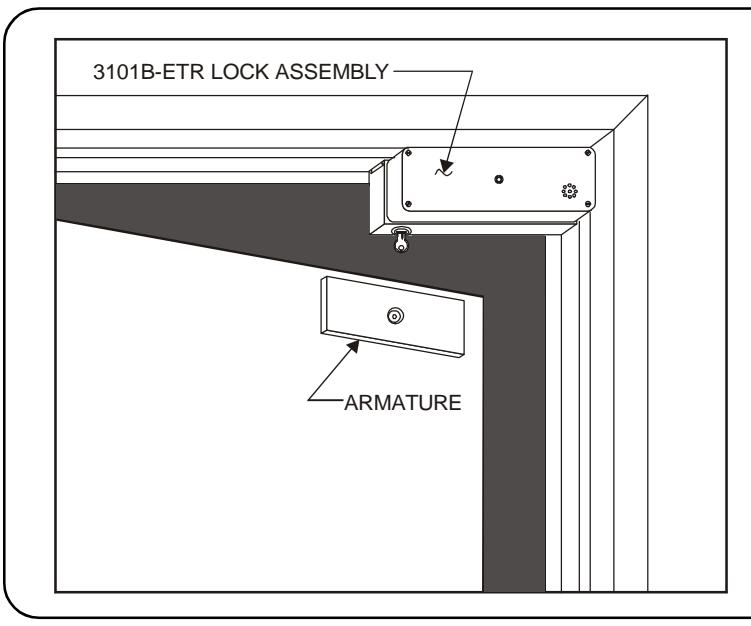
INSTALLATION DESCRIPTION
The 3101B-ETR (Externally Triggered Release) Delay Egress System is a 1500 pound holding force electromagnetic lock electronically controlled to provide a 15 or 30 second delay in unlocking. Delayed egress is activated by an external dry contact closure usually provided by a switch located in an exit device.
The 3101B-ETR requires both mechanical and electrical installation procedures as described herein.
02/02
HANDLING
The electromagnetic lock and armature are ruggedly constructed and designed to provide years of trouble-free service. Care must be taken during installation and use that the lock face and armature face are kept free of dirt, rust, paint, or any other obstruction which may interfere with the lock and armature making good contact.
MECHANICAL INSTALLATION
Familiarize yourself with the door and frame conditions. The lock must mount rigidly to the underside of the door frame header and against the vertical strike jamb.The armature is designed to pivot slightly to compensate for reasonable misalignment.
NOTE: This lock does not change hands to match the hand of the door. Do not remove the coil assembly from the lock housing.
NOTE: If this lock is supplied with the DSM feature be certain to mount the armature with the DSM block extension aligned with the end cover of the lock assembly.
ELECTRICAL INSTALLATION
After mechanical installation is complete the 3101 needs to be wired and adjusted. A power source, 12 or 24 VDC or VAC is required. Once low voltage power is supplied the unit is operational, however a normally-open dry contact from an external exit device must be wired to the lock to trigger delayed egress. Delay egress systems also normally require fire panel tie-in. All other wiring is for selected options.

Phone:(860)582-4761 Fax:(860)585-0338
TABLE OF CONTENTS
| General Information | 1 |
|---|---|
| Bill Of Materials | 2 |
| Using The Template | 3 |
| Mounting The Armature | 4 |
| Mounting The Lock5 | |
| Basic Set-Up6 | |
| Basic Wiring | 7 |
| Indicator Descriptions8 | |
| Optional Set-Up | 9 |
| Option Wiring10-11 | |
| Factory Wiring | 12 |
| Exploded Parts View | 13-14 |
| Installation Notes | 15 |
REQUIRED TOOLS
- (1) Electric Drill
- (1) #2 Phillips Screw Driver
- (1) Soft Faced Mallet
- (1) Hammer
- (1) Center Punch
- (1) 3/16" Hex Wrench
- (1) Pencil & Tape
Drill Bits: 1/8", 1/4", 17/64", 5/16", 3/8", 9/16", 21/32"
MODEL #3101B-ETR BILL OF MATERIALS
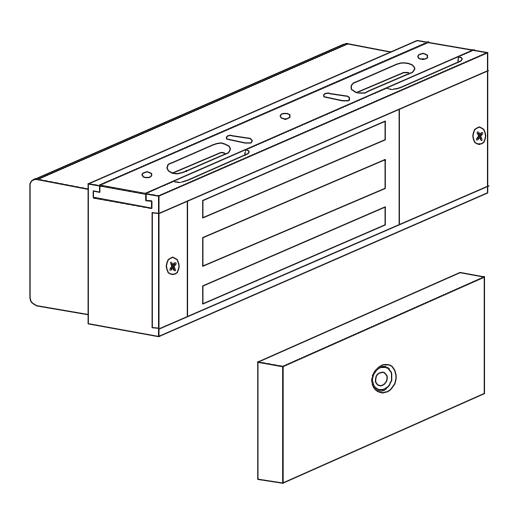
- (1) 3101B-ETR LOCK ASSEMBLY
- (1) ARMATURE
- (1) HARDWARE KIT
- (1) TEMPLATE
- (1) DOOR SIGN 15 SECONDS
HARDWARE KIT CONTENTS
| QTY. | ITEM | DESCRIPTION |
|---|---|---|
| (5) | Baseplate Mounting Screws | #10 x 1" phillips pan head tek screw |
| (1) | Armature Mounting Screw | 5/16-18 x 2" hex flat head machine screw |
| (1) | Armature Spacer | 3/8"D x 1/4"L spacer |
| (1) | Steel Washer | 1/4" flat steel washer |
| (1) | Rubber Washer | 1/8" neoprene washer |
| (1) | Door Spacer | 5/8"D x 1-11/16"L spacer |
| (1) | Sex Nut | 5/16-18 sex nut |
| (2) | Armature Anti-Spin Pins | 3/16"D x 1"L split roll pin |
| (1) | Anti-Tamper Cover Screwdriver | #6 spanner key |
| (1) | Baseplate Set Screw Wrench | 1/8" ball head hex wrench |
NOTE: For further parts clarification refer to the Exploded Parts View on page 13 or consult factory.
MOUNTING CONSIDERATIONS
Inspect the door frame and determine if an angle bracket or filler plate will be required for installation. The lock will require a 2-3/16" wide header stop for a suitable mounting surface.
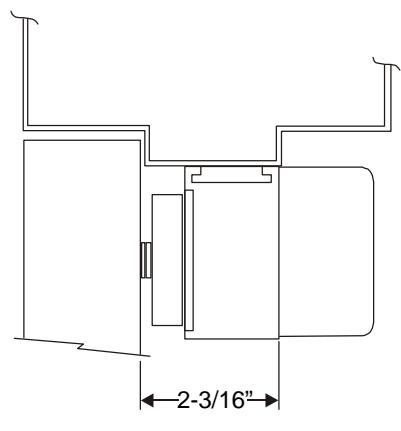
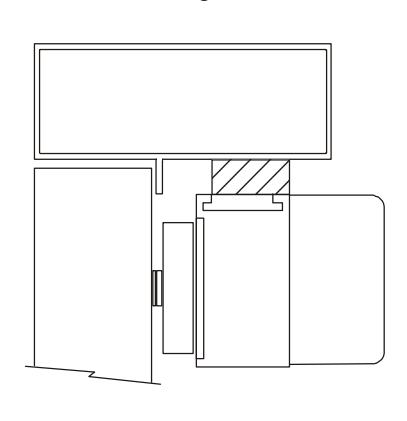
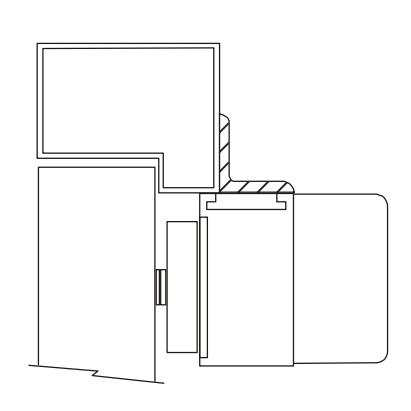
NORMAL MOUNTING
*FILLER PLATE REQUIRED
*ANGLE BRACKET REQUIRED
USING THE TEMPLATE
- Fold the template on the dotted line to form a 90 degree angle. Scoring the template with a straight edge and a screwdriver will make it fold easier.
- 2. With the door in the closed and latched position place the template against the header and door with one edge against the vertical strike jamb and tape in place.
- 3. Transfer all hole locations to both the door and header with a center punch, then remove the template from the door.
- 4. Referring to the template drill two 1/8" dia. lock mounting holes and one 9/16" dia. wiring hole in the top of the frame, at the transferred locations.
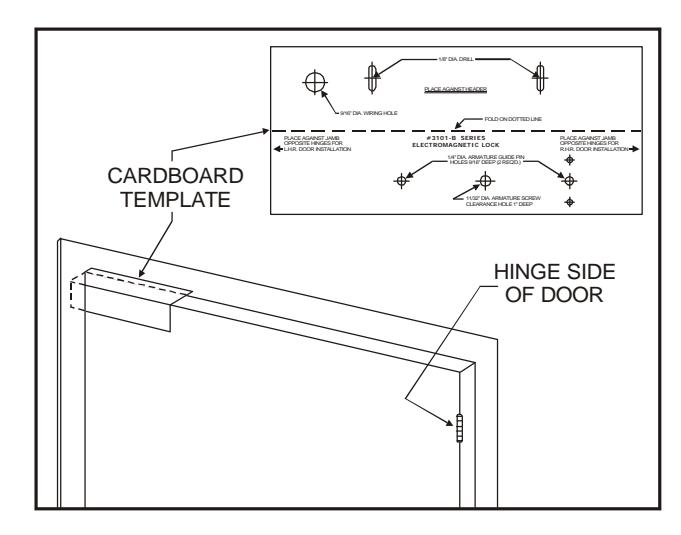
5. Drill the remaining transferred holes in the face of the door to accept the Armature following the instructions on page 4 for your specific door type.
* These items are available from DynaLock.
MOUNTING THE ARMATURE ASSEMBLY
From the three illustrations below select the one that resembles your door type and follow the instructions for drilling the Armature mounting screw hole. Drill two (2) 1/4" dia. holes 9/16" deep at the Anti-Spin Pin locations (See Template).
GLASS AND ALUMINUM OR HOLLOW METAL DOOR SOLID CORE DOOR REINFORCED DOOR
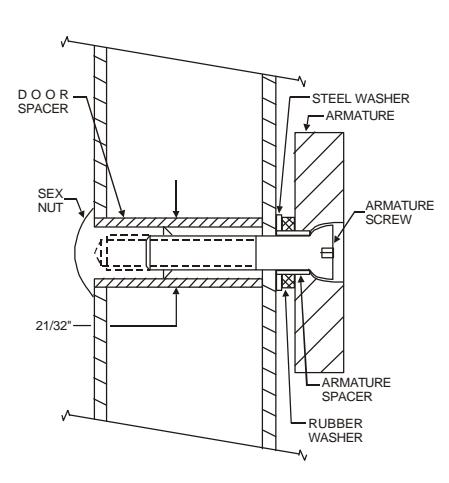
Drill an 3/8" diameter hole through the door. From the sex nut side only enlarge the 3/8" hole to 21/32" diameter.
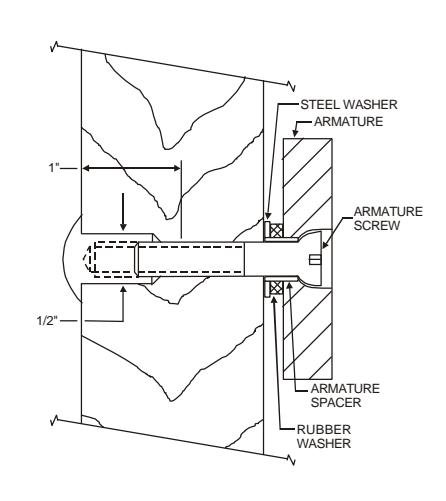
Drill an 3/8" diameter hole through the door. From the sex nut side drill 1/2" diameter hole to 1" depth.
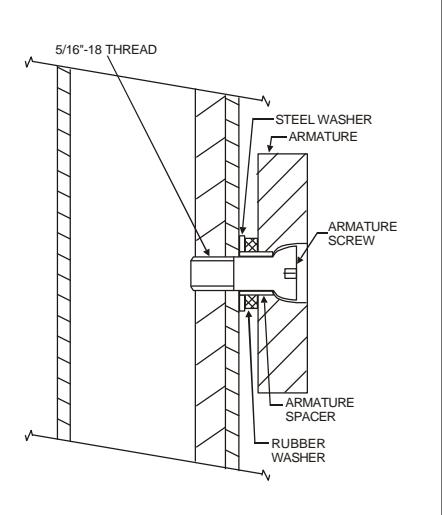
Drill a 17/64" diameter hole and tap for 5/16-18 thread
Locate the two 3/16" dia. Anti-Spin Pins from the hardware kit. Place the Armature face down on a soft surface (i.e. the shipping carton) and drive the pins into the holes provided. Refer to the illustrations above to select the correct hardware and mount the Armature to the door. Firmly tighten the Armature mounting screw with a 3/16" hex wrench. Failure to properly secure the Armature to the door could result in serious injury or possible security breach.

MOUNTING THE LOCK
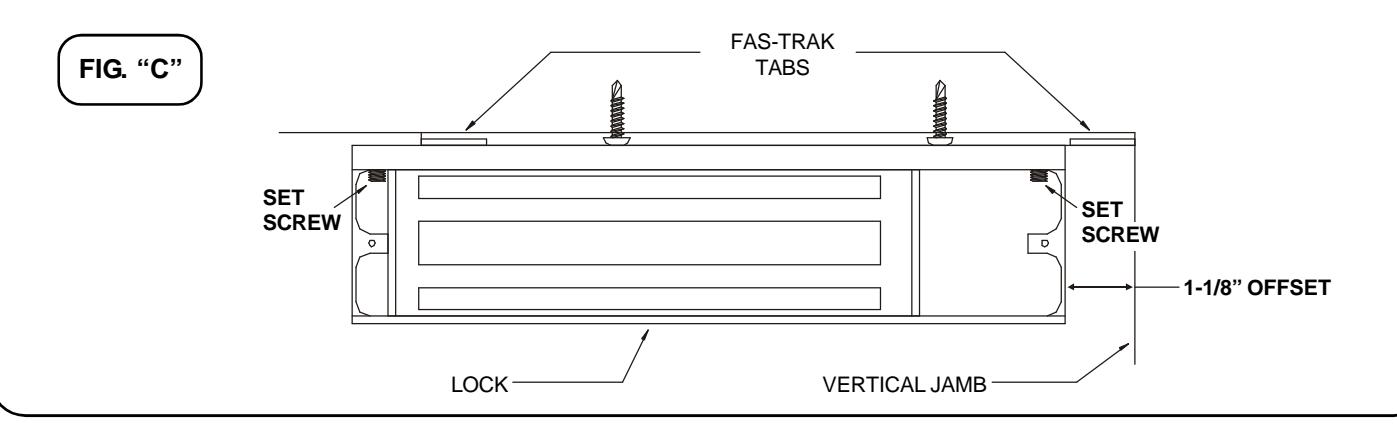
- Before installation begins remove the rear Electronics Cover, End Cover and Access Cover (see page 13 for parts locations). In the upper inside corners of the lock housing are located two #1/4-28 set screws. Using the 1/8" ball head hex wrench loosen (do not remove) the two set screws until the Fas-Trak Baseplate is free (Fig. "C"). Remove the Fas-Trak. 1.
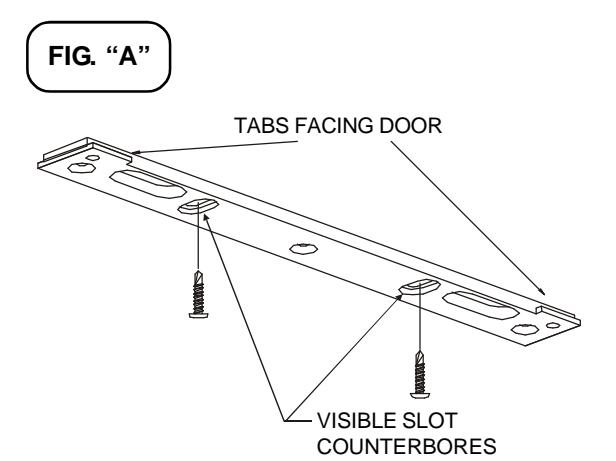
- Place the Fas-Trak against the header with the slot counterbores visible and the tabs facing the door (Fig. "A"). Attach the Fas-Trak to the header at both slotted hole locations, with two #10 x 1" tek screws. Tighten the screws just snug enough to allow for final adjustment. 2.
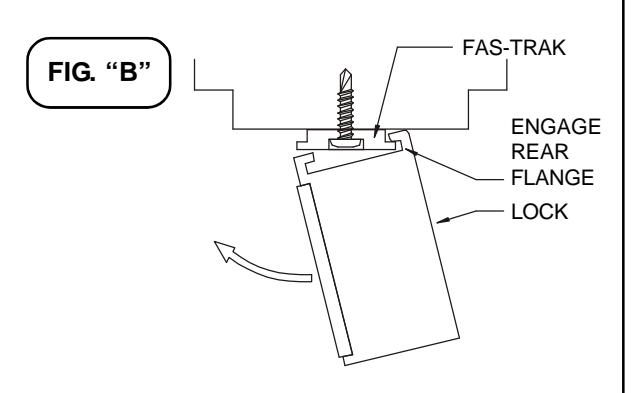
- Temporarily mount the lock to the Fas-Trak by offsetting the lock 1-1/8" from the jamb (Fig. "C") and tipping the front of the lock down engaging the rear flange of the Fas-Trak (Fig. "B"). Rotate the lock up allowing one tab to pass through the corresponding notch in the top of the lock housing. Slide the lock into position. Close and latch the door. Check that the armature and lock faces make full contact. If any adjustment is required gently tap the housing with a soft mallet until full contact is achieved. Open the door, remove the lock from the Fas-Trak and tighten both slot screws. Drive three #10 x 1" tek screws into the header using the Fas-Trak as a physical template. Screw heads must not project above the Fas-Trak. 3.
Any roughed-in wiring may be brought in at this time through the slotted wiring holes. Re-install the lock on the Fas-Trak. Firmly tighten both housing set screws with the 1/8" ball head hex wrench. Re-install the End Cover and Access Cover. If the lock wiring and set-up are not being done at this time replace the electronic cover and see that these instructions are left for the electrical installer. 4.

BASIC SET-UP
Remove the Electronics Cover to expose the circuit board assembly. 1.
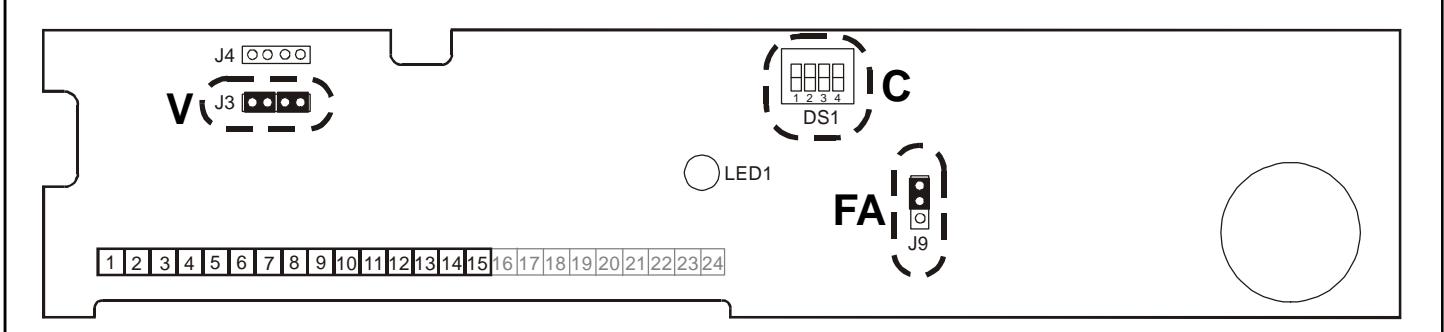
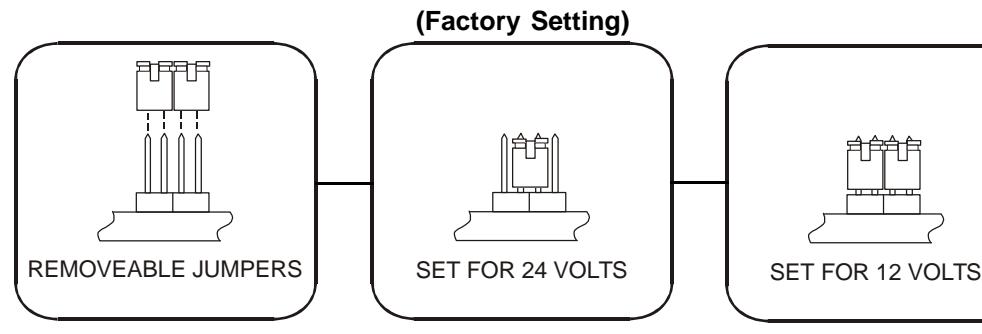
- Voltage Selection 2. V
Check that the voltage selection jumper (J3) is properly set to match your input power. Note that all locks are factory set for 24 volts.
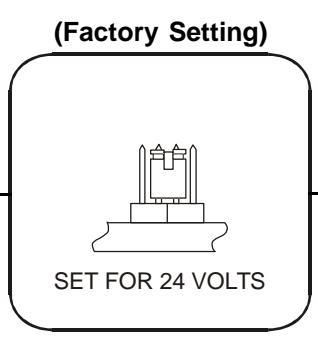
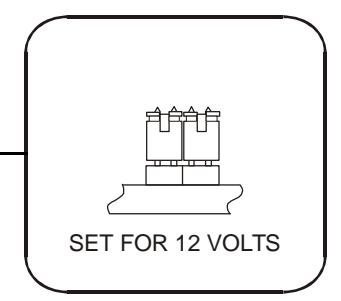
- Fire Alarm Control 3. FA
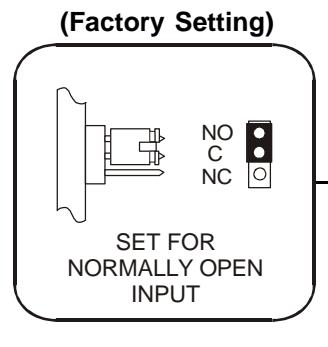
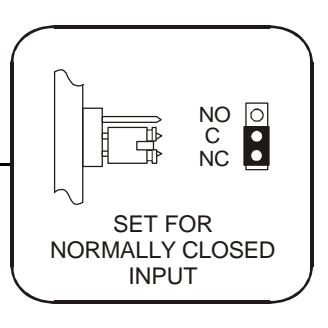
Check that the fire alarm control jumper (J9) is properly set to match your fire panel input contacts. If fire panel tie-in is not required leave jumper at factory setting (N.O.).
- System Selector Switches 4. C
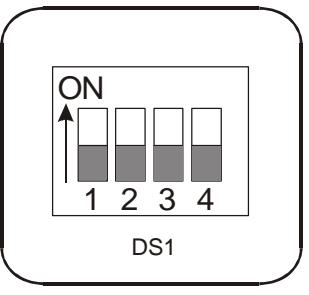
The selector switches (DS1) that control major system functions are factory set to the OFF position for basic lock operation. Switch 1 is not used . Switches 2, 3 and 4 are only used for options described on page 9.
(Factory Setting)
BASIC WIRING
Basic hook-up is shown below. For other system features hook-up see "Option Wiring" (page 10).
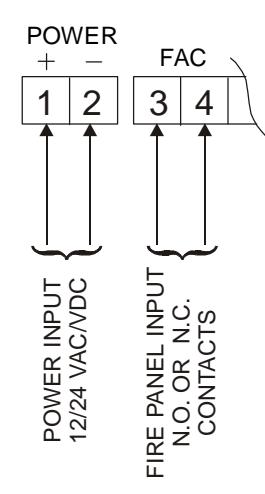
Terminals 1& 2 - Power Input. May be 12 or 24 Volts, AC or DC. Current requirement is 0.75 Amps for 12 Volts and 0.5 Amps for 24 Volts (check voltage selection jumpers "V" - page 6).
Terminals 3 & 4 - Fire Panel Input. May be normally-open (N.O.) or normally-closed (N.C.) dry contacts from fire panel (check fire alarm control jumper "FA" - page 6).
When the fire panel trips, the 3101B-ETR will release, the audible will sound a constant tone and the bi-color LED (LED1) will change to green. When the fire panel is reset, the lock will reset and lock.
NOTE: DO NOT APPLY POWER TO TERMINALS 3 & 4 OR DAMAGE WILL OCCUR.
INDICATOR DESCRIPTIONS
| COLOR | STATUS | |
|---|---|---|
| RED | LOCKED | |
| GREEN | UNLOCKED | |
| BLINK RED | DELAY EGRESS | |
LED1 - BI-COLOR LED INDICATOR (Located at center of circuit board.)
Indicates system status.
Also monitors door movement during egress sensor adjustment.
| COLOR | STATUS |
|---|---|
| RED | NORMAL |
| BLINK RED | TROUBLE |
LED2 - WATCHDOG LED INDICATOR
(Located upper right corner of circuit board.) Troubleshooting indicator.
Monitors proper operation of the microprocessor.
| AUDIBLE INDICATION MODES | ||
|---|---|---|
| CONDITION | SIGNAL | |
| ACTIVATION OF | One second pulse rate during delay cycle. | |
| DELAY EGRESS | Steady tone after delay until reset. | |
|
FIRE ALARM
RELEASE |
Steady tone until fire alarm contacts are reset. | |
| OPTIONAL REMOTE | Steady tone during release time (selectable). | |
| AUTHORIZED BYPASS | One second pulse rate if door held open past relock time, | |
| (TERMINALS 7 & 8) | (requires reset). | |
| FACTORY SERVICE | Steady tone. | |
| REQUIRED | Watchdog LED pulses at 1.5 second rate simultaneously. | |
| POOR MAGNETIC BOND | Rapid pulse rate until problem is corrected. | |
| (DYNASTAT OPTION) | Only functional with Dynastat Force Sensor Option. | |

J4 J3 S2 DS1 J9 J11 LED2 AUDIBLE 1 2 3 4 LED1 1 2 3 4 5 6 7 8 9 10 11 12 13 14 15 16 17 18 19 20 21 22 23 24 OPTIONAL SET-UP C A
- System Selector Switches 1. C
Set the System Selector Switches (DS1) to address your specific system requirements.
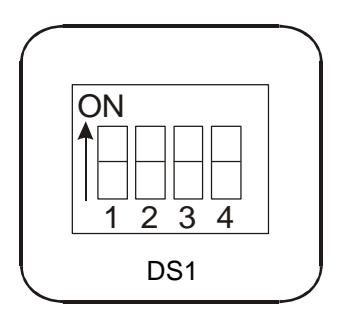
| MODE SETTINGS | |||
|---|---|---|---|
| SWITCH | FUNCTION | OFF | ON |
| 1 | FACTORY SET | NORMAL | |
| 2 | BYPASS AUDIBLE | DISABLED | ENABLED |
| 3 | NUISANCE DELAY | 1 SEC. | 3 SEC. |
| 4 | EGRESS DELAY | 15 SEC. | 30 SEC. |
- Audible Selector 2. A
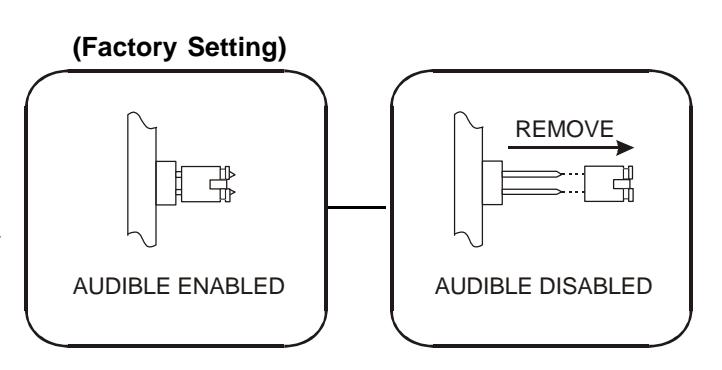
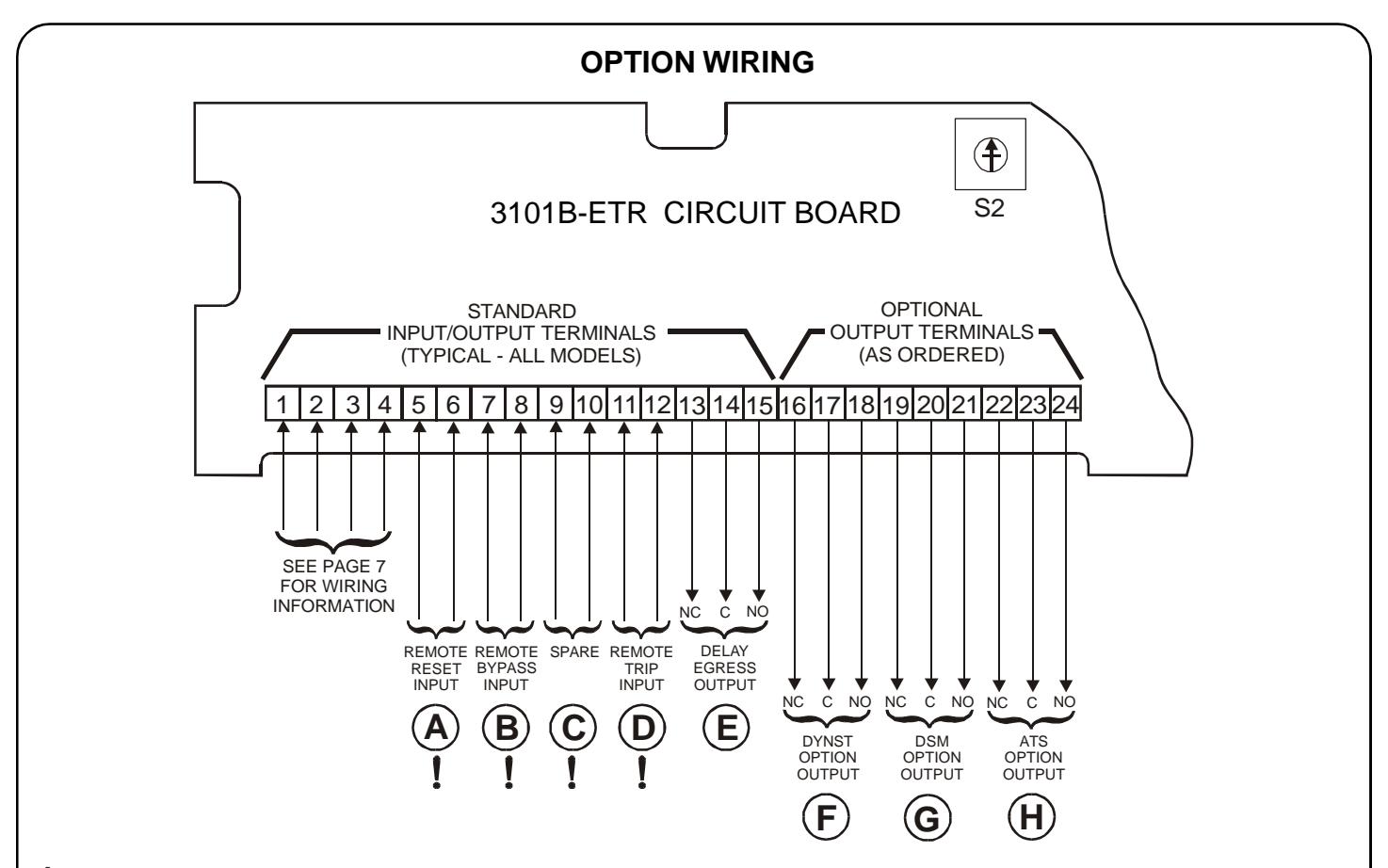
The on-board audible is normally enabled for local signaling of lock and alarm status. To completely disable the audible remove jumper (J11).

WARNING: DO NOT APPLY POWER TO INPUTS MARKED " ! " OR DAMAGE WILL OCCUR.
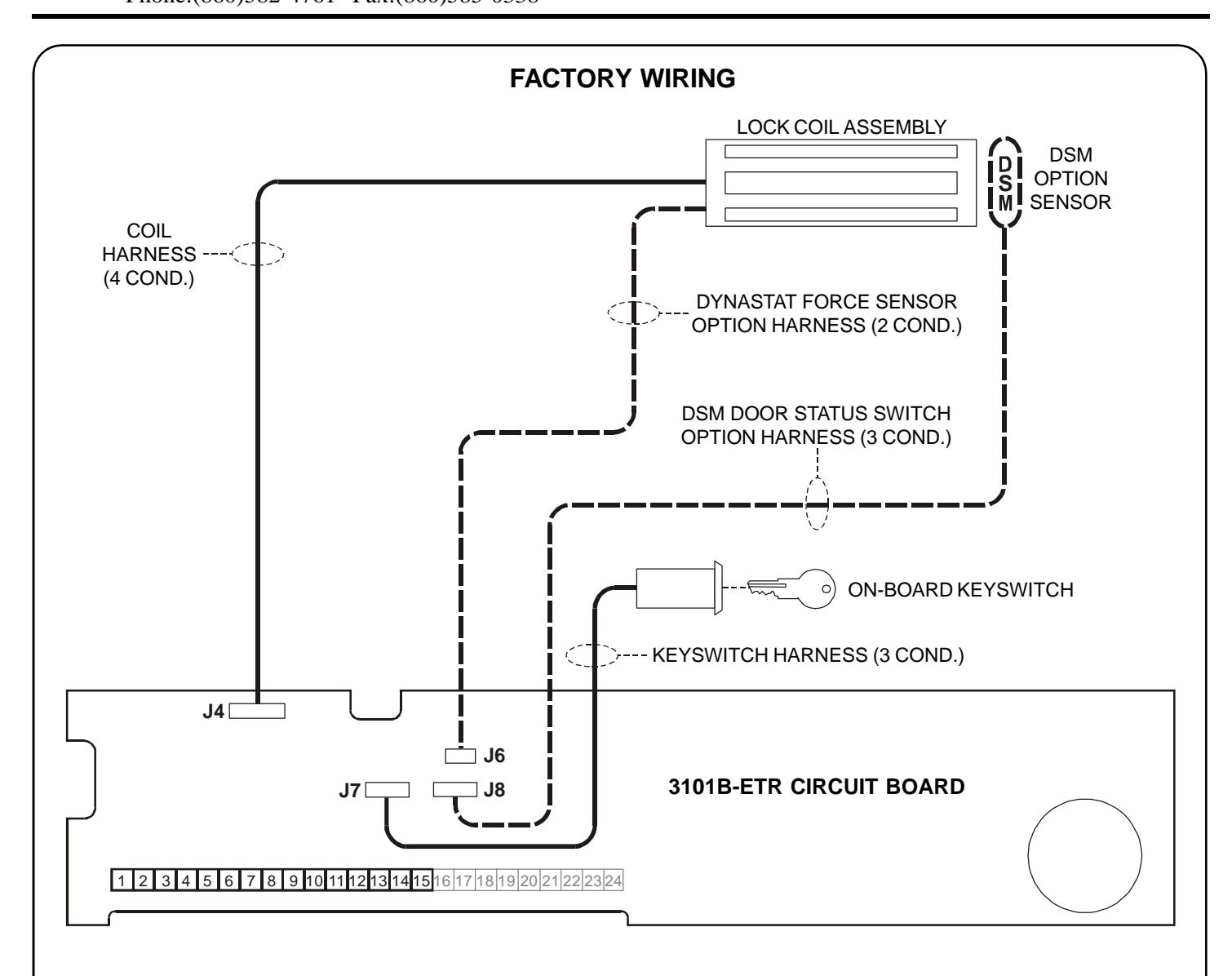
REMOTE BYPASS INPUT Momentarily closing a normally-open dry contact across terminals 7 & 8 will immediately release the lock without alarm. The door will remain unlocked for a period of time controlled by on-board adjustable timer S2. To increase the delay rotate timer S2 clockwise - range is 1 to 75 seconds. A B C D REMOTE RESET INPUT Momentarily closing a normally-open dry contact across terminals 5 & 6 will reset and re-lock the 3101-B following delayed egress and re-closure of door. REMOTE TRIP INPUT Momentarily closing a normally-open dry contact across terminals 11 & 12 will initiate delayed egress. SPARE Do not use. INPUT DESCRIPTIONS

OPTION WIRING
| MONITORING OUTPUT DESCRIPTIONS | TYPICAL WIRING |
|---|---|
|
E
DELAY EGRESS OUTPUT Delay egress alarm monitoring. SPDT dry relay contacts rated 1Amp @ 24 Volts Contacts change state upon initiation of delayed egress and remain in that state until door is closed and reset. |
NC
C NO 13 14 15 TO INDICATOR ALARM POWER SUPPLY SECURE NOTE: INDICATORS ARE NOT INCLUDED |
|
F
DYNST OPTION OUTPUT Dynastat bond sensor monitoring. SPDT dry relay contacts rated 1Amp @ 24 Volts Contacts change state to signal lock status as either locked or unlocked. |
NC
C NO 16 17 18 TO INDICATOR UNLOCKED POWER SUPPLY LOCKED NOTE: INDICATORS ARE NOT INCLUDED |
|
G
DSM OPTION OUTPUT Door position sensor monitoring. SPDT dry relay contacts rated 0.5Amp @ 24 Volts Contacts change state to signal physical door position as either closed or open. |
NC
C NO 19 20 21 TO INDICATOR OPEN POWER SUPPLY CLOSED NOTE: INDICATORS ARE NOT INCLUDED |
|
H
ATS OPTION OUTPUT Anti-Tamper Switch monitoring. SPDT dry relay contacts rated 0.5Amp @ 24 Volts Contacts change state to signal removal of the lock electronics cover. |
NC
C NO 22 23 24 TO INDICATOR TAMPER POWER SUPPLY NORMAL NOTE: INDICATORS ARE NOT INCLUDED |
NOTES:
- Harnesses J6 and J8 are only present if the 3101B-ETR is equipped with the DYNST Dynastat Force Sensor and DSM - Door Status Switch Options. 1.
-
Observe polarity when re-connecting the J7 and J8 harness connectors. Orient these connectors with respect to harness wire colors as follows: 2.
- J7 WHT BLK BLU J8 GRN WHT RED
- Harness connectors J4 and J6 are not polarity sensitive. 3.
2-3/8" 1/2" 7-3/8" 2-3/4" 1-1/2" 1-1/2" 11" EXPLODED PARTS VIEW LOCK ASSEMBLY ARMATURE 1 H1 5 6 2 3 4 7 9 H2 H3 H4 H5 H6 H7 8 H8
EXPLODED PARTS VIEW LEGEND
| LOCK ASSEMBLY | ||
|---|---|---|
| ITEM | DESCRIPTION | PART NO. |
| 1 | Fas-Trak Baseplate | 300011 |
| 2 | Electronics Cover | 300353 |
| 3 | Lock Assembly | Consult Factory |
| 4 | End Cover | 300011 |
| 5 | Access Cover | 300009 |
| 6 | Access/End Cover Screw | 300608 |
| 7 | Electronics Cover Screw | 700058 |
| 8 | Fas-Trak Set Screw | 300604 |
| ARMATURE | ||
|---|---|---|
| ITEM | DESCRIPTION | PART NO. |
| 9 | Armature | 300013 |
| HARDWARE KIT | ||
|---|---|---|
| ITEM | DESCRIPTION | PART NO. |
| H1 | Baseplate Mounting Screw | |
| H2 | Sex Nut | |
| H3 | Door Spacer | |
| H4 | Armature Anti-Spin Pin | Hardware Kit |
| H5 | Flat Steel Washer | P/N 301054 |
| H6 | Rubber Washer | |
| H7 | Armature Spacer | |
| H8 | Armature Mounting Screw | |
OUTPUT TERMINALS (AS ORDERED)
INSTALLATION NOTES OPTIONAL 3101B-ETR CIRCUIT BOARD Sketch in all field connections to external system devices specific to your installation, for future reference.
1 2 3 4 5 6 7 8 9 10 11 12 13 14 15 16 17 18 19 20 21 22 23 24
STANDARD INPUT/OUTPUT TERMINALS (TYPICAL - ALL MODELS)
PLEASE DELIVER THIS MANUAL AND THE KEYS TO THE END-USER UPON COMPLETION OF THE 3101B-ETR INSTALLATION
FOR PRODUCT SUPPORT AND PARTS ORDERING INFORMATION CONTACT:
DynaLock Corp. 705 Emmett Street Forestville, CT 06010
Bus: (877) 396-2562 Toll-Free USA
(860) 582-4761 Fax: (860) 585-0338
DYNALOCK ON THE INTERNET:
E-mail: info@dynalock.com Website: www.dynalock.com

GWXT Auxiliary Lock FWAX Special Locking Arrangements