Camden Guide to Code Compliant Installation of Magnetic Locks Reference Guide
Open the original PDF document
View PDF
Code compliant electric locking systems used in the means of egress

Installation of a code compliant access control system can be a daunting task because it requires comprehensive knowledge of applicable regulations, equipment options and installation methods. This 'How To' guide has been published to bring all of this salient information together in one easy to use reference.
Although we have attempted to provide a comprehensive guide, this summary is not intended to replace source documentation, field experience or the interpretations of Authorities Having Jurisdiction (AHJ).
1. Introduction
Means of Egress: The term "means of egress" is defined in the International Building Code (IBC) as "A continuous and unobstructed path of vertical and horizontal egress travel from any occupied portion of a building or structure to a public way."
The Control of an Egress Door
Depending on the code, the year, and the application, egress can be free, delayed, or controlled. Free egress means that the person exiting may do so without delay or obstruction. Delayed egress means there is a delay between the attempt to exit and the ability to exit, usually 15 or 30 seconds. Delayed egress is used in health care to contain those who are ambulatory, but incapable of self preservation. It is also used in retail and warehouse facilities to prevent pilfering. Controlled egress is a locked exit that requires that the person exiting be qualified by a device or by human evaluation. This is containment under supervision and requires special review by the Authority Having Jurisdiction or AHJ. Detention locking falls under similar codes, but requires more human interaction from guards and staff.
Electronic Access Control: Access is not regulated by national building codes except in the case of high rise stair towers where re-entry must be possible to get to the other stair tower in the event of smoke. The AHJ is not concerned with who enters; only that they must be able to exit at will. Early efforts to lock people in and require that they "card out" were illegal and unsafe. They have since been replaced with three other methods: delayed egress, as discussed previously; anti-pass back, a method allowing free egress, but restricting future access if a card, code or other qualifier is not presented prior to egress; and embarrassment alarms, also free egress, but drawing attention to an unqualified egress.
Electromagnetic Locks
NFPA and more recent versions of IBC allow the electromagnetically locked door to be controlled by a switch in the door hardware, usually a bar. It allows true security in that it is not de-powered in an alarm and does not require a sensor or button with a timer. Much like a mechanical lock, control of the door is returned to the user.
One problem area common to both IBC and NFPA is the title phrase "Access Controlled Egress Doors." It is a poorly titled section used to describe an alternative method of releasing electromagnetic locks by using a " sensor ;" a button with a thirty second timer that works independently from the CPU; and a tie in with the auxiliary latching relay of the fire alarm, smoke alarm and/or sprinkler
systems. The code was never about electronic access control systems, but was developed to address a passive release method for electromagnetic locks used with solid glass doors since it was nearly impossible to install a bar with a switch ( active release ) or hide the wiring.
Codes primarily address what is not allowed, reasoning that if it meets the intent of the code , it need not be addressed. Unfortunately, the section "Access Controlled Egress Doors" often is interpreted to mean that it is the only way to release electromagnetic locks. The 2009 and 2012 versions of the IBC specifically address these issues but they don't automatically change what year the local authority has adopted. Ultimately, it is the AHJ who makes the decision.
2. General Guide to MOE Code
Codes developed to provide a safe means of egress have virtually eliminated fire and smoke death where compliance has been monitored by the AHJs. Their efforts have a proven track record, so change does not come easy for them, with good reason. The authority having jurisdiction may be federal, state, county or city. Sometimes there is more than one involved, especially in health care. Conflict is rare within the published codes, but differences are more common within the AHJ community and usually are the result of their interpretation of the intent of the code.
The Industry Language of Locking can be different than that found in the pages of a code book. Electric locks and strikes are defined within the locking industry as "fail-safe" or "electrically locked" (unlocked when power is lost) and "fail-secure" or "electrically unlocked" (locked when power is lost). Codes usually don't recognize these differences and incorrectly lump them into one phrase "electric locks." Electromagnetic locks are always fail-safe.
Security defines the sides of a door as the "secure side" and the "threat side." Most codes do not address which side of a door can be unlocked, and some AHJs take the wording of the sign "this door must remain unlocked during normal business hours" to mean it must be unlocked from the outside, as well. Many years, ago, the words locked and latched did mean the same thing. Newer technologies have made it possible for a door to be locked, but not latched or latched, but not locked.
Fire doors/fire door assemblies are a tested and labeled door, frame and hardware that will keep the door closed in the event of a fire. Fire doors are rated to prevent the spread of fire and are used within a fire wall. Fire walls and doors are typically (but not always) found within the interior of a building. The label can be found on the back edge or the top of the door. Any additions or changes to a fire door assembly can void the label and land the installer in civil or even criminal court. Do not cut an electric strike into a labeled frame!
A means of egress is not a device to release a lock, but a pathway to safety in the event of a fire. When the phrase "two means of egress" is heard, it does not mean a sensor and a button, it means there are two individual paths to safety. Means of egress is broken into three parts, exit access, exit, and exit discharge. Exit access can be a path, stair, ramp, door or other means to get from an area of danger to a safe place. Safe, rated corridors, stairways and the door to the exit discharge are called the exit. The area between the door (usually a perimeter door) and a public way is called the exit discharge.
The expectation of increased security is greatest when the customer spends thousands of dollars on a new system. Never lower the security of a door by replacing existing hardware with an electric lock that offers less resistance to forced entry unless the owner or tenant understands that this is being done. Remember that the doors must close and lock automatically and that all latches should be protected by latch protectors. Security cannot increase unless human error decreases.
BOCA, ICBO (UBC) and SBCCI was the model code groups that merged to form the IBC in 2000. They are referred to as legacy codes and have not been active since IBC presented.
NFPA is the set of model codes from which virtually all fire codes are based. As a code, NFPA 101 is primarily used in federally regulated buildings. NFPA 101 is used by CMS and The Joint Commission to inspect virtually all hospitals. GSA uses NFPA. GSA is the authority having jurisdiction in federally owned buildings on federally owned property.
IBC is the model building code used in most states and municipalities. An understanding of the sections titled Use and Occupancy and Means of Egress are important. Following adoption of a new code, many jurisdictions publish a list of changes to the code pertaining to their jurisdiction.
Codes Regulating Electric Locking
|
Model Code
and Year |
Sensor/button/
timer and fire alarm tie-in |
Switch in hardware
no fire alarm tie-in |
Controlled Egress | Delayed Egress |
|---|---|---|---|---|
| NFPA-all years | Yes, 7.2.1.6.2 | Yes, 7.2.1.5.2 | Yes, 18.2.2.2.4 | Yes, 7.2.1.6.1 |
| IBC 2000 | Yes, 1008.1.9.8 | Silent | No | Yes, 1008.1.9.7 |
| IBC 2003 | Yes, 1008.1.9.8 | Silent | No | Yes, 1008.1.9.7 |
| IBC 2006 | Yes, 1008.1.9.8 | Silent | No | Yes, 1008.1.9.7 |
| IBC 2009 | Yes, 1008.1.9.8 |
Yes, but not when
panic hardware is required, 1008.1.9.9 |
No | Yes, 1008.1.9.7 |
| IBC 2012 | Yes, 1008.1.9.8 | Yes, 1008.1.9.9 |
Yes, I-2 Occupancies
1008.1.9.6 |
Yes, 1008.1.9.7 |
Use and Occupancy
In Chapter 3 of the IBC, there are 10 basic classifications and 26 sub-classifications for Use Groups. NFPA uses similar groupings, but with notable differences. IBC is as follows, with examples:
- 1. Assembly Groups: A-1 Theater, A-2 Restaurant, A-3 Library, A-4 Arena and A-5 Stadium
- 2. Business Group: B Clinic
- 3. Education Group: E School for grades K-12
- 4. Factory and Industrial Groups: F-1 Bakery and F-2 low hazard fabrication and assembly
- 5. High Hazard Groups: H-1 detonation , H-2 deflagration , H-3 physical , H-4 toxins and H-5 exposure
- 6. Institutional Groups: I-1 assisted living 17+ people , I-2 hospitals , I-3 jails and I-4 day care
- 7. Mercantile Group: M department store
- 8. Residential Groups: R-1 motel , R-2 apartment house , R-3 house and R-4 assisted living 5-16 people
- 9. Storage Groups: S-1 moderate hazard storage (books) and S-2 low hazard storage (parking garages)
- 10. Utility and Miscellaneous: Group U (barns)
3. IBC 2012 Electric Locking
(Reworded to Protect Copyright)
1008.1.9.6 Special locking arrangements in Group I-2. This section allows containment of persons whose clinical needs require it. Requirements are as follows:
- 1. The building must be fully equipped with an automatic sprinkler system, smoke detection system or heat detection system. Electric locks that facilitate containment must release if these systems go into alarm.*
- 2. Electric locks must be fail-safe and release upon loss of power*
- 3. Electric locks must release by a signal from the fire command center, nurse's station, or other approved location.*
- 4. A building occupant shall not be required to pass through more than one electrically locked door before entering an exit.*
- 5. IFC Emergency Planning and Preparedness must contain procedures for the operation of the locking system.
- 6. All clinical staff shall have keys, codes or other means necessary to operate the locking devices.
- 7. Emergency lighting shall be provided at the doors.
Note: Items 1-4* shall not apply to doors to areas where persons, which because of clinical needs, require restraint or containment as part of the function of a psychiatric treatment area.
1008.1.9.7 Delayed Egress Locks. This section allows delayed egress to be used in all occupancies except A, E or F. Requirements are as follows:
- 1. The building must be fully equipped with an automatic sprinkler system, smoke detection system or heat detection system. Delayed egress locks must release if these systems go into alarm.
- 2. Electric locks must be fail-safe and release upon loss of power
- 3. Electric locks must release by a signal from the fire command center
- 4. A building occupant shall not be required to pass through more than one delayed egress door before entering an exit.
- 5. The initiation of an irreversible process which will release the door in 15 seconds when a force not exceeding 15 pounds is applied for 1 second to the releasing device. Must be reset manually. Upon approval by the AHJ, the delay time can be 30 seconds.
- 6. A sign located within 12" of the releasing device shall read: Push until alarm sounds. Door can be opened in 15 (30) seconds.
- 7. Emergency lighting shall be provided at the doors.
1008.1.9.8 Access controlled egress doors. Electromagnetically locked doors in a means of egress, in buildings with occupancies in Groups A, B, E, I-2, M, R-1, and R-2 are permitted to be equipped with entrance and egress access control systems, listed to UL 294, which shall be installed in accordance with all of the following release criteria:
- 1. A sensor shall be provided on the egress side of the door that will detect an occupant approaching and will unlock the door. Loss of power to the sensor will also unlock the door.
- 2. Loss of power to that part of the access control system which controls the locks, shall unlock the door.
- 3. The doors will unlock from a manual unlocking device, compliant with ADA, and located within 5' of the door. The device will be clearly identified by a sign that reads "PUSH TO EXIT." This device must operate independently from the access control electronics and directly interrupt power for a minimum of 30 seconds.
- 4. Activation of the fire alarm system, sprinkler system, or fire detection system will unlock the doors and they will remain unlocked until the fire alarm system has been reset.
Note: Although this section does not limit the locks to electromagnetic, no other electric lock will fit the criteria. This section was originally an alternative to the switch-in-bar for Herculite doors.
1008.1.9.9 Electromagnetically locked egress doors in the means of egress in buildings with an occupancy in group A, B, E, M, R-1 or R-2 shall be permitted if equipped with listed hardware that incorporates a built-in switch and meet the following requirements:
- 1. The hardware has an obvious method of operation and is readily operable in all lighting conditions.
- 2. The hardware can be operated with one hand.
- 3. The hardware directly interrupts the power to the electromagnetic lock and releases the door immediately.
- 4. Loss of power to the listed hardware immediately unlocks the door.
- 5. Where panic or fire exit hardware is required by Section1008.1.10, operation of the listed panic or fire exit hardware also releases the electromagnetic lock.
Note: No other hardware or fire alarm tie-ins are necessary when using this positive release method.
4. System Components
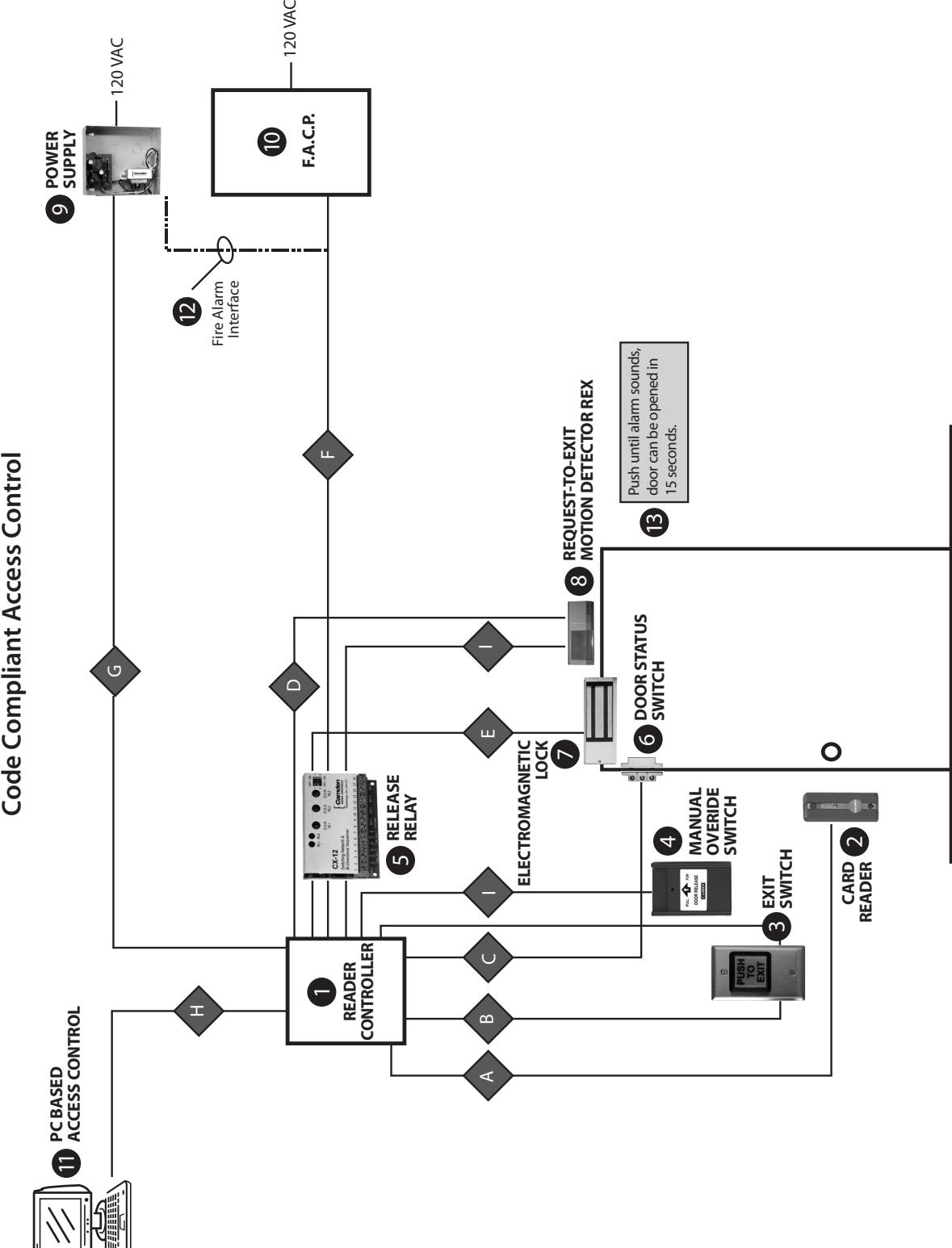
1 Controller (Hub):
A controller is located between the head end and the devices at the door. It is used to transmit information to and from the ACU.
2 Qualifying Device:
A card reader, keypad or biometric device used to qualify an entry or exit.
3 Push to Exit Button (REX):
A button with a 30 second timer that will directly break power to an electromagnetic lock and keep the power broken for a minimum of 30 seconds. It must be located within 5' of the door and between 40" and 48" above the finished floor. (CM 30EE)
| Recommended Camden UL Compliant Exit Switches | |||
|---|---|---|---|
| CM-30EE 2" Square, Single Gang Faceplate | Illuminated with fixed Electronic Timer | ||
|
CM-5085PTE 2 3/8" Button, Single Gang Faceplate
CM-4185PTE 1 5/8" Button, Narrow Gang Faceplate |
|||
| Mushroom with adjustable Pneumatic Timer | |||
4 Manual Override Switch:
A switch that can be installed at the fire command station, nurse's station, or guard station that will disconnect power to electromagnetic locks. (CM-701)
| Recommended Camden UL Compliant Manual Override Switch | |
|---|---|
| CM-701 | Blue Manual Pull Station |
5 Door Release Relay:
A relay used at the door assembly to drop power to an electromagnetic lock when a signal is received from the fire alarm panel. (CX-12)
| Recommended Camden Release Relay | ||
|---|---|---|
| CX-12 | Door Interface, microprocessor controlled, (2) Relays, 3amps @ 30V DC | |
6 Door Position Switch (DPS):
A magnetic or mechanical switch that can signal an open or propped door. (CX-MDC)
| Recommended Camden UL Compliant Door Status Switch | |
|---|---|
| CX-MDC | Magnetic Door Contacts |
7 Electromagnetic Lock:
A door lock that uses electromagnetic energy to secure the door. They are available in strengths for both traffic control and high security, for single or pairs of doors and with or without an options package. (CX-91S-12, CX-91S-12 TDS, CX-91S-06, CX91S06 TDS, CX-92S-12, CX-92S-12 TDS, CX-92S-06, CX-92S-06 TDS)
| Recommended Camden Interior UL Compliant Magnetic Locks | |||
|---|---|---|---|
| CX-91S-12 | 1200 lbs.Surface Mount | ||
| Single Door | CX-91S-06 | 600 lbs.Surface Mount | |
| CX-92S-12 | 1200 lbs.Surface Mount | ||
| Double Door | CX-92S-06 | 600 lbs.Surface Mount | |
| TDS versions of above models provide adjustable timer, lock sensor, door status switch, | |||
relay and LED.
8 Sensor (Usually Motion):
When installing electromagnetic locks using the passive release option of a button, timer, sensor, and fire alarm connection, a sensor must be placed at the door to detect the approach of a person wishing to exit. (CM419)
| Recommended Camden UL Compliant REX Motion Detector | |
|---|---|
| CM-419 | Infra-red detector with adjustable timer and (2) Form C contacts |
9 Power Supply:
A linear or switching power supply converting line voltage to the common 12 or 24VDC used in low voltage systems. (CX-PS10UL, CX-PS30UL, CX-PS60UL)
| Recommended Camden UL Compliant Power Supply | ||
|---|---|---|
| CX-PS10UL | 1amp. with latching fire alarm tie-in/reset and battery charger | |
10 Fire Alarm Control Panel (FACP):
Depending on the code and the year of construction, the alarm panel monitors by building or by zones and may have interfaces for other systems.
11 Access Control Unit (ACU, CPU, Head End):
Depending on the system design, the ACU directly connects to the door mounted devices such as the lock, DPS and reader or connects to the controller or hub. The other side of the ACU connects to the PC.
12 Fire Alarm Interface:
Auxiliary latching relays designed to control electric locks are located in most modern fire alarm systems, but are usually rated for 1 amp or less. We recommend using the fire alarm relay to control a secondary relay with a higher rating. (CX-12)
13 Required Signage:
Delayed egress systems require signage on the door "Push until alarm sounds. Door may be opened in 15 (30) seconds."
14 Power Junction:
This junction may be made in a separate box, with cover, or within existing control boxes.
15 Electric Strike:
A frame or inactive door mounted device that electrically releases the latch of a lock or panic bar.
| CX-ED1010 | ||
|---|---|---|
| Grade 1 | CX-ED1850A | EZ FIT™, No Cut |
| Grade 1 | CX-EL1410 | |
| Fire Rated | CX-EL1450A | EZ FIT™, No Cut |
| Grade 2 | CX-EPD2010L | |
|---|---|---|
| Pre Load | CX-EPD2040L | EZ FIT™, No Cut |
| Grade 3 | CX-EL3011 |
16 Other Electric Locks:
Many other electrically controlled locks are used in new construction or found existing in retrofit. Common are electric cylindrical and mortise locks, electric latch retraction panic bars and electric trim used on the access side of panic bars.
17 Switch Bar (active dummy with switch)
A bar with a built-in switch that releases an electromagnetic lock in the normal action of egress. Use is compliant with NFPA-101 and later years of IBC without redundancy or fire alarm connection.
5. Technical Drawings
Two technical drawings are attached to this summary document in order to provide a complete review of the typical installation requirements of a system:
- Block Diagram Typical Access Control System Indicating system components #1 to #14, as described in section 4 below.
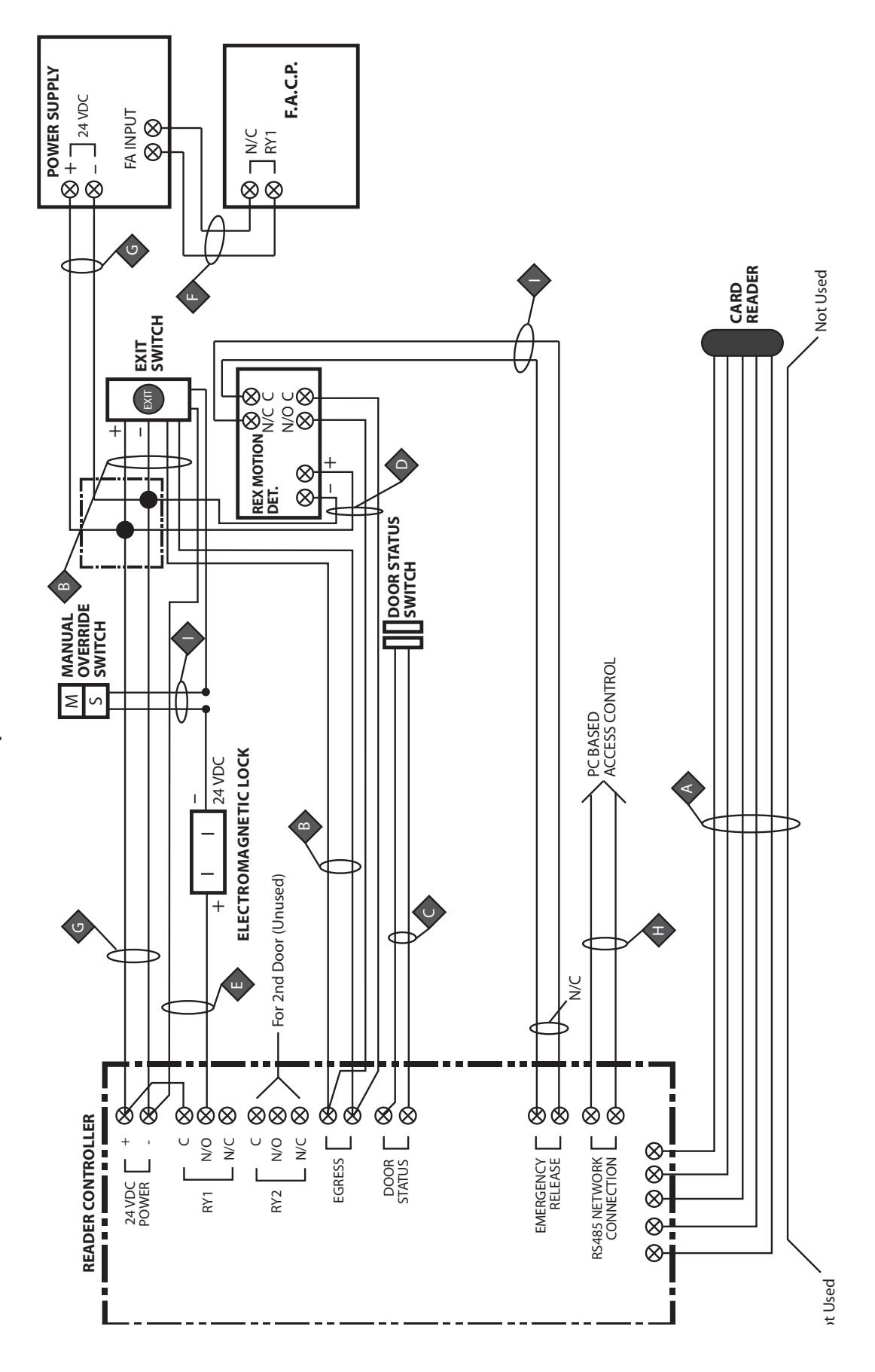
- Wiring Diagram Point to Point Connection of ComponentIndicating cable specifications 'A' to 'I', as described in section 5 below.
6. Component Wiring
We have attached a typical point-to-point wiring diagram as a quick reference for specification writers and installers.
Please Note: The cable types shown here are typical. In all cases, please refer to the installation manual of the equipment you use for specific details.

A 6-Conductor, 18 AWG, with drain:
This cable is used to transfer power and data between the Reader Controller and a proximity Reader. Uses the Wiegand data protocol.

B 4-Conductor, 18 AWG:
Carries the Exit Switch output to the Reader Controller while also carrying power to the switch for illumination of switch button.

C 2-Conductor, 22 to 18 AWG:
Carries door status information between a mechanical or electromechanical switch mounted on or inside a door to a Reader Controller. This allows the access control system to monitor the status of the door for features such as "door ajar."

D 4-Conductor, 22 to 18 AWG:
This cable is used to interface the Reader Controller to the REX Motion Detector. Two wires carry power while two convey status. For distances over 50 foot, use 18 AWG or larger.

E 2-Conductor, 18 AWG:
This cable type is suitable for transporting power to the EM lock from a set of dry contacts inside the Reader Controller. This type of cable is also used to interrupt power to the EM lock from the Egress Motion and REX devices as part of a double-break circuit.

F 2-Conductor, 18 AWG:
Power Limited Fire Alarm (PLFA) Cable: This cable is commonly used to interface the FACP to the EM lock via the power supply for the purpose releasing the door when a fire is detected. Return air ceilings require plenum cable while vertical runs require riser-rated cable.

G 2-Conductor, 18 to 14 AWG:
This cable provides operating power to the EM lock and other devices, such as the Reader Controller and can also be used to illuminate the REX Egress Button.

H Refer to Manufacturer's Specifications:
This cable provides real-time connectivity between an access control unit (ACU) and one or more Reader Controllers in an access control system. Always refer to the manufacturer's instructions for the actual gauge and wire type.

I 2-Conductor, 18 AWG:
Power Limited Fire Alarm (PLFA) Cable. This cable is commonly used to provide emergency release of the EM lock as a safeguard to the electronic.

Typical Block Diagram

Typical Wiring Diagram Code Compliant Access Control

Liability Statement
Camden Door Controls has created this guide to serve as a general orientation to the topic and assumes no liability whatsoever for errors or omissions in the information contained herein, nor in how this information is understood or interpreted. In all cases, the reader is directed to consult the applicable codes, standards and laws that are in force within the country, state and municipality of their installation, and are further advised to submit their interpretation of the installation requirements to their local authority having jurisdiction (AHJ) prior to purchasing equipment or installing equipment.

Push Buttons Keypads Strikes Magnetic Locks Key Switches Relays & Timers Access Control
DISCOVER THE BEST IN DOOR ACTIVATING AND LOCKING PRODUCTS!
www.camdencontrols.com Toll Free: 1.877.226.3369